|
| Not long after it had given a go-ahead for development and production of the Saab-32, the Swedish air force began to draw up its specification for a new single-seat fighter that would be able to intercept bombers flying in the transonic speed range. The new type was obviously going to need supersonic speed capability (at a time when only the Bell X-1 research aircraft was able to demonstrate such performance), an unprecedented rate of climb, above, average range and endurance, and a considerable weapon load. To 'add icing to the cake', it was required to have STOL (short take-off and landing) characteristics to allow for its deployment from a variety of dispersed sites.
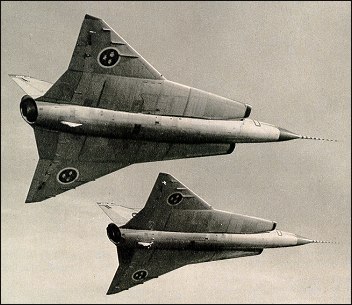
Saab began work on this requirement in August 1949, selecting a wing of double-delta configuration that promised great structural integrity with low weight and which, if it performed satisfactorily, would provide the volume needed for the equipment, fuel and weapons demanded by its primary role. The capability of such a wing was confirmed by wind tunnel testing of models and by the Saab-210 small-scale research aircraft, powered by a 476kg thrust Armstrong Siddeley Adder turbojet. First flown on 21 February 1952, the Saab-210 confirmed that there were no particular problems in the handling of the double-delta wing, and following inspection of a wooden mock-up the company received an order for three Saab-35 prototypes. Features of the design included fully-powered controls, a combination of bag and integral fuel tanks, and retractable tricycle landing gear complemented by two retractable tail wheels, an arrangement permitting a tail-down landing to gain the full aerodynamic braking effect of the wing. Such a landing, combined with the use of a braking parachute, makes possible a landing run as short as 610m.
The first of the prototypes was flown on 25 October 1955, the other two in early 1956, all three of them powered by Rolls-Royce Avon turbojets with afterburners. The type was ordered into production during 1956, and the first series-built J 35A Draken (dragon) was flown on 15 February 1958, this being powered by a Flygmotor RM6B turbojet, a licence-built version of the Rolls-Royce Avon. Entry into service began in March 1960, initially with Flygflottilj 13 at Norrkoping, and production for the Flygvapen totalled approximately 525 aircraft in all versions. Sixty J 35J and 12 Sk 35C two-seat trainers remain in service with F10's four squadrons at Angelholm, in southern Sweden. Serving as pure interceptors, the J 35J 'Johanns' will be retained until 1995 at least.
Saab also developed the Draken for export, under the designation Saab-35X, with increased fuel capacity and a higher gross weight to allow the carriage of heavier external loads. The first customer was Denmark, receiving aircraft known as the A 35XD (similar to the Swedish J 35F), but becoming the F-35 once in service with the Kongelige Danske Flyvevabnet (Danish air force). The RF 35 (Saab S 35XD) is a variant of the Swedish S 35E photo-reconnaissance Draken, no longer in service. Eventually 11 Sk 35XD (TF-35) two-seat trainers were also delivered. Denmark's last Draken squadron, operating all three versions of the aircraft, is slated for disbandment at the end of 1993.
The second export customer was Finland which received 12 J 35XS (Swedish J 35F-2) fighters, five J 35CS (Swedish Sk 35C) trainers and finally 24 J 35FS zero-timed ex-Flygvapnet J 35F single-seaters. A single unit, 'Lapland Wing', flies the aircraft today.
Austria became the fourth Draken operator with the delivery of its aircraft in the mid-1980s. Twenty-three J 35Os (Swedish J 35Ds) serve as the nation's primary air defence fighter.
Now virtually replaced in Swedish service by the Saab 37 Viggen, a total of 606 Drakens was built. Saab achievement in building Europe's first supersonic combat aircraft (and one capable of Mach 2 at that) remains undiminished, with only governmental restrictions impeding wider sales.
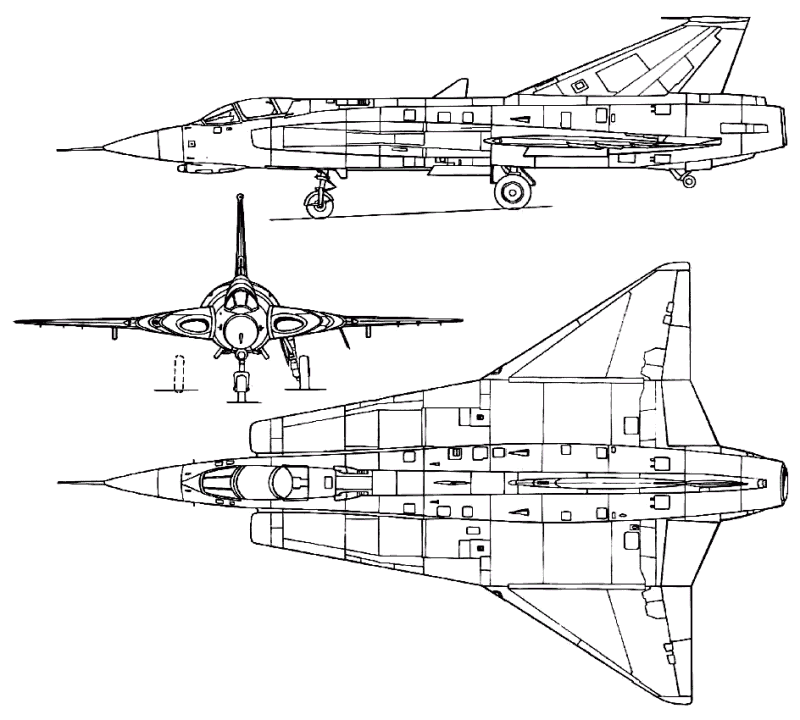
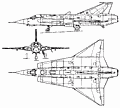 | A three-view drawing of Saab J 35F Draken (1719 x 1169) |
| CREW | 1 |
| ENGINE | 1 x Volvo Flygm. RM 6C, 56.9kN |
| WEIGHTS |
| Take-off weight | 11400-15000 kg | 25133 - 33070 lb |
| DIMENSIONS |
| Wingspan | 9.4 m | 31 ft 10 in |
| Length | 15.4 m | 51 ft 6 in |
| Height | 3.9 m | 13 ft 10 in |
| Wing area | 49.2 m2 | 529.58 sq ft |
| PERFORMANCE |
| Max. speed | M2 | M2 |
| Cruise speed | 950 km/h | 590 mph |
| Range w/max.fuel | 3250 km | 2020 miles |
| ARMAMENT | 4 x 30mm cannons, missiles |
| e, e-mail, 15.11.2025 14:02 e reply | | e, e-mail, 15.11.2025 14:02 e reply |
| ubaTaeCJ, e-mail, 21.02.2025 15:45 20 reply | | Shawn, e-mail, 20.08.2014 05:38 I have a generator off of on of these if anyone is interested. reply |
|
| | Swabbie, 10.09.2012 17:14 one error in data though, the -35 only had 2 Aden 30mm guns on in each wingroot outboard of the intakes, later models only carried one gun. reply |
| Barry, 22.12.2010 16:41 Whilst the cranked delta was a clever and novel wing design I somehow do not think that this was the initiator of the "Ogee" planform of the Concorde wing. Leo you really do not like the Lightning do you? reply | | Claus, e-mail, 10.09.2010 14:54 Correction to the date I worked on it. Naturally it was supposed to be much earlier, 1985 /86.
Blame it on not enough coffee this morning! reply | | Claus, e-mail, 10.09.2010 14:53 I had the distinct honor of working on these beautiful planes back in 2005 /06 while serving in the Danish Airforce, and I have quite the stories about them. This type of plane is as solid as they come, and during their distinct service with the Danish Airforce not a single plane was lost due to incidents or accidents (it came close). On one instance during a photo rec mission in the Baltic sea, a pilot got a little close to the water while cranking it around for a better picture of a Russian trawler, and dipped the wing in the drink. The drag pulled the outmost section (the double delta part) off, but he recovered and flew home. Try that in just about any other plane!
One very important feature hardly ever mentioned is the ability to start the plane without aux power unit. In a time and age where just about all jet powered planes needed a boost to get going, the pilots of the F35 simply turned the key and pushed the starter button. It was a combination of electric starter and a very foul smelling chemical that was shot through the engine under pressure. Never stand down wind from a starting F35, I found out the hard way. This is foul smelling and burns your eyes!
This was a wonderful plane both to look at, to work on and according to the pilots a fun thing to fly! reply | | Johan Runfeldt, e-mail, 27.05.2010 08:15 When I was on summer camp with the RSwAF Air Cadets at F10 in 1984, the Lt who was in charge of us told that on the first week of field maneuvres every 35 was opposed by two or three 37s, the second week the strenghts were about even and in the third week only the 35s flew. Of course his statement could have been biased by the fact that by this time F10 in Ängelholm was the only wing still operating the 35. reply |
| Ben, e-mail, 25.04.2010 21:54 Yes, it's a remarceble aircraft that's so beautiful! Remember when I was a kid and skating next to the military airport, and 20-30 Draken came in for landing just 15 meters over our head. You have to cover your ears while the whole body was shaken by the thunder... It happend every weekend in the age when Sweden still have a military strength. Draken flies like a spear, and turn like a spear. So compared with Viggen and Gripen (Griffin) it have no chance! Gripen turns twice as fast as Draken, so I understand that it belongs to the past.... Still beautiful though! reply | | Peter M Hawley, e-mail, 23.03.2010 07:01 This magnificent aircraft should end all the stupid jokes about "dumb Swedes". With it's tremendous performance in all areas, one wonders why there was any need to replace it! Equipped with modern power, fire-control systems & avionics, it could probably hold it's own with the best of them! reply | | paul scott, e-mail, 17.08.2009 18:46 It just goes to show what can be done with the will (I know you have to have enough money too!). And for Sweden to do this in a short space of time. Of course the UK had the Lightning, France the Mirage, and rather oddly the USA had numerous failures until the great Phantom II, but it seems the Draken got it right - speed, fair range, armament (9,000 LBS load). after using a British engine, we here in the UK had no excuse, though our post war austerity still showed we had drive, but that turd Duncan Sandys with almost one stroke nearly destroyed our wonderful aero industry. reply | | leo rudnicki, e-mail, 14.04.2009 03:59 With a wing planforn that spawned Concorde, the draken was a real piece of work. Compared to RAF aircraft of the period, Sweden could have fought the second Battle of Britain and won. Later, when Lightning came out powered by twice the engines, it didn't have the range to protect the coast. politicians hiring accountants to buy an air force gets you useless garbage, expensive garbage. When an RWR makes a noise, check your six, Thomas. reply | | Hilton, e-mail, 04.01.2009 23:07 Draken was /is a fabulous achievement - at least 10 to 15 yrs ahead of it's time. Not just a good performer but reliable and durable as well ! Also one of the first (if not THE 1st) truly multirole Mach 2 fighters........ reply |
|
| | AirCombat, e-mail, 13.07.2008 19:28 All the Swedish aircrafts are the best all over the world!!! The F-16, the Phantoms, the Eurofighters they are all B U L L S H I T S ! ! ! reply | | chaiwat kosatanakom, e-mail, 25.03.2008 10:38 Thailand is successfully made this draken in paper models. There are hundred of paper models that been made and ready for kids. reply | | Marc, e-mail, 19.02.2008 14:43 An excellent aircraft, one of my favourites, and for a country like Sweden, who had not previously had the mass of experience the WWII allies had in jets they surprised us all. Right through to the great Gripen, they put a lot of our politicians who pussyfoot over cost, yet claim to be big nations to shame - the Swedes do it right! reply | | Mick Dunne, e-mail, 29.12.2007 03:48 The danged thing flew 0nly 10 years after WWII!!!....BRILLIANT! reply |
| thomas, e-mail, 23.02.2007 00:53 whats an ALR-45 RWR reply |
|
Do you have any comments?
|
| 
COMPANY
PROFILE
All the World's Rotorcraft
|


 Shawn
Shawn

20
reply