|
| On 11 July 1969 Saab flew the prototype (SE-301) of a two/three-seat civil/military trainer or general utility aircraft to which it had allocated the designation Saab-MFI 15. As then flown it was powered by a 119kW Avco Lycoming IO-320-B2 flat-four engine and had a conventional low-set tailplane, but this was modified subsequently to T-tail configuration to minimise damage when operating from rough airfields.
The prototype was flown on 26 February 1971 with a more powerful Avco Lycoming engine, which became the standard powerplant for the production version, which was re-designated Saab Safari. A braced shoulder-wing monoplane with fixed tricycle landing gear, available optionally with tailwheel landing gear, it provides side-by-side enclosed accommodation for two and has dual controls as standard.
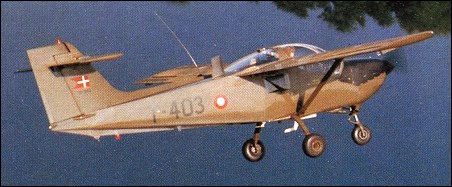
A military version designated originally Saab-MFI 17 was flown on 6 July 1972 and differed from the Safari by being equipped more specifically for use as a military trainer, or for such duties as artillery observation, forward air control and liaison; this version was later named Saab Supporter.
In August 1978 Saab flew a version of the Safari with a 157kW Continental flat-six turbocharged engine; designated Safari TS it did not progress beyond the prototype stage.
Saab built a combined total of about 250 Safari/Supporter aircraft before production ended in the late 1970s. Military Supporters were supplied to the Pakistan air force and army (45), Royal Danish air force (32, which designated it T-17) and Zambian air force (20). Licence-production of this aircraft was started in Pakistan during 1976, initially from kits supplied by Saab, but there has been a gradual change to indigenous manufacture from raw materials. Designated Mushshak in Pakistan, more than 150 have been built.
 | A three-view drawing (800 x 684) |
| MODEL | Saab-Safari |
| ENGINE | 1 x Avco Lycoming IO-360-A1B6 piston engine, 149kW |
| WEIGHTS |
| Take-off weight | 1200 kg | 2646 lb |
| Loaded weight | 646 kg | 1424 lb |
| DIMENSIONS |
| Wingspan | 8.85 m | 29 ft 0 in |
| Length | 7.0 m | 23 ft 12 in |
| Height | 2.6 m | 9 ft 6 in |
| Wing area | 11.9 m2 | 128.09 sq ft |
| PERFORMANCE |
| Max. speed | 235 km/h | 146 mph |
| Ceiling | 4100 m | 13450 ft |
| lxbfYeaa, e-mail, 17.01.2026 20:37 20 reply | | Hans Edvart Olsen, e-mail, 17.04.2025 02:03 Any SAAB MFI 15 /17 for sale ?? i am looking for one ! reply | | ubaTaeCJ, e-mail, 21.02.2025 16:12 20 reply |
| lxbfYeaa, e-mail, 14.03.2024 06:02 20 reply | |
| | lxbfYeaa, e-mail, 14.03.2024 06:00 20 reply | | SANDEEP ASRANI, e-mail, 22.07.2022 12:58 Hi Everyone,
Our company is supporting and supplying MFI-15 (Mushshak) & MFI-17 (Super Mushshak) Aircraft spares. If you have any related requirements, please do not feel hesitant to contact us. We believe such a contact would be fruitful and beneficial to both of us. We are appreciated for your interests very much and looking forward to hearing from you at your earliest convenience.
With warm regards,
SANDEEP ASRANI reply |
| Taimuvr Ali Khan, e-mail, 21.09.2020 09:46 I am so infuriated by people calling with false hood Pakistan a terrorist country . This is all because of the NWO Illuminati so called fake "free press". 9 /11 was a self staged event just to cause hatred and division in the World between Muslims, Christians and others. About the reverse blame of 9 /11 self staged by the USA. On clearly see that the World trade tower buildings 1 & 2 explode with explosives below when the twin buildings fall in a matter of seconds and no where near in the upper floors where the aircraft collided. Furthermore the fire in such a case is maximum around 1300 degrees F while steel melts at 2600 F. In a building fire, the building burns down but the steel structure always remains. Furthermore WTC building 7 a football field away, went down in a matter of seconds in a similar manner when no aircraft had collided. Why? Well your answer is probably that the Devil’s trident has 3 spokes, that execute better than 2 in an effective plan. One day before 9 /11, ex-president George Bush senior (father of President George W Bush jr was having breakfast in the Ritz Carlton NYC with Shafique Bin Laden, brother of Osama Bin Laden. Osama Bin laden had invested significantly in Georgr W Bush’s oil company. Osama a bad boy? Naw, I’d rather look at Georgee Porgee pdding and pie who kissed the girls and made them cry. 9 /11 was no doubt a staged event in order to divide the Muslims from the Christians and other communities and a false reason to invade Afghanistan , in order to make trillion of $ in arm sales to both sides. India on the other hand is a real terrorist murdering, oppressing and torturing Kashmiri Muslims but is never reported in the press like BBC. Why? because India now is an economic World power and the Brits and other nations need that Indian money rolling in. India has also got great support from the trillions of $ of the NWO Illuminati because they support the disgusting men sleeping with men and Pakistan doesn't. let me mention here that none of Loving God's wise scriptures mention anything against lesbians, probably because many men of old were polygamists and the wives may have had some exposure to each other, reply | | TORBJÖRN KAMPE, e-mail, 20.03.2018 01:38 I HAVE TURBO JET OF MFI-17. AND THIS THING HAVE SUPER STOL AND VERY STONG RESUVER AND 150 % SAAB AND 1000% MFI-17.
AND I CAN FLY OVER 500 KM /H AND VERY BIG WEAPONS PLATFORM.
BUT YOU HILTON YOU HAVE A BALLOON FROM BURT RUTAN FROM 1980.. reply |
| TORBJÖRN KAMPE, e-mail, 18.03.2018 21:20 HILTON YOU HAVE A BAD PAKISTAN COPY OFF SWEDENS SAAB-MFI-17 SUPORTER. NOT MFI-9 BIAFRA BABE, VON ROSEN, OK.
HAVE HYLTON
ALSO BAD COPY OF SAAB-MFI-17, TRUE.
ANOTHER PREVIOUS YEAR FROM SWEDEN.
MFI-9 BIARFA BABE. TYPIST THE FIGHT.
ANOTHER DREAMS ABOUT A PRIVATE PUND RESER. reply | | HILTON, e-mail, 27.12.2017 22:07 I have a MUSHSHAK MFI17.IT is 99% a SAAB MFI17.The PAKISTANIS have done wonders with their marketing far out selling the SWEDES.Give them credit. reply | | TORBJÖRN KAMPE, e-mail, 06.12.2017 18:18 This beautiful aircraft that came from MFI malmö.
As it was called mfi-9 and flew from von Rose, one was called
the one for biafra babe. And rejoin his mission down there in Africa.
Since SAAB was introduced to it, I can understand.
And that they upgraded it to SAAB MFI-15 and SAAB MFI-17.
What I can not understand is how could the Riksdag and Parliament and SAAB,
sell this plane to pakistan, i get cold cries when i think about this.
The fact that the SAAB MFI-17 becomes PAL-MUSHSHAK is completely incomprehensible.
SAAB MFI-17 would remain in Sweden and not in a terrorist country like
Pakistan. Swedish state's big mistake. I say death to the hippie and
state terrorists who own third state power. reply | | Nick, e-mail, 04.12.2017 00:17 Hi there, I'm actively looking for an MFI-15 /17.
If you have any infos please contact me in pvt.
Thanks very much for any feedback! reply |
| Hilton, e-mail, 06.06.2017 16:30 I own a Mushshak.Wonderful aeroplane. reply |
| Paul, e-mail, 09.12.2016 18:10 I would be interested in anyone that can supply spare parts for the Mushak, please feel free to contact me paul.lamacraft@hotmail.com reply |
|
| | TORBJÖRN KAMPE, e-mail, 07.03.2015 00:51 MY IDIOT COUNTRY OF SWEDEN LET PAKISTAN HAVE LICENSE RIGHTS TO BUILD SAAB MFI 15-17. A BLOODY TERRORIST COUNTRY TO LET BIN LADEN STAY THERE. MY HOME CONSISTS OF IDIOTS.
I feel sick EVERY DAY IN THIS IDIOT LAND OF CHICKEN IDIOTS.
I WANT TO LIVE IN USA AND FLY F-15, F-22 and several US AIRCRAFT. reply |
| Muazzam, e-mail, 22.12.2014 16:27 We are manufacturing these aircraft in Pakistan. so anyone has any service or technical issues can contact reply |
| Naseer Khan, e-mail, 24.10.2014 10:53 Dear Derek white
Can we make contact regarding manufacture & spares support of MI-15 200 etc on mail address bestbird17@gmail.com reply | | bakhshal@hotmail.com, e-mail, 18.05.2014 15:57 Its great machine and I am still flying it. reply | | Naseer Khan, e-mail, 08.12.2013 20:07 Can some one get me the TCDS of MFI 15 200A. Data results of vibration & environmental tests on the aircraft. Can this aircraft fly at temperatures as low as -25C etc & as high as +45C.What are the anti icing devices installed. Does it has aircondition system. reply | | Sharjeel, e-mail, 01.09.2013 20:20 I urgently need the drawings of this plane to make a R /C Model will some body help me for this pplease........ reply |
|
Do you have any comments?
|
| 
COMPANY
PROFILE
All the World's Rotorcraft
|


 SANDEEP ASRANI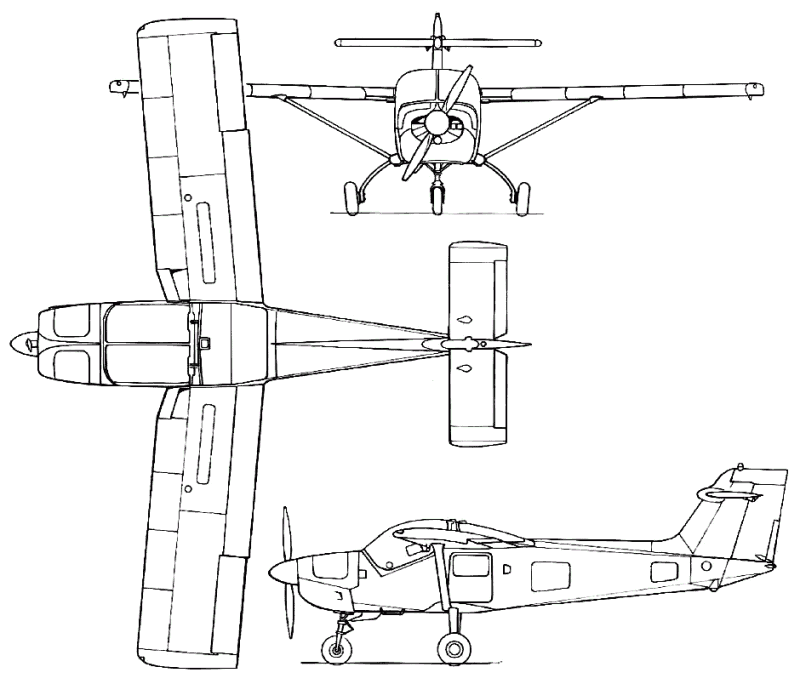


20
reply