|
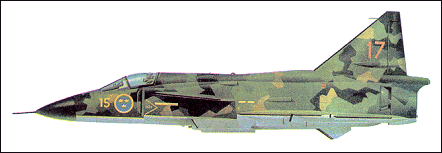
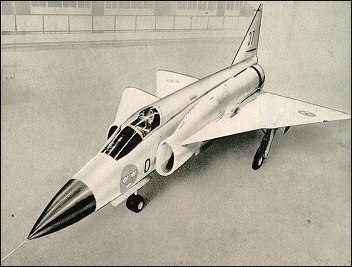
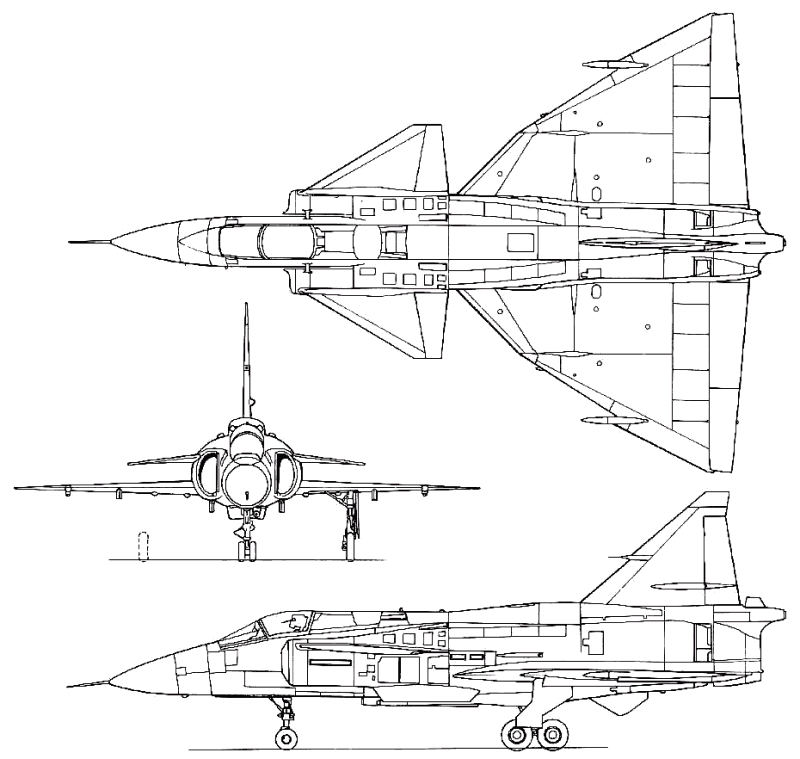
| Development of the Saab-37 was initiated to provide the Swedish air force with a completely integrated weapon system based on the concept pioneered in the USA. Prolonged research led to adoption of a then-unique canard configuration for the interceptor that was to form the airborne component of the weapon system. The configuration comprises a large rear-mounted delta wing combined with a delta foreplane incorporating trailing-edge flaps. This was adopted to provide improved STOL performance so that the Saab-37 would be able to operate from short runways and sections of roadway about 500m in length, greatly increasing the flexibility of dispersed operations. This configuration, in combination with a high-power turbofan engine, has provided the essential short take-off capability. The engine also complements short landing capability by introducing thrust reversal, its first use in a combat aircraft. The Saab-37 has been designed for a 'no-flare' approach to landing with a rate of sink of 5m per second, and this has meant the design of special landing gear able to absorb such a high rate of descent. Once on the ground, thrust reversal plus anti-skid brakes ensure the achievement of a minimum landing run. The pilot is accommodated on a zero-zero ejection seat in an air-conditioned, heated and pressurised cockpit, protected by a bird-proof windscreen. Much of the capability of this aircraft results from the incorporation of the latest avionics, including for attack a head-up display linked via an air-data computer to a digital fire-control system; for its own protection ECM (electronic countermeasures) and radar warning equipment; for navigating Doppler radar and radar altimeter; and for landing in all weathers a tactical instrument landing system plus a blind-landing guidance system.
The first of seven prototypes made its maiden flight on 8 February 1967 and the initial AJ 37 Viggen (Thunderbolt) single-seater was flown on 23 February 1971, with deliveries being made to Flygflottilj 7 at Satenas from June 1971 onwards. The AJ designation signifies Attack-Jakt, or attack-fighter, underlining its primary role as an attack aircraft. The next versions to be developed were dedicated reconnaissance Viggens. R&D funding was allocated for a nominal 'S-37' (Spanning, or reconnaissance) aircraft programme in 1971, resulting in the SF 37 Viggen (Spanning Foto, or photo-reconnaissance) which was intended to replace the S 35E Drakens and surviving Lansens in their overland mission. The first prototype flew on 21 May 1973. The SF 37 is fitted with a varied array of seven cameras in a chisel nose, which dispenses with radar of any kind. These systems can also be supplemented by pods, particularly night recon-naissance units, on the Viggen's shoulder pylons.
The second dedicated reconnaissance version is the SH 37 Viggen (Spanning Havsovervakning, or sea surveillance) aircraft. The third production Viggen served as the SH 37 prototype, first flying in that configuration on 10
December 1973. A look at any map of Sweden quickly explains why national defence policy places such great emphasis on the threat of seaborne invasion. This goes some way towards explaining the importance of the SH 37's capabilities to the Flygvapen. Fitted with a long-range Ericsson PS-371/A surveillance and attack radar, optimised for over-water operations, the SH 37 also boasts an RKA 40 camera which records radar imagery for analysis. Outwardly, the SH 37 Viggen resembles the AJ 37 aircraft, and if any additional reconnaissance systems are carried they are externally mounted on the shoulder pylons. The usual fit is a night photography pod to port and a LOROP pod to starboard. SH 37 pilots got most of their exercise observing Warsaw Pact naval manoeuvres in the Baltic Sea, but they were no strangers to NATO navy crews either.
Obviously, with the Viggen fulfilling its role as the Flygvapen's primary aircraft system, there was a pressing need for a two-seat trainer version. This role is undertaken by the Sk 37 Viggen (Skol, or school), which is somewhat unusual in having two separate cockpits for pilot and instructor.
The Sk 37s have an extended fin and retain the standard Viggen nose, but carry no radar, instead relying on Doppler equipment and DME to find their way around. Based on the AJ, the Sk 37 has reduced fuel capacity as a result of its extra cockpit, and aircraft often operate with external tanks.
The first 27 Viggens were built with weakened spars and early in its career the type gained an unfortunate reputation as a result. The basic integrity of Saab's design was never in doubt, as borne out by the long service of all its post-war military aircraft, so it came as no surprise when the decision was made to proceed with the final and perhaps most radical development of System-37. To replace the J 35 Draken in the air defence role the JA 37 Viggen (Jakt, or fighter) was conceived, externally identical to the AJ 37 but underneath a very different aircraft. Design work had been underway at a low rate since 1968, and the first contracts were awarded in 1972. A total of five prototypes were required, the first flying on 4 June 1974. The fuselage was subtly stretched by 7cm and the fin gained a distinctive extension (a la Sk 37). The other obvious external difference is a blade VHF aerial, behind the rudder.
An extensive test programme was undertaken to integrate the new Volvo-Flygmotor RM8B engine, Ericsson PS-46 multi-mode radar, BVR missile system, and all-new cockpit avionics and displays. While still a relatively small, single-engined aircraft, the JA 37 is phenomenally manoeuvrable and conforms to Sweden's exacting operational requirement for short missions but high sortie rates. Its wing has been restres-sed to cope with a higher load factor and the aircraft's weight has increased. The first of 149 production JA 37s flew on 4 November 1977, with deliveries commencing in 1980. The final aircraft was
handed over to the Flygvapen on 29 June 1990, bringing to an end the Viggen's production run of 329 aircraft (substantially less than Saab had originally hoped for).
Attempts were made to export the aircraft, first as a Starfighter replacement to NATO nations and Japan, a Mirage III replacement for Australia and, later, as a deep penetration strike aircraft to India. All these efforts came to nought, chiefly because of restrictions imposed on Saab by the national legislature.
A proposal to fund attrition replacements for the Swedish air force was also defeated, and first-generation aircraft will be withdrawn before the new JAS 39 Gripen becomes fully operational. To bridge that gap Saab is undertaking an extensive upgrade programme to modify 115 AJ, SF and SH 37s to AJS 37 standard. This involves fitting a new digital databus giving each aircraft a true multi-role capability, a terrain-following radar system, and compatibility with some of the armaments being developed for the Saab Gripen (such as the DWS 39 stand-off dispenser weapon).
| CREW | 1 |
| ENGINE | 1 x Volvo Flygm. RM 8A, 115.7kN |
| WEIGHTS |
| Take-off weight | 16500-22500 kg | 36376 - 49604 lb |
| DIMENSIONS |
| Wingspan | 10.6 m | 35 ft 9 in |
| Length | 16.3 m | 54 ft 6 in |
| Height | 5.9 m | 19 ft 4 in |
| PERFORMANCE |
| Max. speed | M2+ | M2+ |
| Ceiling | 18500 m | 60700 ft |
| ARMAMENT | cannons, bombs and missiles on seven hardpoints |
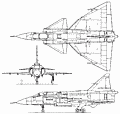 | A three-view drawing of Saab JA 37 Viggen (1730 x 1159) |
| TORBJÖRN KAMPE, e-mail, 29.04.2017 18:33 I LOVE THIS MASKIN. FLYG DATE A REAL DRAM.
THIS MASIN CAN KILL F-16,F /A-18,F-22,F-15, ALL SU AND ALL MIG MODELS.I HAVE TEST IN PC-SIMULATOR ONLINE AND KILL MIGS,SU AND ALL AMERKANS AIRCRAFT FROM F-16,F /A-18,F-15,F-22,F-35 AND ALL OF THEM. REAL DRAM OF VIGGEN WOW THIS IS FUN HAVE VIGGEN AND HELL FOR NOT FREND... reply | | JERRY, e-mail, 15.06.2011 01:14 I work i the swedes forse. I tel you. I Hade fly this aircraft. In SAAB hade to bild super viggen. This aircraft cud start from nathing and fly macke 3,5. start and laning was under 200 meter and have weponlode over 10 ton and have super mabilety over macke 2,5. And i hade test super g-clodes for over 26 G. Trast me i living to dey becos abaut off this super G CLODS. reply | | jerssey.se, e-mail, 19.12.2010 12:11 Jakt Viggen theeprophet=rock.com: Too much LSD? reply | | Fredrik Ast, e-mail, 22.06.2010 15:54 Many parts are not same as in the JT8D and therefore not interchangable. The RM8A and RM8B are stated by swedes to have been developed in sweden but the truth is the desing and much of the data was always owned by P&W and only shared vith Volvo Flygmotor on a need to know basis.
Viggen does not only mean thors hammer bolt but also a bird living in sweden called Vigg.
Seems so far fetched stating such thing that your relative paied saab and made them choose your name for the plane.
Also the plane was not named JA37 jaktviggen but AJ37 Viggen
The fighter version was much later and with the lengthened RM8B engine much easier to handle than the RM8A. reply | |
| | jeffrey, e-mail, 21.05.2010 13:38 i cant really beleave about this reply | | Jakt Viggen, e-mail, 01.10.2009 09:04 This is the last part of the post which was cut off by the limitations of posting length by the system owner. Please see the previous post first then this one for the last couple sentences.
===== I was unsure of what to think or do, and in a day or two the Union president was found dead floating in his tub. less than a week later my Grandfather was followed all over the SeaTac mall by 2 Filipinos in suits with a plate of candies pestering him to try one, but not my grandmother, in one store and the next, finally he did and as he began to chew it they dumped the plate and ran off and in seconds my grandfather fell over dying, moments later I was called, I called and told the police what my Grandmother explained to me, they did nothing. A couple years later I did get some response, from them but they were too late, although it did help to add charges to the ones caught in Las Vegas. The Seattle police are so crooked, It was them I ended up finding out were running a stolen car chop shop with a towing company in Seattle, and the 2 detectives in charge of auto-theft were the leaders, and a total of 28 cops and guards were involved, including a halfway houses, it took me 30 days to track it all down when a car of mine was stolen that I built from the ground up. If anyone tells me gun control is needed, yep, no guns for cops, and full control over any gun you aim and shoot. making sure you hit what you aim at, and that is the only Gun control I accept.
I am currently fighting cancer, without even the slightest fear. I live with a feeding tube in my stomach, and I ride my Harley with an IV pole tied to me, I refuse to give up... The 23rd Psalm was written for me to be my motto. reply | | Jakt Viggen, e-mail, 01.10.2009 08:59 Before I die, I must make some things clear, so history will be recorded properly, and the secret won't pass away with me. Or anyone else who may still be alive and knows it.
This short piece here is only the needle in the haystack, of my life, and brushes with death, all of which can be verified through records kept many places.
My name in the us is spelled differently. My uncle of Swedish decent, and a great admirer of SAAB cars and aircraft, hearing what my name would be when born in 1952, was elated so much he invested heavily in SAAB to have a plane built with extensive power as a fighter plane, and he was impressed with new ideas of canard and delta type wings, he made an agreement with Saab it had to be a delta canard configuration and have my name, and so, in keeping with Saab's current methods of naming their planes, the fighter was named "JA 37 Jaktviggien" (the proper Swedish spelling), and my Great uncle, is Jack Warner of Warner Brothers, he was without children and I had the initials of J.W.V. He called me J Dub 2, as everyone called him J Dub, or JW, and made sure I knew the plane was named after me even though it still had not been built. The King and Queen of Sweden came to see me in Seattle, when I was about 7 or 8, shortly after I came out of an extended coma, in which a death certificate had been written and signed, a casket purchased, a cemetery plot purchased, all waiting for my body to stop the very slow heart rate and respiration's, but my mother refused to let them fully remove life support means and took me home to care for me, refusing to accept I was dead. I awoke after she was beat, my two baby brothers were beat and all 3 left for dead. I half paralyzed, woke up and saved their lives by getting help from neighbors.
The King of Sweden said to me, that I have lived fully up to my name before I was even 7 years old, he also asked if I knew the meaning of my name, I told him, and he was very pleased I knew the Swedish meanings, and stated he knew of no one else who has been the true fighter as I have at that age. The Queen was wearing a full length white fur coat of excellent quality, she was beautiful standing there, she took my hand said a few things in Swedish and asked if I knew what she said, I said yes and told her, and at that they were all amazed I knew more than just a word or two in Swedish.
The story of my first name, and my last, each are of great significance in Swedish lore, and very easy to find out. That is the meaning of the name told with the aircraft, as Jakt the fighter of all fighters, Viggen the speed and power of the lightning bolt from Thors mjoller (hammer).
When JA 37 flew it's maiden flight in 1967, my uncle was there and brought back films to show me, it was an awesome thing to see even on those old news reels, at the old Paramount theater in Seattle one afternoon, him and I alone, is one film I will never forget seeing.
My father, was the drummer for Wayne Newton in the 50's and 60's, His name Was Jack M. Veggin, I am Jack W. Veggin. I was the first to break the 4 minute mile, and twice in one day, it is on record, but kept quiet, when I was in boot camp at 32nd street San Diego in 1971, but my uncle blocked it from the news, because I never wanted any publicity for anything, after being attacked and put in a coma, I wanted from then on to live a normal life, to have the chance to know everyone BEFORE they know who I am.
How my Grandfather and Grandmother met, is amazing in itself, with both families migrating here in to the northwest two different ways from Sweden to other countries first. The background from my grandfather to his great grandfather who was originally from Sweden and the spelling of his name was Viggen, changed several times in migration to Austria, then his son to Italy, and with their fist son who was a grandfather when killed by communist Prussians invading Trieste, who killed all the men and boys in the village except my grandfather who hid in a wine barrel for a 3 days, and his brother, I don't recall where my grandfather said he hid. At 14 he joined up on a merchant ship overtaken by muslim pirates, who killed all but him he finally jumped ship off the coast of Astoria Oregon, during the night, and swam to shore meeting a kid, not speaking any English the boy helped him to shore took him home, the two are famous in the Seattle cooks union, both murdered by Philippine gangsters who conned and took control of all cooks unions on the west coast then began to embezzle the money from all the accounts until my grand father and his friend, who then was the president of the Seattle cooks union, went to their office in Las Vegas, and tried to get answers, being threatened, and unable to get an answer, they broke into the offices that night and got the evidence needed, bank documents of transfers to foriegn accounts, came back, got threats, and scared my grandfather called me, I was unsure of what to think ... reply | | paul scott, e-mail, 30.09.2009 17:27 Excellent piece of kit, keep up the good work Saab! reply | | leo rudnicki, e-mail, 14.04.2009 04:16 The engine is the JT8D, from the DC-9 and many other ailiners, with a swedish afterburner section. That is why the plane looks a little chunky, but it scoots along, carries lots of missiles and the JA model carries a BIG gun. This is not your mother's Boeing 737. reply | | antonio, e-mail, 17.01.2007 23:34 e bellissimo mi piacerebbe pilotarlo e veramente eccezzionale reply | | Tomas Carlsson, e-mail, 31.01.2007 17:45 Wow, Nice. I love Sweden and i love Saab!
/ /Tomas reply |
|
Do you have any comments?
|
| 
COMPANY
PROFILE
All the World's Rotorcraft
|




20
reply