|
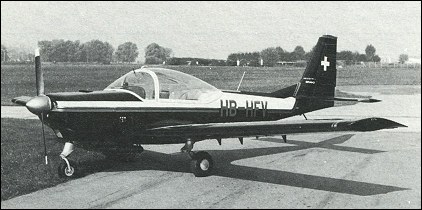
| In the late 1960s, SIAI-Marchetti in Italy and Flug- und Fahrzeugwerke AG Altenrhein (FFA) of Switzerland agreed to develop jointly a two/three-seat lightweight touring/training aircraft. It was intended that it should be built in both countries, as the SA 202 Bravo in Italy and AS 202 Bravo in Switzerland, but it was decided subsequently that as a result of a shortage of production space in SIAI-Marchetti's factory it should be built exclusively in Switzerland. Since that time the aircraft division of the Swiss FFA company has been re-named Flug-zeugwerke Altenrhein AG (FWA), accounting for the current designation of this aircraft.
The Bravo is a fairly conventional light-plane, a cantilever low-wing monoplane with non-retractable tricycle landing gear and power provided by an Avco Lycoming piston engine. Side-by-side accommodation for two is provided in aerobatic versions, plus a rear seat or space for 100kg of baggage in utility aircraft. The first Swiss-built prototype was flown on 7 March 1969, followed two months later, on 7 May, by the second prototype, the only example built by SIAI-Marchetti. Production versions include the AS202/15 powered by a 112kW O0-320-E2A, AS202/18A with an inverted flight oil system, and the single AS202/26A, powered by a 194kW Lycoming O-540 engine fitted with a fuel and oil system for unlimited inverted flight.
About 215 Bravos had been built by 1990, the majority sold to military operators including the air forces of Indonesia (40), Iraq (48) (some of which were transferred to Jordan), and Morocco (10). Civil operators include Royal Air Maroc (5), the Royal Flight of Oman (4), the Uganda Central Flying School (8) and the British Aerospace Flying College (11) which renamed its Bravos the Wren.
In 1979 FWA proposed a turboprop Bravo development intended mainly as a military trainer. Designated the AS 32T Turbo Trainer and powered by a 268kW Allison 250-B17C, the aircraft retained Bravo wings and tail unit but had a new fuselage seating two in tandem and a retractable tricycle undercarriage. In August 1980 a standard Bravo, designated AS202/32, was fitted and flew with an Allison 250 turboprop powerplant as part of the AS 32T test programme, but in the absence of orders, development of the type did not proceed further.
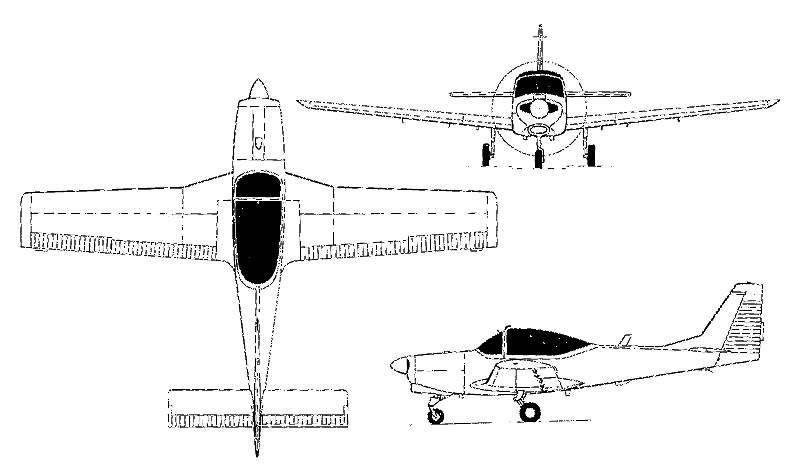
 | A three-view drawing (800 x 475) |
| MODEL | FWA AS 202/18A Bravo |
| ENGINE | 1 x Avco Lycoming AEIO-360-B1F flat-four piston engine, 134kW |
| WEIGHTS |
| Take-off weight | 1050 kg | 2315 lb |
| Loaded weight | 700 kg | 1543 lb |
| DIMENSIONS |
| Wingspan | 9.75 m | 32 ft 0 in |
| Length | 7.50 m | 25 ft 7 in |
| Height | 2.81 m | 9 ft 3 in |
| Wing area | 13.86 m2 | 149.19 sq ft |
| PERFORMANCE |
| Max. speed | 226 km/h | 140 mph |
| Cruise speed | 203 km/h | 126 mph |
| Ceiling | 5485 m | 18000 ft |
| Range | 965 km | 600 miles |
| Mohammed Shahwani, e-mail, 01.06.2014 07:35 I am one of Iraqi pilot how had more than 2,000 hour on AS202 Bravo and interested to Buy one of these aircraft if you still have them. Thank you reply |
| sergio c. sanchez jr., e-mail, 19.02.2010 07:33 What is the cost now for a brand new 18A /Brvo?Do they still manufacture this aircraft?Might be iterested in putting a new flying school here in the Philippines.Thank you. reply | | Walter Buschor, e-mail, 27.01.2009 21:28 I learned to fly on this airplane back in 1979. I still have very fond memories of it. It performed rolls , loops and spins like magic even though I did not have an aerobatic endorsement. I now live in Australia where I built and fly my own little aircraft. I still would like to fly one of those Bravo's again some day. reply | | Walter Buschor, e-mail, 27.01.2009 21:28 I learned to fly on this airplane back in 1979. I still have very fond memories of it. It performed rolls , loops and spins like magic even though I did not have an aerobatic endorsement. I now live in Australia where I built and fly my own little aircraft. I still would like to fly one of those Bravo's again some day. reply | |
| | Evan L., 26.10.2008 04:02 The airframe was designed for +6 /-3 G's, and with the lycoming 260 HP engine option it would outperform many other aircraft of it's day and in it's class. reply | | joe, 20.09.2008 12:55 how aerobatic is it? Is it a sort of T-67 or more of an Aerobat reply | | rahmat d, e-mail, 11.09.2007 19:00 how long is the maximum life time of airframe this aircraft? reply |
|
Do you have any comments?
|
| 
All the World's Rotorcraft |




20
reply