|
| In 1948 the Swiss air headquarters issued a specification for an interceptor/ ground-support aircraft tailored to fit the country's operational requirements. Two factories were contracted to produce prototypes: the FFA at Altenrhein and EFW at Emmen, the latter's competitor being projected as the EFW N-20.
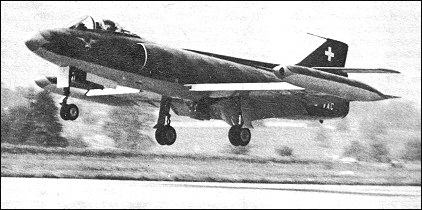
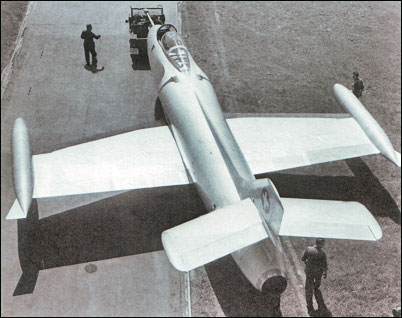
FFA (Flug- und Fahrzeugwerke) submitted a design for a straight-wing, single-seat jet and the prototype flew (as the FFA P-16-01) for the first time on 25 April 1955 with a 3629kg thrust Armstrong Siddeley Sapphire axial-flow turbojet. As the EFW N-20 project had been abandoned in 1953, the P-16 had the field to itself, but the requirements of the specification were demanding. A high transonic performance with STOL. ability for operation from high-altitude strips was needed, as well as good manoeuvrability, a rapid climb with combat load and the ability to use grass airfields. In fact, the P-16 could takeoff in just under 488m and land with a braking parachute in less than 305m. Its remarkable performance was attributable to a very strong thin wing of low aspect ratio, with leading- and trailing-edge flaps; wingtip fuel tanks were a permanent fixture, and to assist in operations from grass twin mainwheels and nosewheels were fitted. Between 28 February and 12 March 1956 this aircraft was evaluated by the Swiss air force, but reports indicate that in spite of a number of good features the overall flight performance was unsatisfactory. However, the programme was proceeding well when, on the 22nd test flight, the prototype was lost following engine failure caused by a fractured fuel line; the pilot ejected successfully just before the aircraft crashed into Lake Constance.
Work on the second prototype had begun, but the programme suffered some delay before the P-16-02 flew on 16 June 1956; it became supersonic in a
dive for the first time on its 18th flight on 15 August 1956 following extensive trials which included weapon evaluations and spinning. A third aircraft, the P-16-03, flew on 4 April 1957 powered by the bigger Sapphire Sa.7 of 4990kg thrust, As a result of the improvement in performance the Swiss government placed an order in March 1958 for 100 aircraft, known as the P-16 Mk III, but only a week later the P-16-03 was lost, also in Lake Constance, the pilot again ejecting successfully. Apparently a failure in the hydraulic-powered flight-control system on landing approach at low altitude prevented the pilot switching to manual control in time to save the aircraft. The production order was suspended immediately and two months later was cancelled. The Swiss government considered that the hydraulic system was faulty and the complete redesign necessary would cause too great a delay in the programme, but FFA and experts from the RAE Farnborough found that the system met British design requirements, an exactly opposite view to the official Swiss investigation team, whose findings were responsible forthe cancellation of the order. The relatively simple modifications to the hydraulic system
were made by FFA and two pre-series aircraft were built on the company's own initiative, the P-16-04 flying on 8 July
1959 and the P-16-05 in March 1960.
The design was eventually proven to be
sound, but the production order was not
reinstated.
| ENGINE | 1 x Armstrong Siddeley Sapphire Sa.6 turbojet, 3629kg |
| WEIGHTS |
| Take-off weight | 11700 kg | 25794 lb |
| Empty weight | 7040 kg | 15521 lb |
| DIMENSIONS |
| Wingspan | 11.15 m | 37 ft 7 in |
| Length | 14.25 m | 47 ft 9 in |
| Height | 4.09 m | 13 ft 5 in |
| Wing area | 29.77 m2 | 320.44 sq ft |
| PERFORMANCE |
| Max. speed | 1120 km/h | 696 mph |
| Ceiling | 14020 m | 46000 ft |
| Range | 998 km | 620 miles |
| ARMAMENT | 2 x 30mm cannon, 4 x 500kg bombs |
| ubaTaeCJ, e-mail, 21.02.2025 19:17 20 reply | | Agueda, e-mail, 01.02.2022 23:35 Yes! Finally something about สมัครbetflix.
สมัครเบทฟิก reply |
| Hannelore, e-mail, 12.08.2021 08:23 betflix เวปสล็อตทุกเกมส์ชั้นนำ เลือกลุ้นไà¸"้ทั้งเกมส์สล็อตแมชชีน ยิงปลา และเกมการพนันทุกแนวอื่นๆให้เราเลือกลุ้นอีกกว่า 68 ผู้ผลิตระà¸"ับโลก เล่นสล็อตออนไลน์ผ่านเวบไซต์ เบทฟลิก รวมสล็อตคาสิโนและการลุ้นเจนใหม่ บริการผ่านระบบทันสมัย ฝาก â€" ถอนเงินฉับไว เว็ปเกมสล็อตและกาสิโนออนไลน์แบรนà¸"์ยอà¸"นิยมเอาไว้เวบเà¸"ียวการันตีชื่อเสียงเราสมัครเปิà¸"ยูส
Betflik Thai ช่องทางเข้าเล่นเกมส์สล็อตออนไลน์ เกมยิงปลา อีกทั้งเกมส์คาสิโนออนไลน์รวมกว่า 246 ทางเข้าเล่น บริการโà¸"ยค่ายผู้ออกแบบเกมส์คาสิโนออนไลน์ชื่อà¸"ังเยอะกว่า 30 ผู้ผลิตยอà¸"นิยมทุกมุมโลกเล่นเกมไà¸"้ทั้งสล็อตJoker123
slot PG PP Slot สล็อต Blueprint PS Slot Simpleplay อีโวเพลย์ NetEnt Gaming สล็อตKalamba Gamatron สล็อต Toptrend Micro Gaming FA Chai Funky Game สล็อตค่าย Quickspin สล็อต
Red Tiger ฮาบาเนโร่ คิงเมกเกอร์ เวบ BETFLIK เกมส์สล็อตแตกบ่อยแล้วยังเà¸"ิมพันเกมส์เสี่ยงโชคทั้งไà¸"้เงินและสนุกไà¸"้อีกมากกว่า 40
แบรนà¸"์à¸"ัง ลุ้นไà¸"้ทั้งเกมยิงปลา บัคคาร่า ไพ่เสือมังกร 11ไฮโล รูเล็ตออนไลน์ เบทฟิก มีเกมส์เสี่ยงโชคทั้งมันส์และสนุกเข้าแทงไà¸"้ทั้ง AEsexy SA gaming DreamGaming WMคาสิโน Big Casino AG
Gaming GDG Gaming Heng Casino AMBpoker เรานำเกมคาสิโนสล็อตทั้งหมà¸"มารวมไว้ในที่เà¸"ียว BETFLIXให้บริการà¸"้วยเทคโนโลยีใหม่ฝากเครà¸"ิต
â€" ถอนเครà¸"ิตอัตโนมัติที่เร็วทันใจระบบเว็บไซต์ที่ใช้งานง่ายเล่นสล็อตจากแท็บเล็ตและโทรศัพท์ของผู้เล่นไà¸"้ทั้งแพลตฟอร์ม Ios และ android reply | | bombardier, e-mail, 24.05.2011 14:17 Looks like a straight wing Hunter reply | |
| | Rio, e-mail, 12.01.2011 19:51 As a professsional pilot in Switzerland, I got to fly the FFA AS202 Bravo sportsplane - and was personally introduced to the CEO-(owner) of the company, Dr. Claudio Caroni.
This gentleman told me the true whole story about the P-16:
he payed further development of ongoing prototypes with part of hiw own private fortune AND only the WINGS were used to develop the Learjet 23, not the fuseage. reply | | Paul Guilden, e-mail, 22.12.2010 00:06 I was an apprentice engineer in 1961, working in Altenrhein with Dr. Hans Luzius Studer, designer of the P-16, who was hired by Bill Lear to design his business jet. The consensus was that the P-16 was an excellent-performing aircraft and that Studer had been given a raw deal by the Swiss government.
Any essay about the P-16 should mention Studer, as it was his design.
It would probably not be exact to say that the Learjet "evolved" from the P-16 other than to the normal extent that Studer, the designer of both, learned from his experiences. reply |
| Dave, e-mail, 27.04.2010 02:26 I believe this AC was used in the groundwork development for the Lear-23. reply | | Marco, e-mail, 31.08.2010 12:18 hello leo rudnicki,
The testpilots reportet that the P-16 is a very stabil weaponplatform. they fired with the 2 inbuild guns, the inbuild rocketlauncher, unguidet rokets and ironbombs on the wing and 4 big napalmbombs (but for safty the had wather inside not napalm). Echeckout the videoFFA P-16 on youtoupe the firing is on the last part of it. reply | | leo rudnicki, e-mail, 28.04.2009 20:17 As a contemporary of Swift /Hunter /Lansen, and no sign of area rule, I wonder if they ever fired the guns in flight. Learjet didn't increase cabin headroom much. reply |
| leo rudnicki, e-mail, 28.04.2009 20:17 As a contemporary of Swift /Hunter /Lansen, and no sign of area rule, I wonder if they ever fired the guns in flight. Learjet didn't increase cabin headroom much. reply | | Nikos J. Farsaris, e-mail, 27.12.2008 19:26 This was actually the basic design Learjet-23 (business jet) evolved from. reply | | LILY, e-mail, 25.06.2007 21:24 LOVELY! reply | | LILY, e-mail, 25.06.2007 21:24 LOVELY! reply | | SHAW, e-mail, 25.06.2007 21:10 ITS VERY NICEW! reply |
|
Do you have any comments?
|
| 
All the World's Rotorcraft |

 Paul Guilden

20
reply