|
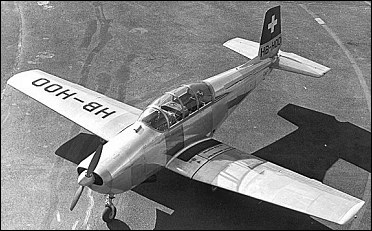
| The undoubted success of the P-2 led to development of a new general-purpose trainer under the designation Pilatus P-3, the prototype of which was flown for the first time on 3 September 1953. Intended for use as both a primary and advanced trainer, the P-3 is of cantilever low-wing monoplane configuration and differs from its predecessor by being of all-rnetal construction. It has retractable tricycle landing gear, but as the P-3 was required by the Swiss air force for 'all-through' training, from the primary stage to the point of passing on to the de Havil-land Vampire jet trainer, a lower-powered engine was adopted, the Avco
Lycoming GO-435-C2A. Like the P-2 that preceded it into service, the P-3 has similar standards of equipment or weapons for comprehensive pilot training by day or night. A total of 72 P-3s was built for the Swiss air force, and in 1993 a handful of these remain in service; a small number was also supplied to Brazil, but these have since been superseded by trainers of indigenous design and construction.
| MODEL | P-3 |
| CREW | 2 |
| ENGINE | 1 x Avco Lycoming GO-435-C2A, 194kW |
| WEIGHTS |
| Take-off weight | 1500 kg | 3307 lb |
| Loaded weight | 1110 kg | 2447 lb |
| DIMENSIONS |
| Wingspan | 10.4 m | 34 ft 1 in |
| Length | 8.75 m | 29 ft 8 in |
| Height | 3.05 m | 10 ft 0 in |
| Wing area | 16.5 m2 | 177.60 sq ft |
| PERFORMANCE |
| Max. speed | 310 km/h | 193 mph |
| Ceiling | 5500 m | 18050 ft |
| Range | 750 km | 466 miles |
| John R Osbourn, e-mail, 04.07.2012 23:12 How many of these are still flying today? reply | | Jerry Jeffers, e-mail, 16.04.2011 21:21 I own P-3 842.It now has a GO-480 engine with equal length exhaust and fuel injection,producing approx.305 horsepower which gives me a cruising speed of 150Kts.It also has Garmin avionics and an STEC 60-2 autopilot. reply | | Hans R. Egli, e-mail, 18.01.2011 22:38 In 1963 I worked at Pilatus Air Service in Zurich. We rebuilt the P-3 HB-HON from a Lycoming engine with an AirResarch turbine, which was to become the Testbed for the later PC-7 and PC-9 developments. reply | | jean-rene cadorel, e-mail, 03.09.2008 10:45 3 of these were bought by Jacques Lacombe, brought to Mascouche Airport (in Quebec, Canada)in crates, reassembled and flown for a while before being sold to local canadian pilots. reply |
|
Do you have any comments?
|
| 
COMPANY
PROFILE
All the World's Rotorcraft
|