|
| American inventor Moulton Taylor's dream of a 'roadable aircraft' saw
construction of a series of novel, but largely impracticable vehicles over
20 years, none of which reached series production.
Taylor's Aerocar I flew in 1949 but was not certified until 1956. Six were
built, followed by a non-roadworthy version called the Aero-Plane and finally
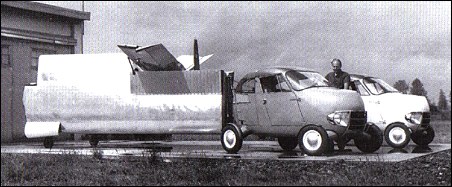
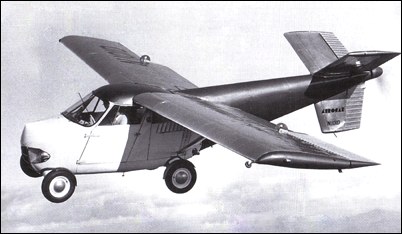
the definitive Aerocar III in 1968. The Aerocars were essentially small,
lightweight cars with detachable conventional light aircraft wings and an
unusual Y-tail with a pusher propeller.
New rules on automobile safety in the 1970s required additional
equipment for the car component of the Aerocar, such as bumpers, which
increased the weight and expense and reduced performance. Plans to build a
sleeker sportscar version were dropped. FACTS AND FIGURES © The same steering wheel was used
to manoeuvre the Aerocar in flight
as on the ground. The engine only
gave 40hp for road travel
and the top road speed was about
113km/h. © The Aerocar could be converted
from aircraft to car configuratioi
by one person in five minutes.
The first step was to flip up the
rear licence plate and connect
the propeller shaft. © A locking system prevented
the engine starting if the
wings and tail were not
securely locked in place in
aircraft mode. © The wings could be towed
behind the car like a trailer
or left at the airport until
required for flight. © The Aerocar I had a frame of aluminium and steel with fiberglass skins.
| Scott Boyd, e-mail, 05.03.2011 05:47 I still remember the tv show with Bob Cummings. reply | | louis moore, e-mail, 04.03.2011 23:20 It might be of interest to note that another "flying car" is now being produced in Florids. It uses a parasail for lift'
I think it is named "Hercules"
Developed 2006 - 2010 reply |
| Reg Prosser (UK), e-mail, 09.07.2010 12:26 Ref: e-mail from Nancy Backinger 11.05.2010
I can understand Ms Backinger's feelings regarding her grandfather's work on the Aerocar and I feel that I must try and explain about design /inventions in general.
As a retired designer, albeit in a different industry, it appears to be an unknown fact that any work carried out by a designer becomes the property of the company automatically.
I too have worked into the early hours, trying to solve a problem, in the full knowledge that the company will remunerate me for my efforts, but it will be the company that takes the credit in the end.
It seems unfair, but it pays the bills and any problems that arise from that time will be the company's responsibility.
Some solutions can be too complicated for a colleague to take over and that is the reason for wanting to retain the original designer. Otherwise it could be an expensive 'start again' problem.
I'm sorry to read of the distress that this caused you, but at the same time, a designer enjoys the challenge without complaint. If the job was a big one it could even find your name on the patent somewhere.
I believe that 'Molt' Taylor appreciated the work that your grandfather Jess Minnick did for him and both of them would get great satisfaction from seeing those designs actually working. reply | | Nancy Backinger, e-mail, 11.05.2010 17:56 As a child I stayed with my grandparents months at a time and was always minus my grandfather Jess Minnick,who could always be found working late in the night putting this dream he also had together. My grandmother and I would stop by for lunch and find him alone day in and out working to make this dream happen. He built the aerocar letting Molt Taylor get all the credit because he had the fiances but it is time that my grandfather gets some recognition, My grandmother Helen Minnick was a widow to the aerocar and I get sick of reading only about Molt Taylor's dream because it would never of happened if my grandfather had not helped put this all in place. When Jess Minnick would get mad and quit Taylor the aerocar would have to shut down, until Jess agreed to come back. reply | |
| | vintage aviation lady, e-mail, 27.05.2009 01:24 I am writing a childrens book about the AeroCar, Airphibian, and the Transition. I'm intrigued that the vehicle was used during Airwatch AeroCar in 1961-62. Are their any videos or audio tapes available on line or in any other format? reply | | Jake Schultz, e-mail, 30.05.2008 03:00 Molt Taylor was a friend of mine. He was as full of life as he was brilliant. I conducted researched for 13 years, using his personal archives, to tell his story in the book "A Drive in the Clouds." Molt himself, just prior to his death wrote the Introduction and Paul Poberezny, founder of EAA wrote the Foreword.
It has been a privilege to pass along the passion he held for his lifelong work - to make an automobile fly...!
www.historicaviation.com /historicaviation /product_info.po?ID=11630&product=Books&category=civil&subcategory=Civil%20Aircraft reply | | Wayne Nutsch, e-mail, 30.04.2008 00:53 I used to fly N103D for KISN radio's Airwatch traffic reporting in 1960's. My log shows about 350 hours of flight time in it. It was painted white with red hearts all over and KISN underneath the wings. reply | | Ivan Harris, e-mail, 28.04.2008 10:41 The Aerocar was used for traffic reports for many years in Portland, Oregon. Molt was just a little way up the river at Longview, I think. They also designed other planes. I do remember seeing a plan to use a Honda CRX with detachable wings. reply |
|
Do you have any comments?
|
| 
All the World's Rotorcraft |




20
reply