|
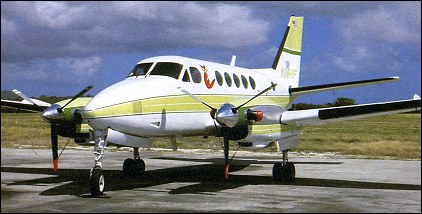
| The Beech Model 100 King Air was
added to the range of Beech corporate transports when initial deliveries were made in August 1969. It differed from the earlier King Airs in several respects: reduced wing span, a lengthened fuselage to provide accommodation for a maximum of 15 persons, increased elevator and rudder areas, twin-wheel main landing gear, and more powerful engines. The new wing was generally similar to that developed for the Model 99 Airliner.
In October 1971 Beech began deliveries of the improved King Air A100, this variant incorporating detail improvements, and the first five were supplied to the US Army under the designation U-21F. Examples have been procured by the Spanish air force, and a Universal Aircraft Com/Nav Evaluation (UNACE) configured version, for the rapid inspection and calibration of air navigation systems, has been supplied to countries that include Algeria, Belgium, Canada, Indonesia, Malaysia, Mexico, and the USA. Beech also produces specially modified camera-equipped versions of the King Air for aerial survey, and examples are in service in this role in Canada, Chile, France, Jamaica, Saudi Arabia, Thailand, and the USA.
In parallel with A100 production since late 1975, Beech has produced a complementary King Air B100 offering higher performance. It differs by the installation of 533kW Garrett TPE331-6-252B turboprop engines, and of equipment directly associated with the engine installation. Production of the King Air 100 ended in 1983.
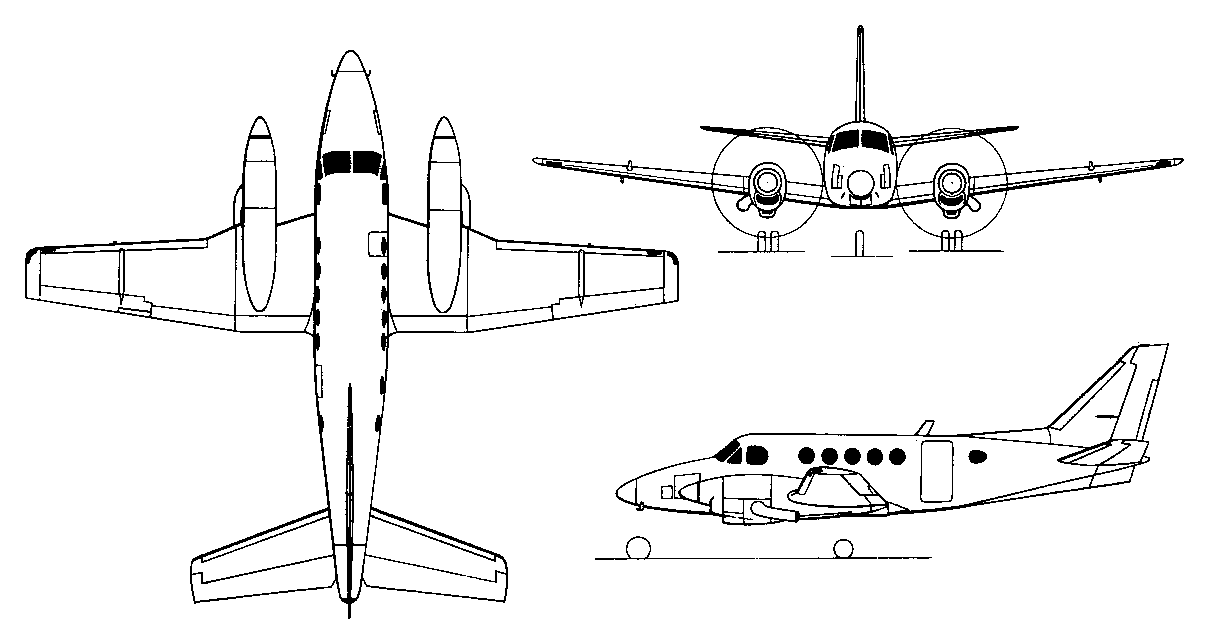
 | A three-view drawing (1206 x 636) |
| MODEL | King Air A100 |
| ENGINE | 2 x Pratt & Whitney Aircraft Canada PT6A-28 turboprops, 507kW |
| WEIGHTS |
| Take-off weight | 5216 kg | 11499 lb |
| Empty weight | 3083 kg | 6797 lb |
| DIMENSIONS |
| Wingspan | 14.0 m | 46 ft 11 in |
| Length | 12.17 m | 40 ft 11 in |
| Height | 4.7 m | 15 ft 5 in |
| PERFORMANCE |
| Max. speed | 459 km/h | 285 mph |
| Ceiling | 7575 m | 24850 ft |
| Range | 2483 km | 1543 miles |
| Bob, e-mail, 13.11.2014 19:18 So true John with ,, I remember our boss would always blame our flight crews for improper engine starts every time we would send the engines in for hot sections. After continuous "butt chewings" by our boss,,,, Garret and Pratt finally came out with the "high nickel vane rings" ! Amen :) reply | | berkane redda, e-mail, 22.11.2012 23:44 I have worked onthis airplane in 1985to1994.its a verry good airplane and verry hard engie .Redda from algeria reply | | Scott Boyd, e-mail, 17.07.2012 07:58 Flew the 90 and 200 but never the 100 and in nearly 8,000 hour flying PT-6's and the 118 /118A in the EMB120 never had a single problem. I do agree the 90, 90A and 90B were pretty poor performers especially out of Denver on a hot day, but E's did real well in and out of Aspen and other high spots. A couple of the A's and B's had E engines and did a lot better, though you had to use the original power limits in cruise takeoff and climb was greatly improved. reply | | jim hallows, e-mail, 17.07.2012 07:34 Not sure what john above is talkin about losing an engine. The airplane did exactly what the Beech performance numbers said it would do. That said, it is not a high altitude airport airplane at gross wt. A prudent pilot takes that into account. 2000 hrs in A100 n23BW reply | |
| | john davis, e-mail, 18.12.2010 02:16 Flew an A100 back in the 70's & 80's. Plane was nice and everyone liked it but God help you if you lost an engine. The engines were always ruining the early guide vane rings and this became really expensive! reply |
|
Do you have any comments?
|
| 
COMPANY
PROFILE
All the World's Rotorcraft
|