|
| The Beech Model 35 Bonanza was
the founder member of a remarkable family of aircraft, not only for the fact that production of Bonanzas of all types amounts to about 15,000, but also because the V-tail Bonanza extended over 35 years of production.
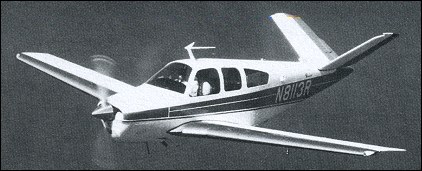
Flown for the first time on 22 December 1945, the prototype Model 35 Bonanza, distinguished easily by its V-(or butterfly-) tail, was to become another outstanding success in the mould of the Models 17 and 18. Unlike them, it got off the ground rather more quickly for when the company announced that full-scale production was to begin in March 1947, it already had a backlog of around 1,500 orders. It was a moment for the benefits of wartime experience to pay off, for about 1,000 deliveries had been made by the end of that year.
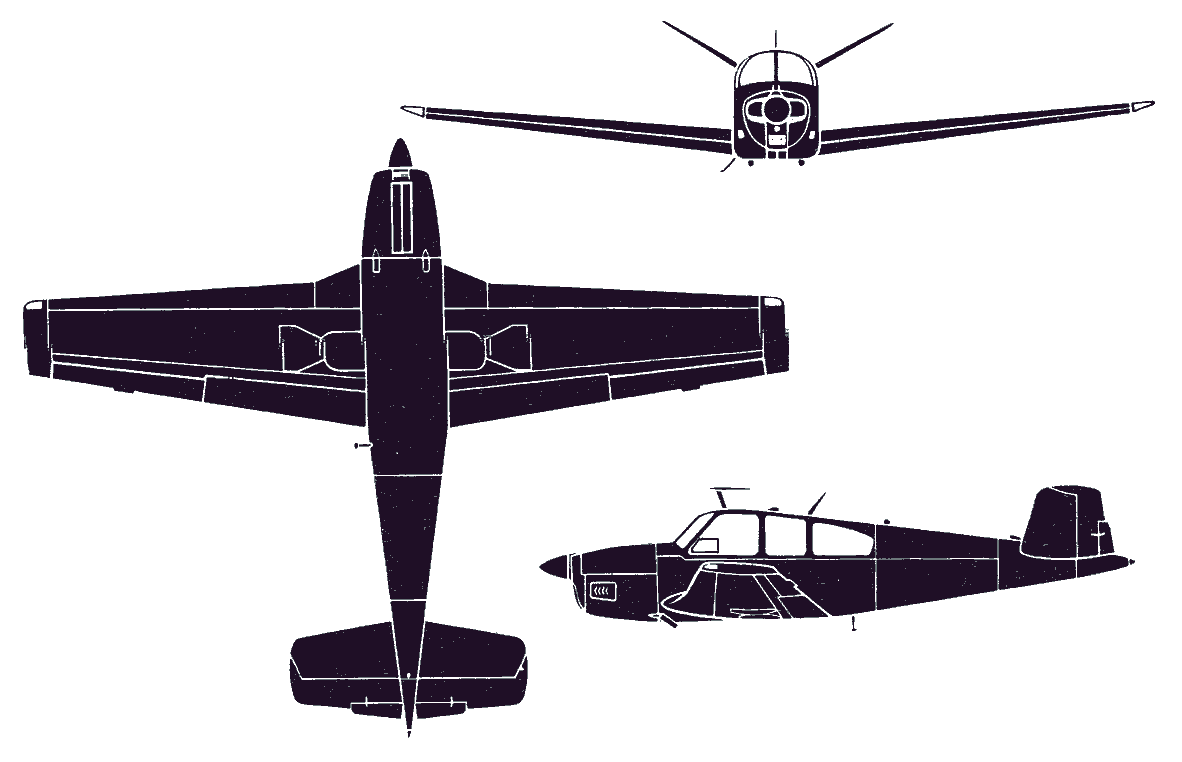
The general configuration of the. Model 35 has remained virtually unchanged throughout the aircraft's history. A cantilever low-wing monoplane of all-metal construction, including the distinctive tail unit, the Model 35 has an enclosed cabin providing seating for a pilot and three or four passengers. From the outset the Model 35 has had retractable tricycle landing gear, but the original version had only a swivelling nosewheel: a steerable unit was introduced on the Model A35 in 1949. An optional feature throughout the years has been a landing gear safety system of Beech design. Named 'Magic Hand', this ensures that the wheels cannot be retracted accidentally on the ground, or a landing made with the wheels up. As first flown, power was provided by a 138kW Continental E-185-1 flat-six engine, but a variety of standard and optional powerplants have been installed during the long production run. These have included turbocharged units for the V35 TC and the V35B TC.
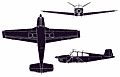 | A three-view drawing (1182 x 762) |
| MODEL | Model V35B |
| ENGINE | 1 x Continental IO-520-BB flat-six piston engine, 213kW |
| WEIGHTS |
| Take-off weight | 1542 kg | 3400 lb |
| Empty weight | 955 kg | 2105 lb |
| DIMENSIONS |
| Wingspan | 10.21 m | 34 ft 6 in |
| Length | 8.05 m | 26 ft 5 in |
| Height | 2.31 m | 8 ft 7 in |
| Wing area | 16.81 m2 | 180.94 sq ft |
| PERFORMANCE |
| Max. speed | 338 km/h | 210 mph |
| Cruise speed | 253 km/h | 157 mph |
| Ceiling | 5445 m | 17850 ft |
| Range | 1648 km | 1024 miles |
| Bob Roseberry, e-mail, 07.04.2021 07:33 I owned a 1963 v35 bonanza for ten years and loved her. Used her to transit from CT to FL each snowbird year. reply | | Jay Scattergood, 26.06.2020 21:03 I had a N774DF. I gave it up to a guy. Ihad it until the I had a jab. reply | | Rex, e-mail, 28.03.2014 22:35 Bought a 1947 35 from a Dr in Maryland. After flying 172's , musketeer, and a sundowner, I bought this beauty! Found out it was owned straight from factory by Merrill Meigs, sold to founder of Lear Jet Corp (Bill Lear?). Loved the plane, Walter, but sold it after a mishap with the nosegear. reply | | Ed Pull, e-mail, 13.02.2014 04:12 well after 3.5 years the bird is gonna come home. Its been in the penality box that long to get her ready for record flights and a extremely meticulas rebuild will pick up as soon as the windshield mod is complete was damaged in the FBO they decided too make up for the time and trouble and put a speed slope in get a few extra knots on the world record runs--the gentleman that owns and runs the FBO helped set Bill Odums plane in the non stop run from Honolu to New jersey cannot wait ill its time to pick her up. reply | |
| | Bob Gentry, e-mail, 13.01.2014 09:45 I currently own Bonanza N80462, serial #62 that was mentioned in an earlier post by Richard Cook. I bought it from him and flew my family on wonderful adventures for ten years but had to sell for financial reasons. However, I was able to buy her back seven years later as my wife Denise's literal last request and have since been flying and making more great memories with the kids, honoring that request. During the time I've owned Bonanza 62' I've made many improvements including nice avionics, interior, fresh engine and prop just to name a few. The early model "Straight 35's" are the best feeling and most agile to fly. Also very economical at 145 kts /10 gallons per hour. Plan on keeping her for the long run. "Denise" is a fantastic airplane! reply | | Ron Darbo, e-mail, 07.07.2013 17:52 Owned a 57H Bonanza for many years.7955D..Went to a twin comanchee..The best was still the bonanza..The continental people are terrible to deal with but the bonanza was great.. reply | | Ed pull, e-mail, 23.06.2013 02:18 Have a 1@950 "B" model heavily modified for around the world trip in 2014 ,range 4500 statute miles @ 165 Knonts real hot rod love it reply |
| Tom Tucker, e-mail, 24.02.2013 05:28 The first aircraft I owned was a model 35H. I got my instrument rating in this airplane. This was by far the best single aircraft I have ever flown. One of my children went to college in Washington DC and I would fly into Washington National each weekend and take her back. When it came time for number six to go to college I was forced to sell my toy. A very sad day. reply | | Scott Boyd, e-mail, 15.11.2012 05:10 I flew the original Turbo quite a bit as well as the Baron with the big engines and others with smaller engines.
I normally flew C-210T and C-206T as well as the 310T, 340, 421's and other models.
The Baron's were people who bought them and wanted to know how to fly them, I taught myself teaching them, thing were not so formal in those days.
One student went from zero to International Captain, that's not too bad, beat me I was a Commuter Captain until 1998. reply | | Stan Taylor, e-mail, 10.08.2012 04:18 My favorite airplane! I have managed to fly every version of the model 35 except the factory turbocharged one. Flew freight in a B35 with wood prop and no pitot heat. Thought it was normal to lose the airspeed indicator in icing conditions. We went all over the US. By the way, "If it ain't got a V tail, it ain't a BONANZA! reply | | Dexter Rumsey, e-mail, 18.06.2012 23:47 I owned BE 35, Ser. No. 107, N5245N, with a partner for over six years and flew as far north as Manchester VT, down to Key West and all over the Middle Atlantic States - there was no sweeter plane to fly, but with the wobble pump tank selector, "piano" switches, and lack of hands off stability you had to be on your game, especially when IFR conditions closed in or you were in a busy landing pattern. I especially remember night landings on grass being so smooth you hardly knew you had touched down. The front and back seats were like those in a 1948 Buick. I miss that old bird. reply | | Bruce Overson, e-mail, 15.02.2012 17:45 I have owned my 1969 V35A for 26 happy years. It came after a C-182 which I loved...the best compromise in the air IMHO.
But the Bonanza is simply the best small airplane anyone can imagine and I don't know a pilot who doesn't want to own one someday. It's numbers...speed, payload, range... ....match those of light twins. It is a delight to fly and it can't be beat for family traveling. My payload with full fuel (80 gal /74 useable) is 840 pounds. That is impressive for any light airplane.
The statistics above about cruise speed are a little off...at 65% power and 6000 feet I cruise at 165 knots which is the book speed.......not 157 MPH as above...that is only 136 KTS which is almost 39 KTS slower than cruise; I use 125 to 130 KTS in the pattern! I think the numbers above apply for older Bonanzas with the E225 engine and not the IO 520BB as in the stats above. Book, and actual top speed @ 75% power is 173 KTS...200 MPH.
I fly my bird all oner the western USA and Baja California Mexico. I am a member of the Baja Bush Pilots and, most importantly, the American Bonanza Society where we all keep track of Bonanza stuff.
If you maintain a Bonanza properly it will fly just about forever. Annuals ain't cheap and parts are exorbitant but you won't need many if you keep up with the bird's care and feeding. :-) reply | | Richard Calarco, e-mail, 13.02.2012 04:13 I have owned and flown a K-35 Bonanza for 30 years and have made many upgrades to this aircraft which makes it a great airplane for the age of the airplane Lots of room and fast for a single engine private aircraft.As far as I'm
concerned,there is nothing like an all metal aircraft if taken care in the proper manner. That goes for airliners also which I have flown. reply | | HJ Trout, e-mail, 05.02.2012 04:41 was there a two seater simular to fhe Beech Model 35 Bonanza reply | |
| | Vern Baisden, e-mail, 16.01.2012 19:54 In 1970, as a captain with Catskill Airways, Oneonta, NY. We had a B-80 Queenair a Baron and abrand new V35B Bonanza.
The Bonanza is truly the Cadillac of lightplanes. Enjoyed flying it. Anybody remember, Catskill Airways ? reply | | Wiliam E. Smith, e-mail, 29.10.2011 01:21 I purchased a used 1950 Bonanza called a R model Rebuilt at the factory in 1950 Originaaly an A Model they reskinned the wings and rebuilt the landing gear to C model specs E-205 engine electric prop wooden propeller limited to 2500 RPM on take off 2050 rpm for cruise I could get a cruise speed of 180 mph at 10000 ft. elevatio only 13 were rebuilt because of factory expense of S13000 per plane Great airplane all electric could fly with feet flat on the floor most of the time burned 8 gallon an hour I was worried about how hard the plans would be to fly after sellig my ercoupe A lady delivered it to my airport and she was prequent about 6 monoths along so my fears of a real hot and hard to fly vanished in a hurry flew the plane old 3272Victor for 8 yrs allover the Western US even went to Catilina Island a few times Hated to sell her but my pardner coudn't pass hjs phyical and family grew up Bought a 1966 Alon to play with than reply | | Vern Baisden, e-mail, 21.05.2011 20:17 About 1958, I flew a charter in a'57 Tri Pacer to BUF from ART. A gentlemen who was sitting in the pilots lounge, was telling me about his E-35 Bonanza, outside. I asked him if he would take me for a ride in it.(wasn't generally that nervy, but just had to have a ride in it).Obligingly he took me up. I thought the Tri-Pacer was pretty snazzy. To me at that time, the Bonanza was totally silent, you could converse without raising your voice and the handling was a dream. Flew many, many airplanes since, including many different Bonanzas, but, they will always leave a soft spot in my heart. reply | | Rod Upton, e-mail, 09.05.2011 19:59 I owned a V tailed, 6 place, 300 HP. Bonanza for four years. Made a gear up landing with it with only a bent prop. Traded it for a Baron. Great airplane reply | | David Nichols, e-mail, 07.03.2011 21:36 IN 1964, THE DAY AFTER RECEIVING MY PRIVATE PILOTS LICENSE AT 17, I WAS CHECKED OUT AND FLEW A V-TAIL BONANZA, N3250C, A 1954 Beech E35 C /N D-3915 BELONGED TO GEO. A. CALES, MGR. OF SUFFOLK AIRPORT, (SFQ) DURING THE '60'S AND '70'S. GEORGE MANAGED THE AIRPORT FOR TWENTY YEARS. THIS AFTER ACTUALLY SOLOING AT 14 YRS. OLD, ON 9 JUN '62 IN HIS AERONCA CHAMP 7AC, N82589. I WAS THE "AIRPORT KID" AT SUFFOLK FROM 11 MAR. '62 TILL I GOT ON THE AIRPLANE GOING TO THE ARMY AND VIETNAM ON 15 MAY '68. I LOVED THIS AIRPLANE AND I LOVED GEORGE ALBERT CALES! reply | | Ronald L. Wilson, e-mail, 01.03.2011 22:34 I owned and flew Beech bonanza V /35 "N595T" in all kinds of weather from my upstate New York base to most parts of the USA,and the Bahamian islands for several years. It was a dependable - magnificent aircraft. reply |
|
Do you have any comments?
|
| 
COMPANY
PROFILE
All the World's Rotorcraft
|




20
reply