|
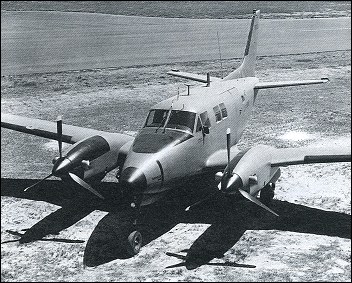
| In early 1963 Beech had started flight tests of an aircraft, then identified as the Beech Queen Air Model 65-80,
which was powered by two 373kW Pratt & Whitney Aircraft of Canada turboprop engines. Then envisaged as a further extension of the Queen Air range, the type had been developed to satisfy a US Army requirement for a staff/utility transport. The above designation was a little confusing as there were Model 65 and Model 80 Queen Airs in production, so the aircraft became known temporarily as the Model 65-90T (T standing for turboprop). In due course, an even better job was made of clarifying the situation by renaming the turboprop-powered Queen Airs as King Airs. In effect, therefore, the Model 65-90T was the prototype for the Beech Model 90 King Air series, but more specifically became the prototype of the unpressurised military Kings Airs. Following the first flight of the Model 65'-90T, a civil equivalent was produced in parallel with a pressurised cabin, and the first production prototype of this aircraft, designated Model 90 King Air, flew for the first time on 20 January 1964. These aircraft represented the beginning of the King Air series, which now represents an important area of Beech activities, and the 3,000th example of the King Air family was delivered to a customer on 17 April 1981.
US Army testing of the Model 65-90T, under the military designation NU-8F, had shown the aircraft to be suitable for the military requirement, so an initial order for 48 aircraft, under the designation U-21A, was placed. Beech distinguished its military King Airs from civil versions by identifying them as Model 65-A90-1, and began modification of the civil aircraft to provide a utility interior. This accommodates a crew of two and 10 troops, or six to eight command personnel, or three stretchers, and seating can be removed easily for the carriage of up to 1361kg of cargo.
Initial deliveries of production U-21As, which were given the name Ute, began on 16 May 1967, and subsequent contracts resulted in more than 160 being built. These included U-21As and RU-21A/RU-21D variants all with 410kW Pratt & Whitney PT6A-20 turboprops, and RU-21B/ RU-21C/RU-21E variants with 462kW PT6A-29s. The RU-21s were developed especially for operation in an electronic reconnaissance role in South-East Asia, sprouting a strange collection of aerials and sensors, and being equipped internally with related avionics' systems, plus nav/com systems suitable for all-weather operations. RU-21Bs and RU-21Cs had Beech designations Model 65-A90-2 and Model 65-A90-3 respectively, and the designation U-21G applied to 17 aircraft for the USAF that were similar to the U-21A.
Deliveries of the civil Model 90 King Air began in late 1964, this having cabin pressurisation, and accommodating a maximum of 10 persons, including the pilot. It was superseded in early 1966 by the King Air A90, which introduced the more powerful PT6A-20 engines, and one of these aircraft was supplied for military service under the designation VC-6A.
The A90 was followed by a King Air
B90 with detail improvements, and in September 1970 by the King Air C90
which introduced a more advanced pressurisation and heating system for the cabin. The C90 remains the current production version in 1982, with a total close to 1,000 having been delivered by the end of the year. One of these, designated VC-6B, also serves with the USAF's 1,254th SAM Squadron. Since its introduction, the C90 has been the subject of steady improvement, and current powerplant is the PT6A-21. Ten examples of the C90 serve with the Spanish air force and civil aviation school for instrument training and liaison.
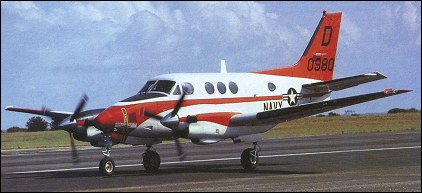
A first extension to the King Air 90 range came in the early summer of 1972 with the introduction of the King Air E90. Generally similar to its predecessor, it has more powerful PT6A-28 turbo-props, flat-rated to 410kW, and this version remains in production in 1990. In 1976 Beech was awarded a contract from the US Navy for an advanced pilot-training aircraft that combined features of the C90 and E90, designated T-44A.
The most recent model in the King Air family was the Model F90 Super King Air, of which deliveries began in mid-1979. This combined the pressurised fuselage of the Model 90, with the wings and tail unit of the Models 100 King Air and 200 Super King Air respectively. Power was provided by two PT6A-135 engines, these driving slow-turning four-bladed propellers, that gave a much quieter cabin environment. While production of the F90 ended at 231 aircraft, the C90 continues in production, 1,415 of the low-tailplane variants having been delivered by early 1989.
| MODEL | Model F90 Super King Air |
| ENGINE | 2 x Pratt & Whitney Aircraft of Canada PT6A-135 turboprops, 559kW |
| WEIGHTS |
| Take-off weight | 4966 kg | 10948 lb |
| Empty weight | 2971 kg | 6550 lb |
| DIMENSIONS |
| Wingspan | 13.99 m | 46 ft 11 in |
| Length | 12.13 m | 40 ft 10 in |
| Height | 4.8 m | 16 ft 9 in |
| Wing area | 25.98 m2 | 279.65 sq ft |
| PERFORMANCE |
| Cruise speed | 495 km/h | 308 mph |
| Ceiling | 9085 m | 29800 ft |
| Range | 2920 km | 1814 miles |
| Lee Hendley, e-mail, 22.05.2011 02:05 In late 1970, another varient of the King Air was introduced into the Vietnam conflict, with the 138th Avn. Co.(RR), at Phu-Bai, RVN. This aircraft the JU-21 Alfa, was a much more sophisticated Radio Research /Electronic Intelligence gathering platform than the previous RU-21 variants. I served with the 138th as Avionics Officer from May '70 to May '71, and knew the majority of the pilots and crew that flew these aircraft. On 03-04-1971, JU-21A, call sign Vanguard 216, and all of the crew, out of the 138th Aviation Company (RR) at Phu-Bai, RVN was shot down over North Vietnam. Lost on that mission, were: WO1 Harold Algaard, SP5 Richard Hentz, CPT Michael Marker, SP5 Rodney Osborne, and SP6 John (Tom) Strawn. May they never be forgotton, and may they rest in peace. reply | | Steve Greenlee, e-mail, 10.04.2011 05:56 I flew the Army's VC-6 (a modified A-90) while stationed at Dugway Proving Ground as the airfield commander from 1988 to 1992. This aircraft was built for Werner Von Braun for his use during his work at the White Sands Missle Range. It was retired in the early 90's and is currently on display at White Sands, NM reply | | CDR M. E. (Foots) Huston, USN , e-mail, 30.01.2011 01:34 I reported to VT31 as XO in 1977 when we had 2 T44s. I believe I am the only pilot who flew every T44. BuNo 161059 crashed the day after I flew it, brand new. It was made into a cockpit trainer. As a civilian I flew every model of the King Air except for the B100. Typed in the 350. Loved them all. reply | | Krys Dean, e-mail, 27.09.2010 20:42 I took my ATR (dated myself didn't I) in our straight 90, the FAA check pilot almost had a heart attack when I caged the engine for a single engine approach simulation. Loved that airplane. I understand it is still flying with -20 engines and the last reverser kit Beech ever made available for the 90. reply | |
| | Russ Vaughn, e-mail, 23.09.2010 03:27 I was fortunate to get checked out by the "New Equipment Test Team" in Long Than RVN in Jan-Feb 1968. I was on my checkride /night qualification the night TET started. Flew the first U=21G model from Beech (Wichita KS) to Ethiopia in 1971, later returned to Ft Rucker, AL and was the first cililian instructor to teach the U-21 Instructor Pilot course. A vwry comfortable, safe aircraft. I have approximately 2,500 hours in the U=21 and several hundred in the C-12 /BE 200. reply | | "Nick" Nicholas, e-mail, 09.09.2010 20:50 I logged 3,000+ hrs the U-21A [with a few in U-21H's with all 'RRU' gear removed] as a Dept of the Army Civilian pilot. What a sweet airplane and very capable of flying safely in prolonged icing conditions. It was an easy aircraft to be an instructor in as well. Two things that would have helped:
1) In 'High-Hot' conditions haveing -20 (or later) engines. Departing from Phoenix in the middle of the summer with any kind of load - very slow rate of climb until you got higher with cooler OAT's - and very thankful for such reliable engines.
2) Pressurization - the Army's U-21 had cargo doors - and to save weight were unpressurized. Flying over a lot of the western US I spent a lot of time with an Oxygen Mask on. As an IP I always gave at least one training XC flight above FL 180, which required 30 min. pre-breathing before T /O
My only real problem was with a main landing gear actuator problem - we got it pumped down OK, and a heater failure in cold temps in the winter.
The U-21 was a quantum leap in performance and reliability above the U-8D and U-8F. reply | | Scott Boyd, e-mail, 21.03.2010 07:07 I flew King Air 90's for Mayo Aviation in Denver back in the early 80's. They ranged from serial #12, with non-reversible props to the E-90 and various other versions and conversions. We also had A and B 90's with E-90 engines which were a pain to fly because you had to use A or B power charts for climb and cruise because the airframes were not certified to the higher speeds.
The same problem existed for piston conversions, but was even worse, turbine aircraft have no yellow line so the yellow line becomes the new red line.
The straight 90 and, I think the A had engine driven superchargers for pressurization only on the right engine, others used bled-air.
The PT-6 was a great engine, the only problems I ever heard about, but never had happen,, was not properly securing the oil dipstick. Eventually we were just told to not check it and leave it to the mechanics.
What surprised me the most when I first started flying them was how easy they were to fly in any conditions, extremely stable and a lot more agile then they looked to be. Having flown the straight 90 through the 200 the F-90 was my favorite, -135 engines and a T-tail they were fast and extremely comfortable. reply | | Jock Williams, e-mail, 16.04.2009 17:16 The King Air was the first truly "civilian" aircraft I flew professionally after retiring from the Air Force. It was also the first turbo-prop after a career of jets -and it was a pleasant surprise indeed!
Although about 350 knots slower than the planes I was more used to -it was a solid instrument platform and had excellent flight characteristics. Its system design was utilitarian and logical -and it had a great flight director /autopilot interface.
I became an instructor on the aircraft and eventually accumulate over 1000 hrs on the 3 models (BE90, BE100, and BE 200) that Transport Canada operated.
The best thing about the entire series was the magnificent PT6 engine. That was the most reliable and user friendly engine I have ever encountered -and I am sure it will be powering aircraft into the 22nd century!
Beech made no mistake when it developed the King Air! In fact -Beech has made very few mistakes...ever!
Jock Williams Yogi 13 reply |
|
Do you have any comments?
|
| 
COMPANY
PROFILE
All the World's Rotorcraft
|