|
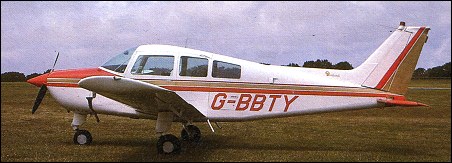
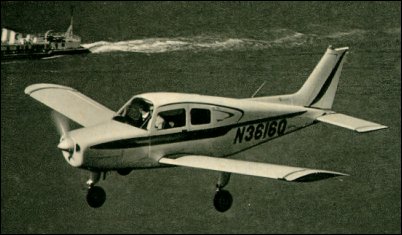
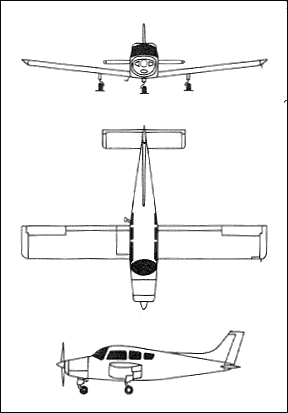
| Showing a general similarity to the earlier Bonanza/Debonairfamily, the prototype Beech Model 23 Musketeer
was fiown for the first time on 23 October 1961. Developed as a low-cost all-metal light business aircraft, it was of cantilever low-wing monoplane configuration, its fuselage providing enclosed cabin accommodation for a pilot and three passengers, and with non-retractable tricycle landing gear. Powerplant of the first production version; of which deliveries began in autumn 1962, was a 119kW Avco Lycoming O-320-D2B flat-four engine.
Early popularity of the type resulted in a range of three Musketeers being marketed from late 1965. Identified as the Musketeer Custom, the two-seat (optional four-seat) Musketeer Sport and the Musketeer Super, they differed mainly by having 134kW, 112kW and 149kW Avco Lycoming engines respectively. Optional aerobatic kits were also available for the Musketeer Custom and
Musketeer Sport when flown as two-seaters. A fourth version was introduced in late 1969: known as the Musketeer Super R, it was basically the same as the Musketeer Super but incorporated retractable tricycle landing gear.
A further change in marketing policy in 1971 was to mark the disappearance of the name Musketeer, and simultaneously production of the Musketeer Super was discontinued. The three remaining aircraft became known instead as the Sundowner C23 (formerly Custom), Sport B19 (Sport) and Sierra A24R (Super R). The designations were changed again in 1974 to indicate engine horsepower, the three types becoming respectively Sundowner 180, Sport
150 and Sierra 200. Well over 4,400 Musketeers of all types had been built when production was suspended in 1984.
In addition to ordinary civil sales, Musketeers have been delivered for civil or military training use to Algeria, the Canadian Armed Forces, Indonesia and Mexico.
| MODEL | Beech Sierra 200 |
| ENGINE | 1 x Avco Lycoming IO-360-A1B6 flat-four piston engine, 149kW |
| WEIGHTS |
| Take-off weight | 1247 kg | 2749 lb |
| Loaded weight | 772 kg | 1702 lb |
| DIMENSIONS |
| Wingspan | 9.98 m | 33 ft 9 in |
| Length | 7.85 m | 26 ft 9 in |
| Height | 2.46 m | 8 ft 1 in |
| Wing area | 13.56 m2 | 145.96 sq ft |
| PERFORMANCE |
| Max. speed | 262 km/h | 163 mph |
| Cruise speed | 213 km/h | 132 mph |
| Ceiling | 4690 m | 15400 ft |
| Range w/max.fuel | 1271 km | 790 miles |
| BP, e-mail, 06.02.2023 06:25 Have a BE-A23A, 1967 Beech Musketeer Custom III, been in the family for 51 years. It is a three generation aircraft, piloted by my Dad, my brother and myself, and my two sons. reply | | Alan Rowell, e-mail, 25.11.2017 10:55 I used to love flying the Super III version with CS prop but I believe the other versions were underpowered. Dare not bounce on landing though. reply | | Ron Cass, e-mail, 21.03.2013 21:23 I learned to fly in a Cherokee 140 I owned 1 /3 share, and flew that for several years, also flew Cessna 152 and 172 club planes, then sold my share and purchased my '63 Musketeer. I flew that for 17 years, sold it 19 years ago for more than I'd paid for it, to buy materials for the house we were building. BIG MISTAKE! I was unable to fly again until this fall, when I was able to afford to buy another plane. I again chose a '63 Musketeer since it was such a delight to fly. Fast enough and able to carry a good load for a long range. The farthest I flew in one hop was 6.5 hours, over 8oo miles, full fuel (60 Gallons) with two adults (Before I gained a little weight) and two kids (12 & 15)for a trip to Florida. The plane has so much room and can carry a lot (almost 1,000 pounds useful)and cruises 120 MPH easily. Sure, I'd like a Cherokee 6 or equal, but this is everything a low /middle income person really needs. They are truly a bargain to own. reply | | Gary Hooper, e-mail, 19.06.2012 05:00 Owned a B-24 Sierra N24PQ for a bit and flew out of Richmond...some for business trips to Boston, NY, SC...or for pleasure up to the Vineyard or down south...and over to the Eastern Shore during hunting season. Was a pleasure to fly...rock solid airplane; especially after converting to a 3 blade prop at the last TBO. reply | |
| | scottb60, e-mail, 12.06.2012 07:06 I remember having to take a retractable Mouseketeer to the Grand Canyon because the owner of the 210 I intended to take needed to use it. I cycled the gear a few times because I didn't think it was up before I realized everything was normal it was just a slug.
Nice big cabin though and they tried to make it look a lot like a Bonanza inside. reply | | Bill baker, e-mail, 11.06.2012 23:08 I owned N7994L for 20 years .after 172 's,182's and 3 210's. the mouse was a great retierment (82) years bird. reply | | KEITH GREENE, e-mail, 11.03.2011 20:43 I OWN A 1963 BEECHCRAFT MUSKETEER 23,GREAT AIRPLANE. ALSO HAVE A 1970 BEECHCRAFT A-24R, ALSO A GREAT AIRPLANE reply | | WBKnowles, e-mail, 26.11.2010 18:47 Another Beech Model for your files: I owned a Beech Mod.A23-24. Single engine,,200hp,six places,fixed gear
and prop.called "Musketeer III Super".Year of Manuf.1968.
Truly a family airplane.We had N5073T for 20 yrs. reply | | Kenny Perkins, e-mail, 17.08.2010 22:32 We used to call it the Mouseketeer since it was basically a 2 seat airplane posing as a 4 seater. I remember one HOT day when it took the better part of a 9800' runway to get airborne with 4 adults on board. NOT overpowered! reply | | zoe, e-mail, 27.10.2009 12:04 boring boring what kind of stupid thing is this? reply | | JSilver, 14.04.2009 06:13 In my HS Aviation class I got to fly out of Wiley Post airport several times in a Sundowner. Mr. Carter, my instructor, was a retired USAF pilot. A fine gentleman and an enjoyable experience, although 1 adult and 3 HS students barely fit in the cabin. reply | | BRUCE LADD, e-mail, 24.09.2007 03:38 CABIN DIMENSIONS? reply |
|
Do you have any comments?
|
| 
COMPANY
PROFILE
All the World's Rotorcraft
|