|
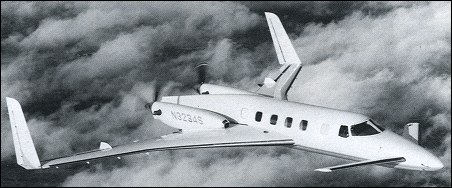
| To provide a new generation of corporate transports, Beech looked to Burt Rutan's Scaled Composites Inc. to design and produce the SCAT 1, an 85% scale technology demonstrator of a canard-configured aircraft. Success in testing led to the construction of the Model 2000 Starship 1. The Starship design has compound
taper main wings, which mount the two pusher engines. Large endplate fins, known as tipsails, provide longitudinal stability, augmented by two small fins on the wing trailing edge. Additional keel area is provided by a ventral fin under the extreme rear of the slender fuselage. The large canard foreplanes of variable-geometry, sweeping forward by 4° for low-speed flight and 30° back in the cruise. Virtually the entire structure is made of Nomex honeycomb and graphite/epoxy composites, with titanium used in high-stress areas.
The first of three flying pre-production Starship 1s flew on 15 February 1986. Another three airframes were produced for static, damage tolerance and pressure testing. Basic FAA certification followed on 14 June 1988, and the first production.machine flew on 25 April 1989.
This has been used for customer demonstration flights, resulting in 40 orders by June of that year.
FACTS AND FIGURES © The lighter weight
allowed for a larger
cabin than the King Air
which was powered by
the same engines. © The Starship's engines were
mounted in the rear to reduce
cabin noise. The main wing was
positioned aft to balance lifting
forces and mount the engines. © The Starship had two five-bladed, fully
feathering, reversible, hydraulically
controlled, constant speed, dynamically
balanced propellers. © It was believed that composite
materials might explode if struck by
lightning, so a web of metal wires
was inserted between composite
layers to act as a Faraday cage and
protect the occupants. © Partly to avoid resonance issues, the
Starship eschewed a conventional
fin and rudder for control surfaces
on 'tipsails' at the wingtips.
| MODEL | Beech 2000 Starship 1 |
| ENGINE | 2 x Pratt & Whitney Canada PT6A-67A turboprops, 895kW |
| WEIGHTS |
| Take-off weight | 6531 kg | 14398 lb |
| Loaded weight | 4484 kg | 9886 lb |
| DIMENSIONS |
| Wingspan | 16.6 m | 54 ft 6 in |
| Length | 14.05 m | 46 ft 1 in |
| Height | 3.96 m | 13 ft 0 in |
| Wing area | 26.09 m2 | 280.83 sq ft |
| PERFORMANCE |
| Cruise speed | 621 km/h | 386 mph |
| Ceiling | 12495 m | 41000 ft |
| Range | 3132 km | 1946 miles |
| lxbfYeaa, e-mail, 14.03.2024 07:01 20 reply | | hubert morokutti, e-mail, 19.03.2017 21:16 Never flown in one.
Only saw it twice, once in Toronto,Ca. and the other time at
Charlotte Regional,Fl.
Still think it was winning looking A /C not to be seen again.
FAA bias for early composite A /C helped to kill it too.
Love the look and sound and climb out on T /O. Will always look for one ! reply | | Barry, 01.11.2016 14:42 For the price of this plane you could buy Cessna Citation V or a Lear Jet 31 which could fly faster and further. Alternatively you could purchase a Piper Cheyenne which could go faster and cost you $1 million less. Just a step too far and with it the whole of Beech started to decline ending up with the setting up of "New" Beech.
Attractive design wise that it was, it was just too much and as a result was not very good value for money. reply | | Jewett, e-mail, 16.02.2015 20:42 A friend, Luther Kutcher, owned a Starship and flew me from Las Vegas to Olympia WA in it to pick up a car. It was one of the smoothest flying planes and I thought very quite! I attended Northrup Aeronautical Inst. in 1947 and bought a Fleet Biplane which you don't have in your list of US planes? reply | |
| | Doug, e-mail, 27.05.2012 21:31 There is an example at the Pima Air and Space Museum in Tucson, AZ. Sad to see such a fine plane sitting unused. Size was a problem, and many executives did not want to ride in a "backwards" airplane. reply | | dave, e-mail, 06.10.2011 06:22 If my memory serves me right, the FAA decided the Starship had to be certified in a different category. This added weight and slowed the A /C down. I always thought that was the biggest reason for it's demise. Wrong? reply | | deaftom, e-mail, 30.03.2011 05:15 An ex-Mexican-owned Starship is preserved at the Beechcraft Heritage Museum in Tullahoma, Tennessee, where I saw it early last year (2010). My understanding is that this one was spared from destruction by special request for the Museum. I was fortunate enough to be able to board it and get a quick look around. It was surprisingly cramped inside for a aircraft of its dimensions (especially compared to a King Air also in the Museum), but its cockpit certainly looked futuristic enough, if a bit snug. reply | | Randall S. Whitehouse, e-mail, 13.03.2011 10:54 This aircraft was an absolute pleasure to fly. The aircraft's exterior design was attractive and functional in all phases of flight. Each location we would land at produced an array of curious aviator's and non-pilots. Everyone wanted to have their picture taken with the Starship in the background. For quite some time it was the rockstar of aviation. I sincerely wish that Beech would have continued with the design improvements as it could have been the springboard of an entirely new aviation concept. I believe that one major detriment to it's sales demise was the premature performance numbers which proved to be slightly ambitious although initally touted as conservative. The Starship was a Cinderella that was never found by it's Prince Charming! reply | | Greg Dixson, e-mail, 04.03.2011 11:35 Worked at the University of Washington wind tunnel while going to school there in 1986 and 1987. Low speed tests on a model of the Starship were done there. Don't remember which year, but I'm guessing it was '86. In addition to collecting balance data on the models we sometimes ran tests with "china clay" or tufts of string or fishing line to look at air flow over the wings with various configurations. Photos were taken of the clay after a run while the tufts were photographed in various configurations at differnt speeds and angles of attack to look where flow over the wing was separating instead of flowing smoothly to generate lift. Where airflow was continuing to flow smoothly over the surface the tufts pointed straight back while they were vibrating where the air was separating from the airfoil. It's been a while but I think the fishing line was used on the Starship. With the fishing line we used UV light and blacked out the the test section. reply | | Mark Ryalls, e-mail, 29.12.2010 17:32 I flew this aircraft once. Very stable, extremely loud in the back. I was told that it was a bear to land until you got used to it, but I made one of the slickest landings in it. Had a 6 other pilots on board. Another pilot made a landing and bombed it on so hard you could see the wings flex. Everybody gave him grief. reply | | Lance Bottari, e-mail, 07.12.2010 07:46 Beech left this absolutely stunning aircraft in the wind to die. economically it made sense to them but it is an aircraft that at least one person loved enough to get hold of spare to canbalize for parts to keep his one bird flying. An airplane has to be really good to do that. Beech should reconsider and put it back in production at some future date. reply | | Harold Moritz, e-mail, 04.12.2010 04:43 Raytheon is trying to buy the starships back to eliminate the product liability for a fleet that it can no longer support. I think I'm correct that one individual owns all four remaining starships flies one and has the other three for spare parts. reply | | Brian McDonagh, e-mail, 14.11.2010 20:06 What a magnificent machine. Is there one for sale? I'd like to buy one. reply | | Rick Davis, e-mail, 08.11.2010 03:00 IK flew this airplane several times on deadhead legs during demontration trips. Absolutely the most stable, easiest-to-fly aircraft ever built by Beech. If you've ever flown any King Air, you know that's saying a LOT... reply | |
| | Scott Boyd, e-mail, 02.11.2010 23:16 Scaled still uses one of the prototypes as a chase plane. reply | | Harold Walter, 30.09.2010 20:06 The Starship has excellent handling characteristics. It can be flown in rough air with surprisingly little deviation from course or attitude. It is the first composite airplane certified by the FAA in the US. reply | | des, e-mail, 21.09.2010 00:52 Lot of interesting things at that location when searched on Google Maps...
- the line of starships
- the boneyard at the other end of the airport
- a street close to the airport name "Wong Way" reply | | jp, e-mail, 22.06.2010 18:09 Didnt know Ferrari is into aircrafts reply | | Lynn McFadden, e-mail, 20.08.2010 05:23 It is my understanding that someone bought up quite a few of these aircraft. they are sitting at a small airport, Marana regional airport, Arizona. I did a google earth a few min ago and saw 6 lined up on a runway, may be more inside. I understand they are rebuilding to new owners specs. great coffee shop there as well.
cheers.
Lynn reply | | L, e-mail, 20.08.2010 05:57 This data will put you right on a ship.
32°24'27.97"N 111°12'39.31"W
Lynn reply |
|
Do you have any comments?
|
| 
COMPANY
PROFILE
All the World's Rotorcraft
|