|
| Walter Beech together with his wife Olive established the Beech Aircraft Corporation during 1932. In late 1950 Walter Beech died but now, just on 50 years after the company's formation, Mrs. Olive Beech remains in office as chairman of the board of the success story that has built some 45,000 aircraft.
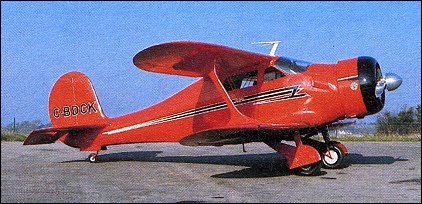
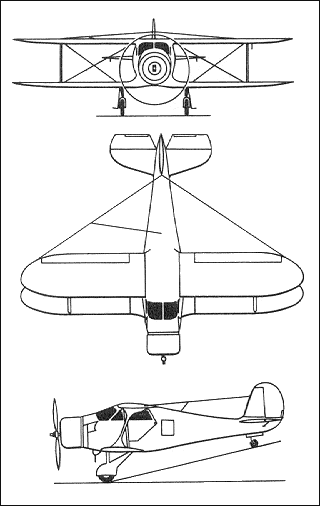
A key to that success was the Beech Model 17, but the high performance of the initial Model 17R, of which only two examples were built, meant that it was very much an experienced pilot's aeroplane, and unsuitable for the far wider market that was sought. First flown during November 1932, an exciting event witnessed by the company's staff of eight employees, the Model 17R was able to demonstrate a remarkable speed range of 97-322km/h. The most conspicuous feature of its configuration was the backward stagger of its biplane wings. Such an arrangement had
been selected to provide the pilot with a good field of view, to help structural integration, and because wind tunnel tests had shown that this particular layout offered a good combination of speed and stability. Basic structure was of .welded steel tube, largely fabric-covered; the braced tail unit was conventional; but the narrow-track tailwheel landing gear, with a non-swivelling tail-wheel, had an unusual feature. The main units were enclosed within large streamline fairings, but the wheels could be retracted some 0.15m (6in) in flight so that they were completely within the fairings. Enclosed cabin accommodation was provided for a pilot and three or four passengers, and the 313kW Wright R-975-E2 radial engine was mounted within an unusual tunnel-type cowling.
The excellent performance of the 'Staggerwing', as the type became popularly known, meant that the company's efforts were concentrated upon making it easier to handle, especially on the ground, which led to a number of improvements, including wider-track main units. However, the real turning point to wider market acceptance came with the Model B17L, first flown in late February 1934. This introduced a new lower wing of deeper aerofoil section, allowing sufficient room for the main landing gear units to retract fully into it. This, coupled with a 168kW Jacobs L-4 radial engine, gave much more docile handling characteristics, while retaining a speed range of 72-282km/h. With just a little more power, provided by the 213kW Jacobs L-5, the Model 17 became the marketable commodity that was eventually to establish Beech as a
major aircraft manufacturer.
From that time a wide variety of Stag-gerwings were built for both civil and military use, being steadily improved, and incorporating over the years a number of different engines. The civil versions included Model B17, C17, D17, E17 and F17 variants before World War II, which were followed in the early postwar years by a much-improved Model G17S, of which only 20 were built to special order. Although the last of these was completed in 1949, it seems highly possible that at least some examples of Walter Beech's remarkable Staggerwing will still be in use at the end of this century.
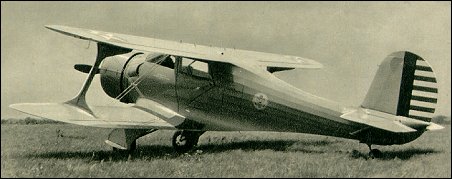
When in 1939 the US Army Air Corps needed a small communications aircraft, the excellent performance of the Model 17 resulted in the procurement of three Model D17s for evaluation under the designation YC-43. However, it was not until expansion of the USAAF began during 1941-2 that an initial production order for 27 was received, this leading to a total procurement of 207 Beech 17s under the designation UC-43, these being powered by the 336kW Pratt & Whitney R-985-AN-1 engine. After the United States became involved in World War II, an additional 118 civil Model 17s were impressed for military service, and comprising D17R, D17S, F17D, E17B, C17R, D17A, C17B, B17R, C17L, and D17W variants under the respective designations of UC-43A, UC-43B, UC-43C, UC-43D, UC-43E, UC-43F, UC-43G, UC-43H, UC-43J and UC-43K
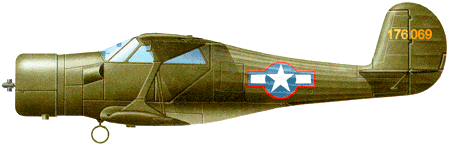
The US Navy had acquired a single example of the Staggerwing as early as 1939. This was a civil C17R which became designated JB-1. The designation GB-1 applied to 10 more, equivalent to the civil D17, acquired in 1939 and, later, to eight civil D17s impressed for military service. Wartime procurement totalled 342 GB-2s, of which 105 were supplied to the UK under Lend-Lease, used primarily by the Royal Navy which named them Traveller, a name adopted also by the US Navy.
| MODEL | Model G17S |
| ENGINE | 1 x Pratt & Whitney R-985-AN-4 Wasp Junior radial piston engine, 336kW |
| WEIGHTS |
| Take-off weight | 1928 kg | 4251 lb |
| Empty weight | 1270 kg | 2800 lb |
| DIMENSIONS |
| Wingspan | 9.75 m | 32 ft 0 in |
| Length | 8.15 m | 27 ft 9 in |
| Height | 2.44 m | 8 ft 0 in |
| Wing area | 27.65 m2 | 297.62 sq ft |
| PERFORMANCE |
| Max. speed | 341 km/h | 212 mph |
| Cruise speed | 298 km/h | 185 mph |
| Range | 1609 km | 1000 miles |
| Harvey Bryan, e-mail, 04.07.2015 19:05 I am 81 and have always loved the Staggerwing. A friend of mine in Pine Bluff, Ar had one and I rode in it a couple of times.Problem with it, landing gear wouldn't retract, FBO couldn't fix it, so he didn't keep it very long. reply | | Tracey, e-mail, 22.09.2014 12:25 Have just read this blog and note with interest 'wigida' comments.
We are blessed to own this aircraft - C17B - Australia's First "Beech".
After a 7 year restoration, we have turned back the hands of
time on this remarkable aircraft.
She is currently based in New Zealand not at Redcliffe Qld. reply | | Granger Haugh, e-mail, 16.06.2014 23:13 I am rebuilding a GB2 to 1944 specifications, that served in the British Navy in WW2. Is there an authentic 1944 in a museum somewhere? Ant help will be appreciated. reply | | Pete deGroff, e-mail, 05.05.2012 00:27 I was raised to believe the Staggerwing was the greatest plane ever built by my father. He was trying to buy one in 1961. He didn't even have an active pilot's license at that time, but that wasn't going to stop him. Fortunately he had plenty of taildragger experience, having soloed in a Lambert monocoupe, and was a C47 and Waco CG4 pilot in WWII. I remember sitting in the backseat of a D model he was interested in at the Coatesville, Pa airport in 61'. I was 13 then. I can still remember the smell of those leather seats. He almost bought a G17 model from one of the Duponts down in Newcastle,Delaware for $7500. And it was in airworthy condition! I can still remember my mother throwing pots and pans around the kitchen when she found out.
The old man never did get his staggerwing, but we saw quite a few in airshows and fly-ins we attended in the 70's and 80's. He's been gone for a quarter century, but whenever I think about him, there's always a Staggerwing silhouette drifting across my mind's eye. reply | |
| | wigida, e-mail, 25.03.2011 07:33 A superbly maintained example of this aircraft in perfect flying condition is hangared at Redcliffe airdrome in Queensland Australia. reply | | E. L. Mitchell, e-mail, 03.12.2010 03:34 The thing I remember most about this fabulous aircraft was the control column. The pedestal was in the center and the yoke could be switched over from the left seat to the right seat. There was a visible bicycle chain from the yoke to the pedestal. Only plane I've ever seen that had this arrangement. reply | | Ray Winn, e-mail, 07.11.2010 20:22 I lived in Las Vegas stareting in 1940. Riding my bicycle to the construction site of the Flamingo Hotel almost every day. Bugsy Segal flew in twice in a Staggerwing. I thought I had gone to heaven when his pilot took me up (age 12)for a ride for a test after a minor repair. I thought then, anad still do, think it is a toss up between the P-51 and the Stagger as the most beautiful airplanes ever built. It inspired me to become a pilot, but after flying from 1956 and stacking up almost 11,000 hours in four Bonanzas and P-Navajos, at age 76, and falling below the 'magic' number of 200 hours per year, I let others do my flying. reply | | Dwayne Burgess, e-mail, 05.11.2010 03:28 I my Uncle, Walter, owned and flew a Staggerwing Beech for many years out of Ely Nevada and Buhl Idaho. It was then and will always remain one of my favorites. What a marvelous air plane. reply | | Bob Yount, e-mail, 28.09.2010 16:21 There is a Beech Musaum in Tullahoma Tenn. which has an uncovered D18 which gives an idea of the manhours required to built it. Also, there is an early version which has a double rudder, joined at the leadibng edge but with about an 8 in. spread at the trailing edge. My guess is that this was to ensure a seelf centering rudder, but no subsequent planes were made with this configuration.
No doubt that the Stagerwing was one of the most beautiful planes made at the time, but the Spartan Executive out performed the D18. reply | | Paul Harrington, e-mail, 22.02.2010 07:37 When I took basic flight training in 1943 at Hartley Field in Denton, TX, the Civilian owner of the field, Mr Hart had anegative stagger Beech. What a beautiful plane that was. Mr. Hart had been a test pilot for Beech before the war. I visited the field about ten years ago with my son and there sat the Beech inone of the hangers. They had just made a movie there about a women's cross country race. Just changed the name on the hanger for different airports in the movie. reply | | Carl Felty, e-mail, 01.02.2010 19:15 At Deer Valley Apt. in the '60's, a mechanic propped a Stagger wing with the throttle wide open. It broke loose from it's chains and chewed the entire rear end, from the trailing edge of the wing back, off of a Cessna 172 tied in front of it. In the coffee shop, I overheard one fellow telling another, that he always wanted a Stagger Wing, but couldn't afford to feed it Cessnas. The Beech did not appear to have any damage from the incident. The C172 was a total loss. reply | | Vince Williams, e-mail, 17.01.2010 04:12 In 1943 our skipper at NAS Hilo obtained a GB2,even though he ws grounded he got this plane,I flew to Pearl frequently with our operations officer.one day the skipper was landing gear up,I ran to the edge of the runway & waved him off,loved that plane. reply | | Irving Louis Hasler, Jr, e-mail, 14.12.2009 21:41 I am 76 years old and as a child I had a Uncle, Joe Lanctot, who was a small plane pilot AND a parachute jumper. He flew out of a very, very, small grass "airport" near what was then Stevens, South Dakota just across the Big Sioux River that is the border between Iowa and South Dakota. Anyway, the name of that old airport was Rickenbacker Field (named after the famous Eddie Rickenbacker)It was at that field in about 1949 or so when those Staggerwing Beechcraft landed and my Uncle and I got to see it...I fell in love with the Beauty of that ship and to this day am in awe of what a beautiful plane that is. Unfortuately my Uncle never got to fly that plane since he did not know the pilot who had flown it in, that was a shame becuase he always took me with him flying so I missed the chance to fly in that Beauty. I "guess" that was a G175..since according to your data that was when the last of them were made. reply | | John Poucher, e-mail, 02.07.2008 04:18 A friend of my father owned one and as a child I thought it was the most beautiful plane ever made--and still do. The owner was a medium bomber pilot in WWII in the Pacific and was lost in combat. His plane was found in New Guinea around 1986. reply | |
| | Bob Watkins, e-mail, 25.05.2008 21:31 This aircraft can be the very best, or, the worst airplane out there depending on the condition of the airplane. reply |
|
Do you have any comments?
|
| 
COMPANY
PROFILE
All the World's Rotorcraft
|