|
| On 17 May, 1946, Bell Aircraft announced that 'experimentation with the use of sweptback wings in an effort to reach the ultimate goal of man-carrying flight beyond the speeds of sound has passed from the high-speed wind-tunnel stage to the use of full-scale aircraft'.
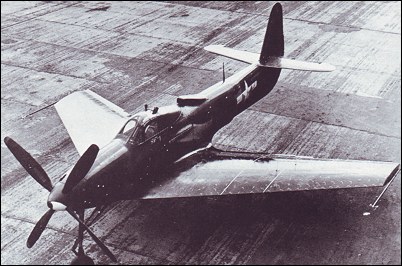
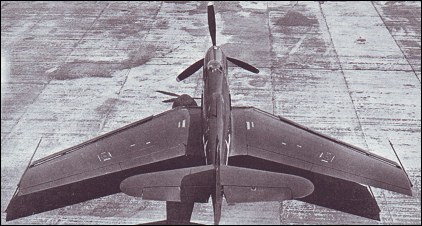
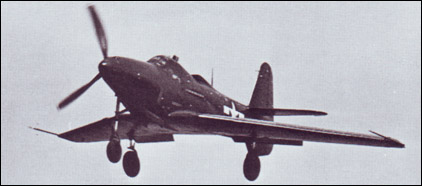
This announcement marked the first stage development of the US Navy research swept-back wing experimental programme. To do so, two P-63 airframes were diverted for modification: one was an XP-63N with 379 hours of flight time and received the model designation L-39-1; the other was a P-63A-9-BE and received the model designation L-39-2. The main modification consisted of mounting P-63E-like outer wing panels with 35 degrees sweep-back. The main undercarriage was not retractable but the nose wheel was still retractable. To modify the centre of gravity position, ballast was installed in the rear fuselage. But it was later discovered that this ballast was insufficient and it was decided to change the four-blade propeller for a lighter three-blade one (from a P-39Q). After further tests, the fuselage was lengthened by four feet, a large ventral fin was added and wing slots installed in the wing leading-edges.
The maiden flight of the L-39-1 was made on 23 April, 1946, at Niagara Falls Airport with A M 'Tex' Johnston, Bell test pilot, at the controls. After several other test flights, the aircraft was ferried to NACA Langley Research Center on 22 August, 1946, by L W Grey. Meanwhile the L-39-2 had been flown by Johnston. This aeroplane was equipped with an automatic fuel equalizer designed to maintain a constant position of centre of gravity during flight. Both aircraft were used to correlate previous wind-tunnel experiments and were also used for various other experiments. For example, in August 1946, L-39-2 was fitted with a circular arc aerofoil developed for the future Grumman XS-2F Tracker.
All tests were halted on 26 August, 1946, and the entire programme was withdrawn. L-39-2 was sent to Langley on 11 December, 1946, and both aircraft were transferred to NACA Lewis Research Center in Cleveland, Ohio, on 12 December, 1949. The two airframes were eventually sold as scrap in 1955.
Alain J Pelletier "Bell Aircraft since 1935", 1992
| DIMENSIONS |
| Wingspan | 10.21 m | 34 ft 6 in |
| Length | 11.18 m | 37 ft 8 in |
| Height | 3.83 m | 13 ft 7 in |
| Wing area | 23.22 m2 | 249.94 sq ft |
| C Mac Kay, e-mail, 21.05.2021 17:49 You can actually see the two different aircraft on the page. The top picture has no stubs from the fuselage whereas the bottom two pictures have. The 35 degree sweep was a direct copy of the ME262 and incorperated in the F-86 including the leading edge slats. Seemingly the Blee L-39 was a good aeroplane to fly. reply | | Ted Smith, e-mail, 16.12.2014 00:48 Finally found a colour photo of the L-39-1. Navy Blue! I can supply a copy if anyone is interested. reply | | Ted Smith, e-mail, 23.02.2013 13:14 The L-39-2 was modfied to test the wing for the Bell X2, not a tracker! I am told that the -2 was blue all over. reply | | Jack Williams, e-mail, 05.02.2012 03:53 I have often wondered what the P-63 would have done in combat if it had received the turbo compound Allison V 1710 of 3,000+ horsepower. Now imagine the P-63 with the turbo compound Allison V 1710 and swept wings. By the way does anyone know how Bell planned to route the turbo compound exhaust? I've never been able to find any information on how the P-63 was supposed to look with the designed engine. reply | |
| | bombardier, e-mail, 24.05.2011 10:39 An enlarged derivative powered by a jet would have been a very effective fighter reply | | Andy Lolk, e-mail, 26.06.2010 12:16 I unfortunately don't think you'll find many colour pictures from that time..
Your logic seems to be right though.. Either navy blue or dark green to make it dark in the night.
Best regards,
Andy reply | | Ron, e-mail, 24.02.2010 01:42 Imagine something like the XLR-11 rocket from the X-1 in the tail of the L-39 ala Soviet La-7! This would both balance the c /g of the swept wing and augment speed (a weakness of the P-63) at the same time. What a thought - Bell would have fighters on both sides of the Korean war if that happened. Wow! reply | | Ron, e-mail, 11.02.2010 08:06 What if Bell wasn't abandoned here in favor of the promise of the P-47? The Russians liked the P-39 better than the P-47. What if the Continental inverted V-12 was developed into a winner outside the caprice of the official constraints on altitude...etc, may in combination with the turbo jet of the P-59? What if all of Bell's test fighters like this L-39 were combined into one fighter?
Who else had the Bells to do the unconventional?
Once a clear canopy was installed the old doors should have bid farewell. Rear view was restricted a bit by the dorsal air scoop - move it to the side under where the door was and it doubles as a handy step to get into the sliding cockpit. Let your imagination go and the Bell Cobra would have a fighting chance to obtain it's designer's dream as a fast climbing high altitude interceptor with a KO punch, instead of the legacy of an underpowered dog in it's own homeland and sent packing to Siberia. Think of it's dogfighting potential with a mid-engine design. The Soviets saw this and stripped the wing guns for agility and climb rate. After some wear, the slow U.S. guns were tossed for more efficient Russian guns for ballistic harmony and more than triple the dense pattern of fire for 3 nose guns (40+ r /s in place of 12 r /s), 2xUBS 12.7mm and a 20mm replacing 2xM2 Browning 12.7mm and a low velocity Olds M4 37mm cannon that jammed.
This was not so much for ground support as for air to air daring do. Thus the high kill ratio against the Luftwaffe for the P-39 with Soviet pilots. Despite it's flaws it certainly had potential! reply | | Ted Smith, e-mail, 12.07.2009 13:40 What colour was it? Logic suggests Pacific Blue as it was a Navy Project but there is a desktop model which is orange. Anyone remember or have a colour photo? reply | | Dr. William Guoan, e-mail, 25.01.2009 04:51 I would like to know more about the wing design and how it was mated to the fuselage of the P-63! reply |
|
Do you have any comments?
|
| 
COMPANY
PROFILE
All the World's Rotorcraft
|