|
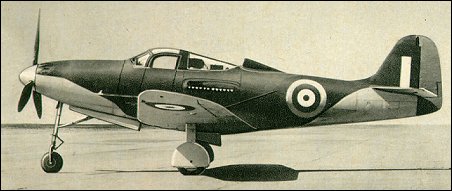
| In 1938 Bell Aircraft produced the Airacobra single-seat fighter featuring a tricycle landing gear, a single Allison engine located behind and below the pilot and driving the propeller by means of an extension shaft, and a cannon firing through the hollow propeller shaft (in addition to fuselage-mounted machine-guns). Advantages of this layout were said to include superior vision and concentration of firepower in the nose. The first production aircraft (originally ordered by the French government) were delivered to the RAF and became operational in October 1941. In British service the Airacobra I/IA was used for a short time for ground attack duties. It was not well received and production aircraft completed for Britain, but undelivered, were taken on by the USAAF as trainers. New production began with 20 P-39G for the USAAF. P-39D (V-1710-35), F (-35), J(-35), K(V-1710-63; E6), L(-63), M(V-1710-83), N(V-1710-85; E19) and Q versions were eventually built, bringing the total number of Airacobras completed to 9,558. More than half the total production went to Russia to act as interim fighters with the air force pending delivery of large numbers of MiGs and Yaks.
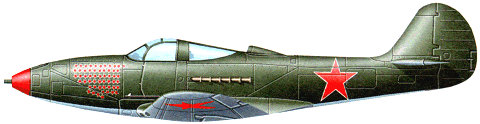
| CREW | 1 |
| ENGINE | 1 x Allison V-1710-85, 880kW |
| WEIGHTS |
| Take-off weight | 3765 kg | 8300 lb |
| Empty weight | 2560 kg | 5644 lb |
| DIMENSIONS |
| Wingspan | 10.4 m | 34 ft 1 in |
| Length | 9.2 m | 30 ft 2 in |
| Height | 3.8 m | 12 ft 6 in |
| Wing area | 19.8 m2 | 213.13 sq ft |
| PERFORMANCE |
| Max. speed | 620 km/h | 385 mph |
| Ceiling | 10670 m | 35000 ft |
| Range | 1200 km | 746 miles |
| ARMAMENT | 1 x 37mm machine-guns, 4 x 12.7mm machine-guns, 1 x 226kg bomb |
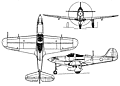 | A three-view drawing (1650 x 1183) |
| Anonymous, 04.06.2022 01:17 "In British service the Airacobra I /IA was used for a short time for ground attack duties. It was not well received and production aircraft completed for Britain, but undelivered, were taken on by the USAAF as trainers." Actually, they were shipped to the South Pacific and used as operational fighters by the USAAF under the designation "P-400". Apparently, they were not very well-liked. American USAAF fighter pilots quipped that "a P-400 was a P-39 with a Zero on its' tail". reply | | ron, e-mail, 12.11.2017 02:24 The 37mm M4 cannon could be recharged once in flight if it jammed. Russian pilots say this was enough. They did not think it was unreliable if properly maintained.
They found the western lubrication for the P-400 Cobra and it's 20mm M2 cannon would freeze too easily. reply |
| ron, e-mail, 14.10.2017 10:18 The P-400 was originally RAF so these Cobras had the Hispano 20mm instead of the M4 37mm.
I would consider the Hispano Mk V to be a contemporary to the B-20. Not as light but more so than the former Hispanos.
It was between them and the B-20 in RoF. It had the heavy hitting shell that the B-20 lacked. The P-63 should've taken a cue from the P-400 and offered a 20mm option with this RAF Hispano in place of the 37mm cannon. I don't believe the VVS would want to replace it like they did the M2 Hispano cannon of the P-400. It may have given the USAAC pause as well. The ballistics would certainly be more harmonized. Why let the Tempest be the only beneficiary of this refined Hispano cannon that worked so well, when they could have the Kingcobra packing it in US colors?
Now back to the VVS. The 20mm Russian shells were too light for many pilots. As for the 23mm cannons, the VYa-23 jammed. The later NS-23 had pedestrian M /V.
In fact, the Hispano Mk V may have been the best WW2 20mm cannon. The Type 99-II Mk 5 was it's near equal, but only a handful of J2M5b interceptors had it for sure.
The powerful MG 151 /20 is close but aside from the mineshells, it was like the ShVAK or Ho-5 in modest punch.
The cannon wing-boots on the Bf 109 had mineshells among the ammo belt shell composition, but not every MG 151 /20 cannon had them.
The Ho-5 was fastest but downloaded to 600m range in 1945 for lack of rare metals.
The RAF Hispano Mk II was too heavy and slow in this crowd.
The US Hispano was also, and jammed too much besides. That goes for all US WW2 models, M1, M2, M3.
This leaves the RAF Mk V smelling sweet.
If anything could tip the balance for Bell in US service, it would be this cannon. A second chance for a reborn P-400.
The Mk V was the best WW2 Hispano. It had no faults. reply | | ron, e-mail, 13.10.2017 05:03 The 97kg M4 jams and has short 460m range.
The 29kg Browning M2 12.7mm is the slowest cowl gun.
The P-39 is prone to spin when nose-ammo is spent.
Nose-guns weigh 155kg.
With the 43-51kg 20mm Hispano M1 jams too but range was 900-1500m. 101-109kg total weight for the P-400 nose-guns.
The 21.5kg UBS is the fastest cowl-gun
+the 25kg B-20.
Nose-guns replacements weigh only 68kg total!
They don't jam and range is good but the B-20 shell is lighter than the that of the Hispano.
But the 12.7mm UBS shell is heavier than the that of the Browning 0.50 Cal.
How to improve the spin tendency with the ammo load spent?
You could say the weight difference between full ammo and empty was a problem for the trim.
My opinion is the 37mm P-39 had the heaviest ammo loadout
and the B-20 cannon, the least.
The 178kg NS-37 had 735g shells so spin may not be helped enough.
The 23mm would be between them with the Hispano. The NS-23 is my fantasy choice, since many pilots felt the 20mm Russian shells were not heavy enough vs the Hispano, MG /FF, Ho-3 or Type 99. The 68kg 23mm VYa cannon jammed at times.
Since the B-20 was the 20mm ShVAK replacement, my choice is the more reliable 37kg NS-23 replacement for the VYa-23.
In the case of the P-63, I would look for more than 1x23 and 2x12.7mm guns. 3x23mm cannons! Three NS-23 cannons total 111kg. The twins in the cowl could be moved to the sides of the cockpit to put their ammo a bit behind the cg to offset the hub-cannon ammo. Longer barrels would only help firing range which was only about 750m (the VYa-23 range was double that). But this is all just academic hindsight. Interesting nonetheless. reply | |
| | ron, e-mail, 13.10.2017 01:24 "When the original US-built armament became unserviceable, it was replaced by the Soviet 20-mm B-20 cannon and the 12.7mm Berezin UBS machine guns."
- Baugher's site on P-39s.
From the slowest 12.7mm gun in WW2 to one of the fastest.
From the heaviest 20mm cannon (P-400) to the lightest; 25kg!
The USAAFC should've acquired some reliable B-20 cannons and copied them to install in all our planes. The Browning M2 0.50 Cal (12.7mm) weighed more!
The Cobra must've been more effective with the Russian guns. Perhaps that was part of the Cobra's success in Russia.
The sightings of P-63s in combat against the Luftwaffe have no Russian recorded evidence, officially. Only in personal diaries of Soviet aces. Shhh!
Anyway, If I were such an ace, I would pack my 'P-39' with a trio of B-20s in the nose. Maybe even NS-23s! They only weigh 37kg but hit with a 175g shell at the same rate as a 20mm M2 Hispano cannon: 600 r /m!
The US 37mm M4 and M10 were not much more reliable than the US Hispano. reply | | ron, e-mail, 22.07.2017 04:27 The P-400 Cobra reportedly had the RAF 20mm Mk 1 Hispano cannon, so it was more reliable than the 20mm US Hispano cannon in the P-38 Lightning. reply | | raoul, e-mail, 31.08.2016 22:02 RE: P-39 in air races.
In one of my books, there is a P-39 painted up with race numbers and sponsor signs. So, at least one was used in an air race. There was no information about its success (or lack thereof). Since it was postwar and undoubtedly a war vet, it might have been picked up for cheap, stripped down of anything that was not essential for flying (Guns, armor, etc.) and then raced.
Surprising how many "worst airplane of all time" books contain entries for the 39 and 63. Far from being the worst and pretty darn good in the application where it was used. Not the use it was designed for but there are a lot of Russian pilots who were glad to have it. reply |
| ron, e-mail, 17.02.2016 00:53 460m was the firing range of the 37mm M4 reply | | Klaatu83, e-mail, 26.03.2015 04:58 The original XP-39 prototype had a turbo-supercharger and exceeded 400 mph, but the Army Air Corps insisted that the supercharger be deleted from the production version. At the same time the AAC also specified additional armament and armor, which increased weight. As a result, the production versions never performed as well as the prototype. reply | | mark, e-mail, 19.02.2015 21:54 George Mellinger and John Stanaway, several pilots stated that the main reason to the mediocre performance on Pacific was the engine and that with decent supercharger to provide decent altitude performance, it would have been better than Mitsubishi A6M Reisen, Zero. The aeroplane itself was a sound construction except the alleged tendency to flat spin, which all pilots did not subscribe their experience referring more to slow controllable oscillation. The mediocre supercharger stemmed from doctrine that there was no real need for high altitude performance over US continent due to lack of potentially capable bombers. reply | | Klaatu83, e-mail, 14.11.2014 06:18 "Wasn't the nick name "pinball"?"
The nickname "pinball" was applied to certain P-63s that were specially equipped to serve as gunnery targets for use in training air gunners. The gunners shot at the P-63s with special frangible ammo, and the P-63s were equipped with additional armor protection and special set of lights that were designed to light up whenever a hit was registered. reply | | Ron, e-mail, 19.09.2014 05:09 If anyone still falls for the myth that the Russians used the P-39 for tank-busting primarily, just remember the words of the top P-39 pilot, Pokryshkin.
His Russian T-34 tank buddies asked him to bust the Nazi tanks, he replied that his P-39s can't penetrate tank armor.
Their Olds M4 37mm hub cannon has only a muzzle velocity of 600 mps vs 900 mps for the Soviet NS-37 in the Yak-9T fighter, wth a throw-weight of 141 gps vs 306 gps.
P-39s were used for air superiority by Russia, primarily. The Yak-9K was for tank-busting with it's 45mm cannon (unfortunately the recoil caused engine leaks in the Yak so it didn't just hurt the Panzers).
That's why the elite Red Guards flew Cobras against the Luftwaffe (P-63s too but thats off the official record).
The Cobra's M4 37mm was very effective against Nazi bombers as well as fighters.
Don't tell anybody about the P-63s used on the Eastern front. On paper they were still officially 'P-39s' (to abide by lend-lease rules to be used against Japan only). But the German pilots that were shot down by King Cobras knew the difference between P-39s and P-63s!
That P-63s didn't fight Germany is another myth but we won't tell. If you were a Russian ace, could you be blamed if you covertly arranged to fly a new P-63 instead of a left over P-39 when you're fighting for your life against the latest from Kurt Tank and Messerschmitt! As long as it was recorded as a 'P-39' on the official flight log. Otherwise thousands of P-63s are just sitting on the tarmac collecting dust waiting till the last Russian offensive against Japan in the of summer, 1945. reply | | Ron, e-mail, 19.08.2014 01:26 Russian pilots thought the P-39 was better around 15,000' using climb and dive, while the P-40 was better lower using horizontal tactics. The spin recovery for the Cobra was dicey. reply | | Ron, e-mail, 07.07.2014 21:27 The RoF for the Browning 0.30 Cal of 1200 was actually more like a dissappointing 840 rpm. However, the synchronized rate was about 730 rpm. Bench tests don't have the idiosyncracies of drive or priming and propeller variations.
Constant speed propellers, and prop drive help as does electric firing if reliable of course.
So, the P-39 had another reason to lose the disappointing '1200 rpm' light wing guns. Only the Zero would be affected by them after mid-war.
The data published can be less than reliable which doesn't help research much. reply | |
| | Ron, e-mail, 06.07.2014 05:16 The dicrepency between the P-39's .50 Cal. Browning ROF nose gun and others US fighters synchronized ROF was in the P-39's reduction gear driven design unlike the prop drive sync design. The F2A even had electric firing of the synchronized MGs like the Luftwaffe but slower. That's why the 300 rpm for the P-39 is worse than about 37% reduction for the synchronized Browning .50 typically (Brittish bench tests). Curiously the Browning .30 Cal. had only a 13% reduction which is closer to non-Browning sync. ROF.
The P-39 was unfortunately the slowest at only 5 rps each gun in the cowl. Others got perhaps 425 rpm for the Browning .50 Cal. cowl gun. Even better for the Buffalo. reply |
| Richard, e-mail, 26.12.2013 22:22 Wasn't the nick name "pinball"? My dad flew the 39 and 63 to the Russians. All the pilots that picked them up where women, with Vodka. He and 17 other men associated with the program were flown to Magadan from Anchorage to celebrate the 60th anniversary of the war ending. He loved both of the planes. He had a lot of photos of the Bell's sitting on the line waiting for delivery with the Red Star's. He told me a story of someone writing TEXACO on one of the stars and what a mess that turned out to be. The Ruskies didn't find it funny. reply | | Richard Kennedy, e-mail, 04.12.2013 17:14 Not a comment but a question, "Was the P-39 ever used as a Racer in speed flying? reply |
| neil rose, e-mail, 09.04.2013 03:44 I am currently planning on rebuilding a P39Q....am long in the tooth but think I can make it. Last airplanes I rebuilt
were a Pv2 and a Hawker Hurricne...yup I flew both of them..If someone were to give me a derlict Hurricene I would run the other way.. actually I still have the data plate and paper work for one... but it will never be rebuilt by me...Figure the Cobra will be a picen of cake.. Any one with parts pices etc.would like to hear from you. Had an aquaintence who flew cobras...one day I asked him "in all the wrecks you witnessed which way did the engine go ...Just as Bell convinced us it always went out the side" "the biggest worry was the driveline coming loose and beating our balls... So said Capt Bob Darling USAAC reply | | Klaatu83, e-mail, 16.09.2012 17:19 "production aircraft completed for Britain, but undelivered, were taken on by the USAAF as trainers."
In fact, the USAAF used these aircraft operationally in New Guinea, where the type was known as the "P-400".
These aircraft were not well received by the RAF because the export versions lacked supercharged engines for good high-altitude performance, the unfamiliar car-type doors, the mixed-caliber armament, and the fact that the tricycle landing gear did not lend itself well operation from the RAF's grass airstrips. reply | | Chris, e-mail, 17.07.2012 22:14 The P-39 "Whistlin Britches " was flown by my great uncle Lt. Zed Fountain. The aircraft is currently in the Kalamazoo Air Zoo in Michigan. It was named after an old man who use to walk up and down his street whistling all the time. reply |
|
Do you have any comments?
|
| 
COMPANY
PROFILE
All the World's Rotorcraft
|

 Ron
Ron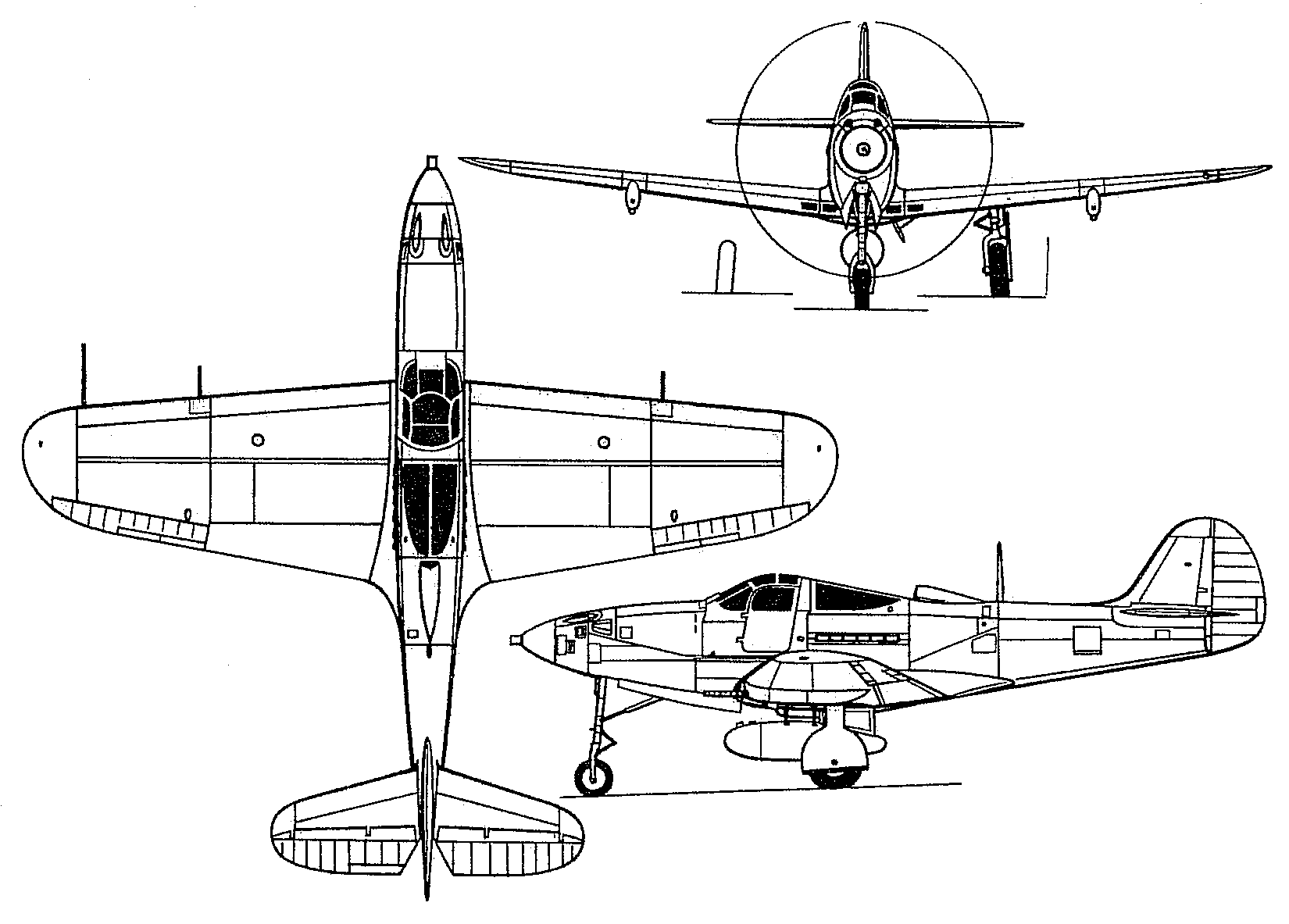


with the P-39L, the M4 37 mm cannon was relatively reliable.
reply