|
| At a fairly early stage in the development of the Bell P-39 Airacobra, work had been carried out to enhance the performance of this aircraft by the introduction of aerodynamic improvements. Three experimental aircraft were built, each utilising the basic fuselage of the P-39D, to which were added a new laminar-flow wing with square wingtips and a revised tail unit. In fact, each of the three XP-39Es, as these aircraft were designated, had a different tail unit. It was planned originally to power the prototypes with the Continental Aviation and Engineering Corporation's IV-1430 12-cylinder inverted-vee piston-engine, which had demonstrated a power output in excess of 1491kW. However, Allison V-1710 engines of little more than half of that power output were installed, presumably because of unreliability of the Continental engine. Testing of the XP-39Es began in February 1942 and, proving satisfactory, the type was ordered into production under the designation P-76. Some 4,000 aircraft were to be built at Bell's Marietta, Ohio, facility but were cancelled only three months later.
It was decided, instead, to build a larger and more powerful version for utilisation in a close-support fighter/fighter-bomber role, and the research and design development which had been carried out for the XP-39E were used in finalising the design of what was to become known as the Bell Model 33, or P-63 Kingcobra. In its layout this latter aircraft was generally similar to the P-39, but apart from being larger and with, the V-1710 engine more powerful than those installed in all but the P-39K and P-39L production aircraft, efforts had to be made to render this new development more suitable for the close-support role regarded as its primary mission.
Two prototypes were ordered by the US Army Air Corps in June 1941 under the designation XP-63, and these made their first flights on 7 December 1942 and 5 February 1943, both powered by
the 988kW Allison V-1710-47 engine. Both aircraft were lost in an early stage of their test programme, resulting in the construction of a third prototype, the XP-63A, first flown on 26 April 1943 and powered by a V-1710-93 engine with a war emergency rating of 1119kW. It was planned subsequently to flight-test this prototype with a Packard-Merlin V-1650-5 engine installed, under the designation XP-63B, but this did not happen.
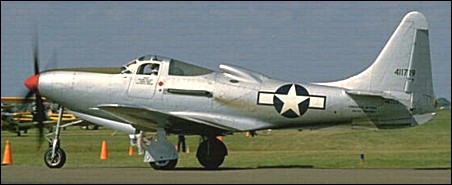
The performance of the XP-63A was found to be satisfactory, and the type was ordered into production in September 1942. Initial deliveries of the P-63A began in October 1943, and by the time production ended in 1945 more than 3,300 Kingcobras had been built in several versions. By far the majority, something in excess of 2,400, were supplied to the USSR under lend-lease, and about 300 went to the Free French Armee de I'Air. Very few of the total production of P-63 close-support fighters/ fighter-bombers were delivered to the USAAF, and so far as is known no King-cobras were used operationally by that service.
Equipment of production batches varied considerably, resulting in many sub-types. The first production P-63A-1s had V-1710-93 engines, a nose-mounted 37mm M4 cannon and two 12.7mm machine-guns in underwing fairings; other sub-types had two additional 12.7mm guns mounted in the fuselage nose. P-63A-1s and P63A-5s could accommodate a 284-litre or 662-litre drop tank, or a 237kg bomb beneath the wing centre-section; P-63A-6s had underwing racks for two similar bombs or additional fuel; and P-63A-10s could mount three air-to-surface rockets beneath each wing. The weight of defensive armour, intended primarily to give protection from ground weapons, increased progressively from 39.8kg on the P-63A-1 to 107.2kg on the P-63A-10.
The P-63A was succeeded on the production line by the P-63C with the V-1710-117 engine, this offering with water injection an emergency war rating of 1342kW. A distinctive identification feature of the P-63C was provided by the introduction of a small ventral fin. Other variants included a single P-63D with V-1710-109 engine, a bubble canopy, and increased wing span; 13 of the P-63E (or Bell Model 41), all that had been produced of 2,930 on order when contracts were cancelled at the war's end, and which were generally similar to the P-63D except for a reversion to the standard cockpit canopy; and two P-63Fs, a version of the P-63E with a V-1710-135 engine and modified tail surfaces.
One other unusual version of the Kingcobra was built extensively (in excess of 300) for use by the USAAF in a training programme involving the use of live ammunition. Developed from the P-63A, all armour and armament was removed, and the external surface of the wings, fuselage and tail unit were protected externally by the addition of a duralumin alloy skin weighing some 680kg. Other protection included the installation of bulletproof glass in windscreen and cockpit side and upper windows, the provision of a steel grille over the engine air intake and steel guards for the exhaust stacks, and the use of a propeller with thick-walled hollow blades. All of these precautions were to make it possible for the aircraft to be flown as a target that could withstand, without significant damage, the impact of frangible bullets. When a hit was made by an attacking aircraft a red light blinked to confirm the accuracy of the weapon being fired against it.
The first five of these target aircraft were designated RP-63A-11; the 95 RP-63A-12s which followed had increased fuel tankage; the next production version, with the V-1710-117 engine, became designated RP-63C (200 built); and the final version was the RP-63G (32 built), this having the V-1710-135 engine. Although never flown as pilot-less drone aircraft, the designations of these three versions were changed subsequently to QF-63A, QF-63C and QF-63G respectively.
| MODEL | P-63A |
| CREW | 1 |
| ENGINE | 1 x Allison V-1710-93, 988kW |
| WEIGHTS |
| Take-off weight | 4763 kg | 10501 lb |
| Empty weight | 2892 kg | 6376 lb |
| DIMENSIONS |
| Wingspan | 11.68 m | 38 ft 4 in |
| Length | 9.96 m | 33 ft 8 in |
| Height | 3.84 m | 13 ft 7 in |
| Wing area | 23.04 m2 | 248.00 sq ft |
| PERFORMANCE |
| Max. speed | 660 km/h | 410 mph |
| Cruise speed | 608 km/h | 378 mph |
| Ceiling | 13110 m | 43000 ft |
| Range w/max.fuel | 3540 km | 2200 miles |
| Range w/max payload | 724 km | 450 miles |
| ARMAMENT | 1 x 37mm cannon, 4 x 12.7mm machine-guns, 3 x 237-kg bombs |
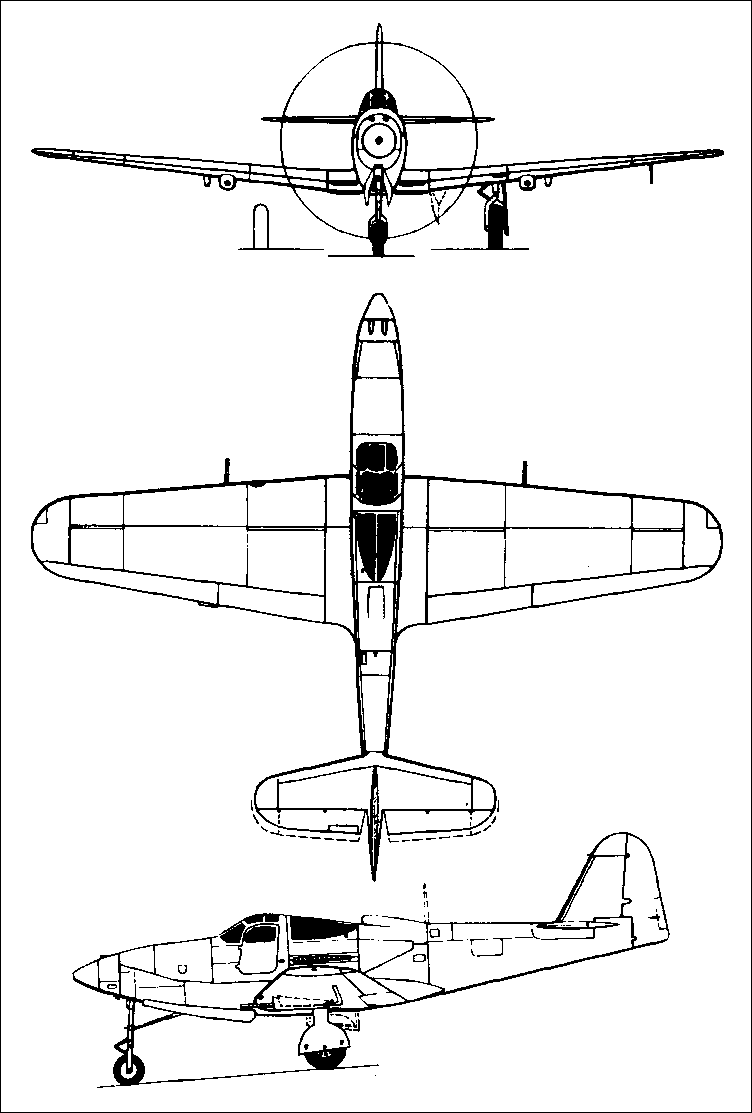
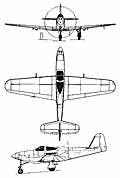 | A three-view drawing (752 x 1113) |
| lxbfYeaa, e-mail, 14.03.2024 06:54 20 reply | | Beverly Juan, e-mail, 16.12.2023 03:32 How do I recover $222,500. BTC sent to a romance scammer?
It's possible to get back your money little I know it was a big shock of my life because the company i sent my money to was revealed to be a total scam.
I contacted the professional and they helped me with the recovery of all my money successfully, you can also contact them for help. They will help you retrieve back your money, I was able to retrieve all my money back through the professional, you can contact them too they are ready to help....
Email Address: dwchzone@gmail.com
Whats-App: +1 (803) 392-1735 reply | | Anonymous, 15.12.2023 00:44 If WEP for the 1325hp P-63C was 1800 hp,
what was it for the 1425 hp D and later?
1825 hp or 1900? reply | | g.beindian@hotmail.com, e-mail, 23.02.2023 04:27 THE BELL P-63 WAS A SOMEWHAT OVER THE BEEL P-39.I WOULD NOT SAY A GREAT IMPROVEMENT.
BELL P-63 "KINGCOBRA" SHOULD'VE BEEN FLOWN IN COMBAT BY THE UNITED STATES ARMY AIR CORPS DURING WW2 IN ALL THEATRES OF WW2.
I'M JUST CURIOUS,I WANDER IF THE ALLISON V 1710 ENGINE WAS MOVED FORWARD VERY SLIGHTLY IN THE BELL P-63.
GARY
22 FEB 2023
8:30PM reply | |
| | Anonymous, e-mail, 23.02.2023 03:50 BEL P-63 SHOULD'VE BEEN FLOWN IN COMBAT BY THE UNITED STATES ARMY AIR CORPS.THE P-63 WAS SOMEWHAT BETTER THAN THE BELL P-39,SAME IDEA.I WOULDN'T SAY THE P-63 WAS A GREAT IMPROVEMENT OVER THE P-39.
JUST A CURIOUS THOUGHT,I WANDER IF THE ALLISON V 1710 ENGINE INSIDE THE P-63 WAS MOVED FORWARD VERY SLIGHTLY. reply | | Anonymous, e-mail, 23.02.2023 03:50 BEL P-63 SHOULD'VE BEEN FLOWN IN COMBAT BY THE UNITED STATES ARMY AIR CORPS.THE P-63 WAS SOMEWHAT BETTER THAN THE BELL P-39,SAME IDEA.I WOULDN'T SAY THE P-63 WAS A GREAT IMPROVEMENT OVER THE P-39.
JUST A CURIOUS THOUGHT,I WANDER IF THE ALLISON V 1710 ENGINE INSIDE THE P-63 WAS MOVED FORWARD VERY SLIGHTLY. reply | | Ron, e-mail, 05.03.2018 23:25 The P-63 was more expensive to build and still high maintenance compared to the P-47 and P-51, and still lacked their speed and range. When the P-63B planned to get the RR Merlin, it went to the P-51. When the turbo Allison was ready, it went to bombers with one exception, the P-38.
The twin-supercharger was still inferior to that of the Merlin.
Tough for Bell!
The Russians loved it though. And especially the injected P-63C. Most all the flaws of the P-39 were addressed except the guns, and the Russians were able and willing to do that.
As for the US, I like the 1946 P-63N (L39) with the swept wings. What if Bell dropped a J33 jet engine from the Bell P-83 in it for laughs? What could it hurt? The J33 powered the P-80 without a twin, so reliability must have improved over the J31 of the 1943 Bell P-59 twin jet. Those Bell twin jet fighters were too big and heavy. But the P-63 was about right. The swept wing version could upstage all the post war straight wing jets, before the MiG-15 did so in Korea. Bell deserved a break. reply | | Ron, e-mail, 13.10.2015 04:29 To pick up on my last post on Russian cannons;
the Yak-9K sported the tank-busting 45mm cannon but suffered engine damage as a result. Right?
P-63 would not have such problems. No engine in the nose!
The 45mm cannon should work fine on a Cobra. Particularly the large King Cobra! Then it could have lived up to it's tank-buster fantasy.
As it was, the P-63 did everything else but.
With it's mid-engine design, it would have been a natural mount for a 45mm cannon that cracked the engine block of the Yak-9K when fired. No other design could make that boast. Add a pair of lightweight B-20s in the wings and watchout! Strip the weight from the nose of cowl guns and interrupter gear to make way for the 45mm hub cannon and the P-63 would be a beast rivaling the IL-10. It would be more accurate against tanks and also more able to dogfight if attacked.
. reply | | Ron, e-mail, 13.10.2015 00:41 Officially, the P-63 WW 2 action amounted to what, 1 victory over a Nate in August 1945?
Unofficially, the P-63 was more likely far more heroic in Soviet hands against the Luftwaffe. I'm sure the story will eventually be told perhaps by the German pilots if no one else.
I can imagine their chagrin when they mistook them for old P-39s! P-63s were righ at home up to 15,000-25,000' while the P-39 choked. It had the best roll-rate of US made fighters too. Markedly better roll than the P-39 which was good already. Ditto for climb. Serviceability was a big advance for the P-63 too, so maintenance crews must have been happy.
I can see P-39Qs at low level with P-63 top cover making sweeps or interceptions to good effect. Can you?
Now, a step further, what if they had Soviet weapons in place of the US inferior ones of the same calibre? These Cobras would have real bite, more so than any other Allied fighter, Anglo or Russian! Even sans wing guns for agility, they'd still be leathal. The P-39 may be hardput with the heavier Russian 37mm cannon of the Yak-9T, so install a 20mm ShVAK, maybe even 3 ShVAKs in the nose! That could work for P-63s too. Later B-20s are even better.
Granted, the US Hispano 20mm cannon of the P-400 Cobra has a heavier shell, but the ShVAK 20mm is much faster and more reliable, not to mention it can be synchronized to fire from the cowl as well as the hub, while the slow Hispano cannot! reply | | Ron, e-mail, 24.04.2013 09:06 Hey KLAATU83,
Aren't you comparing a P-51 with drop tanks to a P-63 without drop tanks? Note the maximum range of 2,200 miles for the P-63 in the text at top!
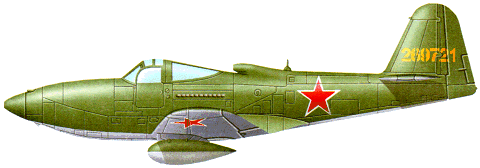
Besides the cost, I think the Mustang stood out at high altitude compared to the Cobra. But range? ... Perhaps it's true if external tanks were dropped to engage combat a P-63 would want to be closer to home than a P-51 on internal fuel or else fight with the center tank in place at some penalty in performance vs enemy fighters. I have to concede that. reply | | Klaatu83, e-mail, 16.09.2012 17:30 The main reasons why the AAF used the P-51 instead of the P-63 was that, by the time the P-63 became available in quantity, the P-51 was already in service. In addition the P-51B and P-51D had one vitally important advantage over the P-63, greater range: 2,000 miles vs. 450 miles. That meant that the P-51D could escort bombers all the way to and from their targets in Germany, something which the P-63 could not do. reply | | Aaron, e-mail, 11.04.2012 18:43 I take back some of what I said earlier. I have recently had the opertunity to read several articles and flight tests of P-39s and P-63s. The P-63 was MORE maneuverable than the P-39. It could outroll it (110 degrees /sec. at 275 mph). It was easy and steady in a roll at any speed. Performance figures for the P-63A-10 with water injection (1,800-1,825hp)were: S.L: 383mph /4980fpm. 1,000km: 394 /4825. 2,000km: 407 /4625. 3,000km: 415 /4350. 4,000km: 421 /3950. 5,000km: 423 /3450. 6,000km: 422 /2950. 7,000km: 412 /2525. 8,000km: 407 /1960. 9,000km: 394 /1500. 10,000km: 376 /1025. Weight of the plane tested was 8,592 lbs. In Axel Urbanke's book "First In Combat With the Dora 9" he states that the P-63 was able to escape from a Fw-190D-9 by climbing away. reply | | Aaron, e-mail, 25.06.2011 21:26 I did a search on the serial number on the P-63 profile 269721. It was a P-63A-9-BE. Did anyone happen to notice that the wing .5 cal gondulas were removed? W.E. top speed of this aircraft was 426mph /23,000ft. at USAAF specifications. Imagine what the figures were in VVS service where it was probably 500 lbs. lighter and the engine was most likely boosted past USAAF standard. 440mph top speed and a max. climb of 4,700fpm maybe? This was just a quick stop. I'm on my way over to the Lavochkin sight to post some facts on the LaGG-3, LaG-5 and La-7.....Maybe some Yakovlev fighters also. reply | | Aaron, e-mail, 22.10.2010 02:31 Herb,
I listed some information about the Buffalo plant at 2050 Elmwood Ave. under the P-39 at this sight. Sorry, I was in a hurry and brought up the wrong aircraft. reply | |
| | Herb Langford, e-mail, 14.10.2010 17:07 I am curious about the aircraft built at the Elmwood Avenue Plant in Buffalo, NY. I thought it was the "Bell Aracobra. I can remember as a child, and still have a couple, old drills that were thrown over a fence around the facility and we found when exploring in the cattails. It would have been in the 40's. Later, one day I awoke and over the tracks was a huge fire as the facility burned because the water was turned off to save money. reply | | Aaron, e-mail, 25.09.2010 20:02 John,
Please elaborate on why the P-63 was your favorite. I am very enterested on what was involve in the acceptance checks and I am sure everyone is interested in why you think the Kingcobra was the best fighter we produced. I'll bring the vodka. reply | | Aaron, e-mail, 12.08.2010 06:40 I never gave favorite powerplant a thought. But if I did the R-2800 would be in the top three....two....one, probably. That's a different story though. The P-63 was fast if you think in terms of combat speed instead of maximum speed. Although its maximum wasn't so bad. A military fighter comparison chart comparing it to other contemporary aircraft showed the P-63 to be capable of 373 mph. at S.L. and 426 mph. at 23,000 ft. Initial climb rate was listed at 4,400 fpm. Combat ceiling (1,000 fpm) was 31,800 ft. The P-63 only out climbed the P-39(N) initially.
The P-63 was a kick-butt fighter but the USAAF didn't need it. The P-51 was cheaper (a dollar and cents thing). The maximum published range of the P-63A was 2,575 mls. (that's eat my dust in USA terms). Ron is right. Less than a handful of WW2 fighters could roll with it. 113 degrees /sec, at 250 mph. and 110 degrees /sec. at 275 mph. And if the graph curve is fluent it would eclipse the fabled FW-190A around 325 mph. All these figures are with USAAF specifications intact. Remove the wing guns and let you immagination wander...WoW! reply | | Aaron, e-mail, 12.08.2010 06:46 Oh, I almost forgot. The F6F wasn't that slow. Go to Hellcat (pun intended) to see my comments. reply | | Ron, e-mail, 17.08.2010 00:34 Aaron,
I'd be interested in this chart. reply | | Aaron, e-mail, 18.08.2010 16:09 Ron, I e-mailed you that information on Sat. 8 /7 /10. The P-63 and P-39N are on the same speed /climb charts. I tried listing the sight here but this sight would not allow it to go through. reply |
|
Do you have any comments?
|
| 
COMPANY
PROFILE
All the World's Rotorcraft
|