 |
Bell X-11946 |  |
| RESEARCH AIRCRAFT | Virtual Aircraft Museum / USA / Bell |
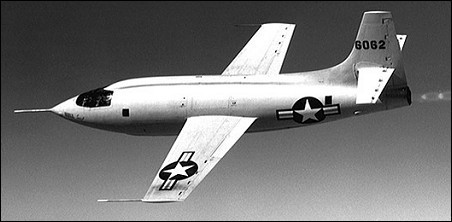 |
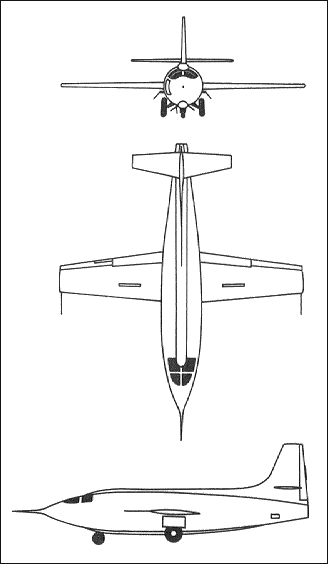
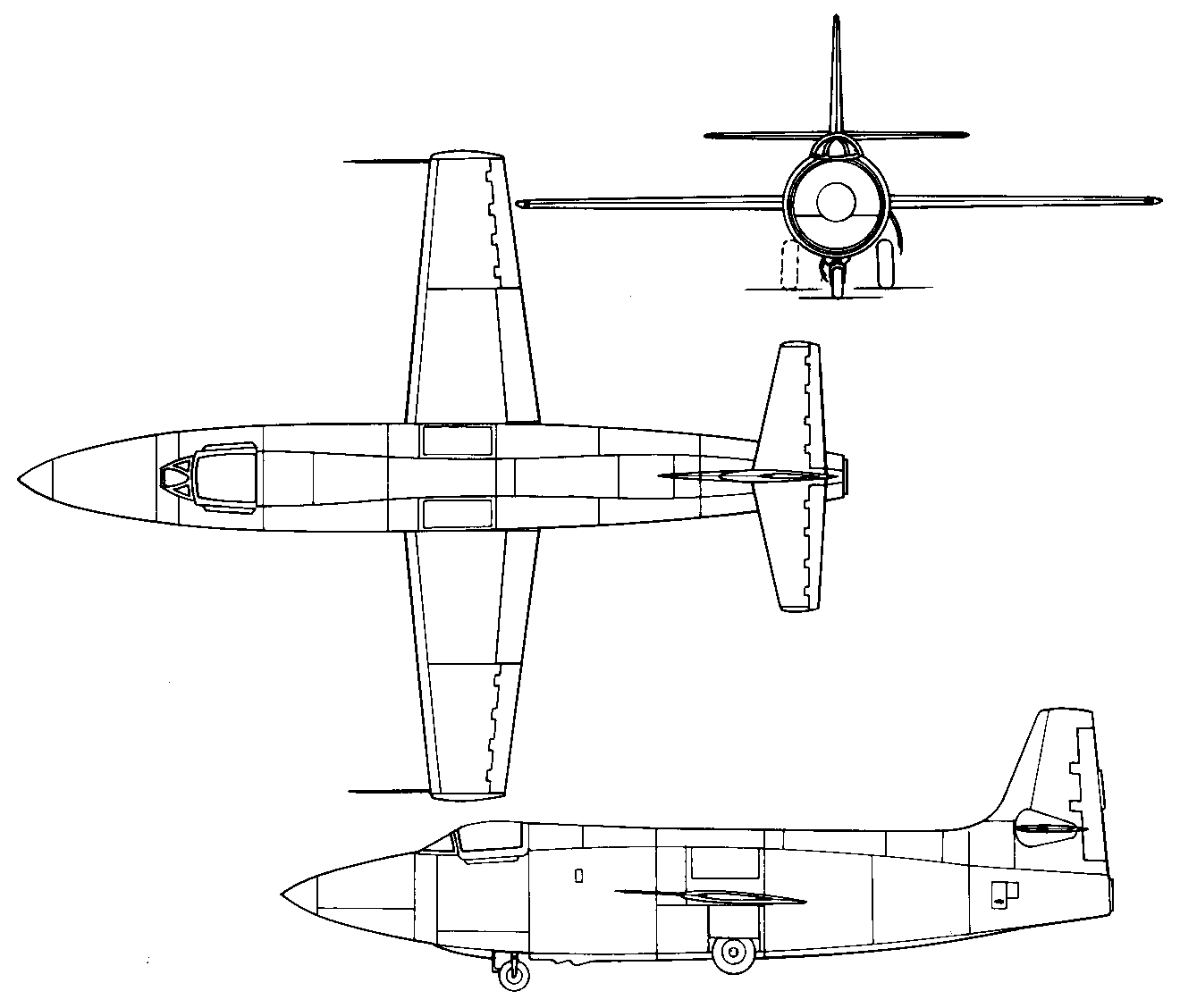
Three X-1 were built to investigate flight problems at supersonic speed. The type was first air-launched (unpowered) on 19 January 1946; powered flights began in December of that year. On 14 October 1947 the first X-1, piloted by Capt Charles 'Chuck' Yeager, became the first aeroplane to exceed the speed of sound-reaching 1,078km/h or Mach 1.015 at an altitude of 12,800m. The second X-1 was used by NASA for high-speed flight research; the third was destroyed at Edwards AFB during flight fuelling operations. The X-1A was similar to the X-1, except for having turbo-driven fuel pumps (instead of a system using nitrogen under pressure), a new cockpit canopy, longer fuselage and increased fuel capacity. In this aircraft a speed of Mach 2.435 was achieved on 12 December 1953; in the following June an altitude of over 27,430m was reached. In 1955 this aircraft was given new wing panels, but was destroyed before its first flight in this configuration. Following the X-1B (used for thermal research) came the projected X-1C and the X-1D. The latter aircraft was destroyed in August 1951 after being jettisoned from its B-50 carrier-plane, following an explosion. The last of the series was the X-1E: the second of the original X-1 fitted with wings of 4% thickness/chord ratio (instead of 10%), turbo-driven fuel pumps and a knife-edge windscreen. Ballistic control rockets designed by Bell Aircraft's Rocket Division were included in this aircraft, which was flight tested by NACA. A total of 156 flights were made with the X-1, 21 with the X-1A, 27 with the X-1B, one with the X-1D and 26 with the X-1E. FACTS AND FIGURES © The fuselage shape of the X-1 series was broadly based around the shape of a 12.7mm calibre bullet, which was a shape known to go supersonic with ease. © The rocket-powered X-1s proved a straight-wing aircraft could go supersonic. The two swept-wing X-2s made 13 powered flights up to Mach 3, but were both lost. © High-speed research aircraft were prone to an aerodynamic phenomenon called inertia coupling. This nearly killed Chuck Yeager in the X-1 and caused the loss of the first X-2. © First flights of the X-1 were made in Florida before tests were moved to California. © On his trip through the sound barrier, Yeager reached 1078km/h at an altitude of 12801m. © Captain Yeager flew the X-1 on his military salary of $275 per month. © The pilot of the X-1 had no throttle, although each of four rocket chambers could be fired separately.
|  COMPANY PROFILE | |||||||||||||||||||||||||||||||||||||||||||||||||
|


|
20
reply