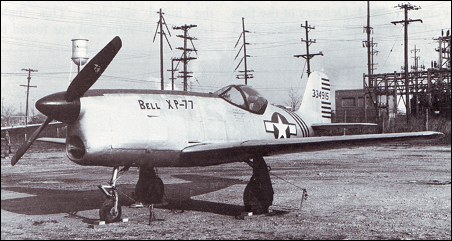
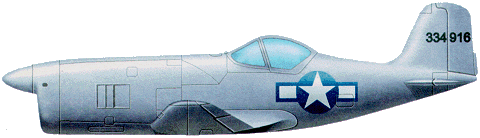
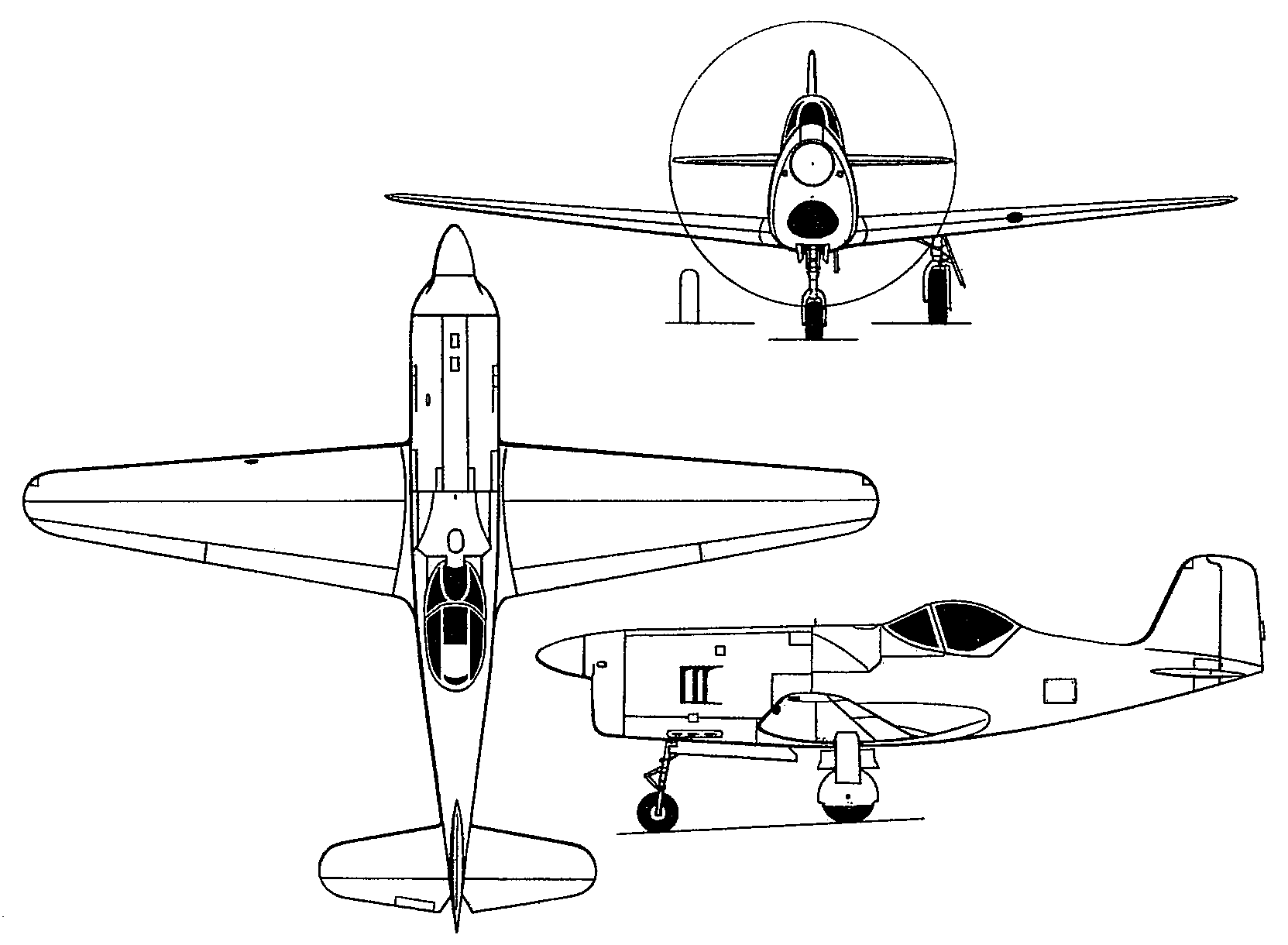
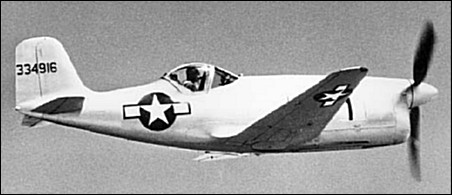
The Bell XP-77, an all-wood light-weight fighter made from Sitka spruce, patterned after racers of the 1930s, and intended to operate from grass runways, was an astonishingly attractive machine. Yet when the first of two XP-77s flew on 1 April 1944 at Niagara Falls, New York, it was not unfitting that the date was April Fools' Day.
Initially, the idea of a small, cheap, all-wood fighter built with few strategic materials had held high appeal. In early 1941, Larry Bell's upstate New York fighter team had begun work on a plane at first called the 'Tri-4', shorthand for an informal USAAF requirement for '400hp, 4,000lbs, 400mph'. On 16 May 1942, the USAAF ordered 25 'Tri-4' aircraft. Delays, technical problems with subcontracting on plywood construction, and disappointing wind-tunnel tests caused the manufacturer to suggest by early 1943 that the number of machines on order be reduced to six. In May 1943, the USAAF pared this figure to two, seeing the XP-77 as
having no operational utility but as useful in lightweight fighter research.
Beginning in July 1944, the second XP-77 was tested at Eglin Field, Florida. Spin problems led to a crash of this aircraft on 2 October 1944, which the pilot survived.
The programme did not. Plagued by noise and vibration, an unexpectedly long take-off run, and general performance 'inferior to the present fighter aircraft employed by the USAAF' (according to a report of the time), the XP-77 was killed by administrative fiat on 2 December 1944. The prototype went to Wright Field, then back to Eglin, then to Wright again. It was seen at post-war displays wearing spurious markings and its final disposition is
unknown. Described in a wartime promotional release as 'an engine with a saddle on it', this effort ended up being another of the many 1941-5 programmes which failed to produce an operational aircraft.
Rich, I am one of Ed Hensley's step son's. If you are still interested in building an RC model of the XP-77 I believe I still have a set of blue prints for the fighter that Ed gave to me in the 60s. Update your post if interested. I had started to build a model of it before I went into the Navy in 73 but did not finish it. The plane had nice lines.
My dad was an engineer at Bell and worked on the XP-77. He told me that the "Ranger" engine delivered and tested was of lower power than the plane was designed for. The right "Ranger" engine was delayed in manufacture.
I have pictures of Cobra I & II with Jack Woolams and "Tex" and the cut-a-way and profile of the X-77. If you want them replace the equal sign with the "at" symble on my listed address on this page.
Tex Johnson and Jack Woolams were good friends of my father Edward Hensley also a Bell aircraft test pilot. They all flew the XP-77. I have a face book page for my father "Edward Hensley Pioneer Aviator" with photos of the XP-77 the XP-59 (Americas first jet) NC-1H (The first licensed helicopter)P-39 and the XP-68. These guys tested all of them. Two other test pilots I remember were Floyd Carlson and Robert Gorrill.
Has anyone discovered what ultimately happened to the remaining XP-77 prototype? Hopefully it wasn't a victim of the elements as a gate guard and then, thanks to some shortsighted USAF staff type or civil servant, unceremoniously towed off someplace, broken apart and shipped off to the dump. What a great little airplane!
My dad, Norvin E. Erickson, worked for Bell Airctaft from 1939 to 1954; at the Model Town plant and Edwards. I was just wondering if any body knew him or his friend Jack Woolams.
Woolams flew the XP77 also. I was employed by Bell at that time. The molded plywood components ,shipped by rail, eroneously wound up in Mexico.This caused a delay in delivery to Bell. Many of us fell in love with the flying splinter at first sight of the first completed model.
John, Test pilot Jack Woolams took the first XP-77 on its maiden flight on April 1, 1944. Test flights showed that the performance was disappointing, a speed of only 330mph /4000ft. being attained. the takeoff run was excessively long, and test pilots complained that there were some unfavorable vibrations at certain engine rpm because of the total lack of engine support vibration-dampening mounts. I wouldn't rule Tex out of later tests.
John, I have not been able to come up with an exact answer at this time. Late in 1942 Alvin M."Tex"Johnson declined a commission in the military service to become a test pilot at Bell to test P-39s. He also tested the XP-63 and XP-59,it is quite possible that he tested the XP-77 also but I have found no conclusive evidence, yet. In 1946 he flew a P-39 to speeds in the 430mph range to win the Thompson Trophy at the National Air Races.
At least this shows Bell knew how to cut the weight. Something between this and any other 1944 Bell fighter design, would be more viable. Maybe even a jet. Pilot and engine swap places and you have a single engined F-49 with no flab. Or L-39... etc.
There was nothing inherently wrong with building WWII aircraft out of wood - consider the success of the De Havilland Mosquito and numerous Russian aircraft. But all those aircraft were otherwise-conventional combat types built around full-sized engines. In choosing the Ranger engine for the XP-77, Bell guaranteed an airplane that would be too small to be useful. Compare to the very successful Swedish FFVS J22 - a light fighter with twice the horsepower.





20
reply