|
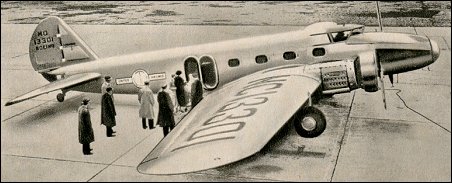
| On 8 February 1933, Boeing flew the prototype of a new civil airliner which was identified by the company as the Boeing Model 247. This had derived via the design of the single-engined civil Model 200 Monomail and the twin-engined Model 215 (US Army designation B-9) bomber, each of which had a cantilever monoplane wing.
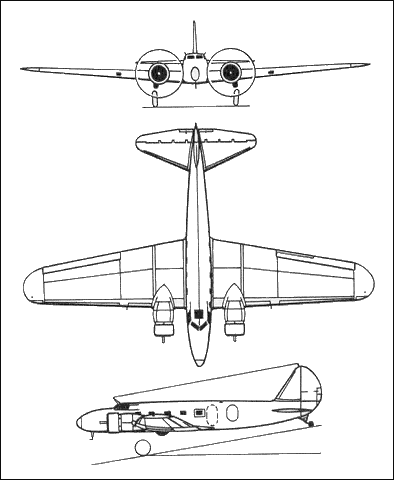
A revolutionary aircraft, the Boeing 247 has since become regarded as a prototype for the modern airliner, for it was a clean cantilever low-wing monoplane of all-metal construction with twin-engine powerplant, retractable landing gear, and accommodation for a pilot, copilot, stewardess and 10 passengers. With one engine inoperative it could climb and maintain altitude with a full load, and introduced a new feature for a civil transport aircraft by being equipped with pneumatic de-icing boots on wing, tailplane and fin leading edges to prevent ice accretion from reaching a dangerous level.
Sixty examples of the Model 247 were ordered 'off the drawing board' to re-equip the Boeing Air Transport System, shortly to become a major limb of United Air Lines, and another 15 were ordered subsequently for companies or individuals. That built for Roscoe Turner and Clyde Pangborn (to compete in the England-Australia 'MacRobertson' air race of 1934) was provided with fuselage fuel tanks instead of the standard airline cabin equipment, and introduced NACA engine cowlings (to reduce drag) and controllable-pitch propellers with optimum settings for take-off and cruising performance. These improvements were incorporated retrospectively on most airline Model 247s, thus elevating them to Model 247D standard.
When the USA became involved in World War II in late 1941, these Model 247Ds remained in airline use, and 27 of them were impressed for service with the USAAF under the designation C-73. It had been anticipated that they could be used for the carriage of cargo and troops, but it was discovered that the cabin doors were too small for this purpose. Instead, they were deployed to ferry aircrew and, later in the war, were used for training. In service they were provided with 447kW Pratt & Whitney R-1340-AN-1 Wasp radials. When no longer required in late 1944, they were returned to civil airline service.
| MODEL | Model 247D |
| CREW | 3 |
| PASSENGERS | 10 |
| ENGINE | 2 x Pratt & Whitney S1H-1G Wasp, 410kW |
| WEIGHTS |
| Take-off weight | 6192 kg | 13651 lb |
| Empty weight | 4148 kg | 9145 lb |
| DIMENSIONS |
| Wingspan | 22.56 m | 74 ft 0 in |
| Length | 15.72 m | 52 ft 7 in |
| Height | 3.6 m | 12 ft 10 in |
| Wing area | 77.6 m2 | 835.28 sq ft |
| PERFORMANCE |
| Max. speed | 322 km/h | 200 mph |
| Cruise speed | 304 km/h | 189 mph |
| Ceiling | 7740 m | 25400 ft |
| Range | 1199 km | 745 miles |
| po jk, 12.10.2023 05:38 hi reply | | Klaatu83, e-mail, 24.07.2014 03:39 The Boeing 247 was the first truly modern airliner. It was the first all-metal, twin-engine monoplane airliner with retractable landing gear and provision for two pilots. When it first appeared it truly represented the shape of things to come, and rendered every other airliner of the time obsolete. About the only negative aspect of it's design was the fact that the main wing spars intruded somewhat upon the space inside the cabin. reply | | Ralph Steeves, e-mail, 10.04.2012 01:48 The Boeing 247 that Gary McArthur referred to on 24.10.2011 was owned by California Standard (later Chevron Oil Co) and was based in Calgary Alberta.It carried people and freight from Calgary and Edmonton into the northern oil fields of BC, AB and NWT.
It was donated to the air museum in Ottawa ON. I was a passenger many times flying "up north" and have visited it in the museum in Ottawa. reply |
| Gery McArthur, e-mail, 24.10.2011 04:59 During the 1950's a Boeing 247 was flown by an oil company out of Calgary Alberta Canada. Off hand I dont remember the company. In the summer of 1958 I was a Helicopter Pilot Engineer working out of Norman Wells NorthWest Territories Canada when a family emergency called me to return to Calgary. I knew the crew of the 247 aircraft and they allowed me to be a passenger on their return flight to Calgary the next day. A memorable flight in one of the many aircraft I have flown in. reply | |
| | zhuma, 18.06.2011 10:50 As a child he saw Beachy crash during the SF 1915 World's Fair, and he built a plane out of yardsticks from a local hardware store in his San Francisco attic. reply | | Brian Ald, e-mail, 06.05.2010 05:13 As a child I was shown the 'first all-metal monoplane' at Heston airport, UK. The nose had an external flap to enable a mail bag to be carried. Was this the 247? reply | | Jhon, e-mail, 18.03.2010 19:44 Good info dude reply | | Robert L. Willett, e-mail, 25.02.2010 03:19 In the earrly thirtys, Chang Hsueh-liang bought a Boeing 247 which shared periodically with Chiang Kai-shek. The plane played a significant role in the kidnapping of the Generalissimo by Chang "The Young Marshal" Hsueh-liang in Xian. The plane was piloted by Americam Royal Leonard and helped bring to the table the characters that would end the stalemate. reply | | jerrold Ulmer, e-mail, 10.02.2010 21:42 A neighbor of ours is 98 years old and was a stewardess on a 247. she recently said that to qualify for the position she would need to be a nurse, a certain size /weight and of good moral character. She said on one of her flights the plane made an emergency stop in Pennsvania and the plan ran off the short run way and stopped just beyond the run way on the nose of the aircraft. the pilot climbed out the cockpit andd went over to a farm house and got a ladder so the 10 passengers could get out. The entire crew and passengers spent the night at the farm house. reply | | Dwight Johnson, e-mail, 21.07.2008 21:50 I'd like to report that in 1933, when I was 2.5 yrs old, my family of four flew from the East coast to West cost on a UA Boeing 247. My brother, Walter, was only about 3 weeks old which made him the youngest baby to have made the trip up until that time.
Of course I don't rember the trip, but was told when older that I was sitting in my father's (Dwight Johnson, Sr.) lap holding a bouquet of panseys. He was seatbelted down, I was not. We hit a "air pocket" which left me in a seated position some distance above my father!
Since they didn't fly at night yet, we landed one or more times to sleep.
When my mother was quite aged, I commented to her that they were really "gutsy" and adventurous to make such a flight on such a early airplane. Her reply was," You only know the half of it. The same kind of plane had crashed and all were killed a week earlier. However, your Father and I decided to go anyway since the whole family would be together. If we were killed we'd all go to be with the Lord at the same time."
I am sure that part of the decision was my father's strong interest in aviation and the experience it would provide. As a child he saw Beachy crash during the SF 1915 World's Fair, and he built a plane out of yardsticks from a local hardware store in his San Francisco attic.
Later in life he was convinced that planes should be shaped like the pointed paper gliders. We know now he was right.
A week before his death, he was thrilled to come onboard one of the first UA 747's upon my family's return to CA from NY.
A few years ago I enjoyed the very good display of this plane in the Seattle Boeing Muesum.
Thank you for this website. It's been enjoyable recalling my past aviation history. Use these comments as you wish. If you do, and its convient, please let me know how you used them.
Yours,
Dwight Johnson, Jr
Logged in as: dnvjohnson@aol.com
Your Question has been Submitted
The reference number for your question is '080721-000074'.
You should receive a response by email from our support department soon.
If you need to add information to or cancel your question, you can do so by updating it through the questions sub area of the 'My Stuff' section of this site.
Home > Frequently Asked Questions
Answers
Ask a Question
My Stuff
Logout
Help
Logged in as: dnvjohnson@aol.com
Your Question has been Submitted
The reference number for your question is '080721-000074'.
You should receive a response by email from our support department soon.
If you need to add information to or cancel your question, you can do so by updating it through the questions sub area of the 'My Stuff' section of this site. reply | | stephen winkler, e-mail, 27.03.2007 01:14 The first act of terrorism involving aviation occurred on 10 October 1933, when a Boeing 247 flying from Cleveland, Ohio to Chicago, Illinois exploded over Indiana by a bomb planted in the baggage compartment of the plane. All three crew members and all four passengers died in the crash. Incidentally, this was the first recoreded crash involving a United Air Lines airplane, which incidentally, has one of the safest records in air travel. Incidentally, in that connection, it was also the first crash of a Boeing B-247, which was one ot the best designed planes of its time and considered to be one of the safest to fly at the time. reply |
|
Do you have any comments?
|
| 
COMPANY
PROFILE
All the World's Rotorcraft
|




hi ralph
chevrons boeing 247d was based in edmonton and flowen by my father and gordon camron
calgary had the dc3 that dick cull often flew with oral fisher
,which in later years was replaced by cf-csc hawker sidley.
have a great day and thanks for contributing
reply