|
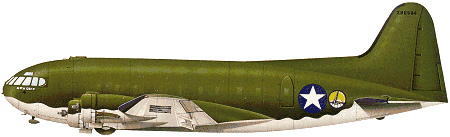
| In early 1934 Boeing began design studies for a multi-engine bomber and a basically similar civil transport. When, in June 1934, the USAAC invited proposals for a new bomber, Boeing's Model 299 was revamped to meet the Army specification and duly became built by the thousands as the B-17 Flying Fortress.
The Model 300 was also changed as ideas were developed and in its Model 307 form was basically similar to the B-17, except for a very different fuselage. This was of circular cross-section, a configuration chosen so that the structure would be able to withstand the stresses of pressurisation, thus ensuring a smooth flight for the crew of five and 33 passengers at, an altitude above much of the atmospheric turbulence.
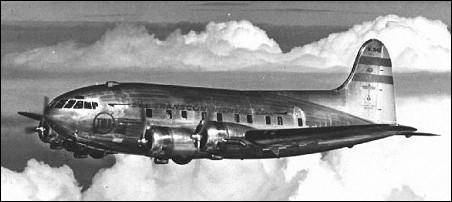
The prototype Model 307 (named Stratoliner because of its high cruising ceiling) flew for the first time on 31 December 1938. A total often were built: the prototype; five SA-307B for Transcontinental & Western Air; three S-3O7 for Pan American; and a single SB-307B for the late Howard Hughes. TWA's SA-307B were impressed for service with the Army's Air Transport Command during World War II, being used as C-75 for VIP transport over the North and South Atlantic.
The Model 307 had the distinction of being the first civil airliner with a pressurised cabin to enter service. It also introduced an extra crew member - known as the flight engineer - to relieve the captain of certain duties such as power plant, fuel and pressurisation management and monitoring
| MODEL | S-307 |
| ENGINE | 4 x Wright GR-1820 Cyclone, 671kW |
| WEIGHTS |
| Take-off weight | 19050 kg | 41998 lb |
| Empty weight | 13608 kg | 30001 lb |
| DIMENSIONS |
| Wingspan | 32.61 m | 107 ft 0 in |
| Length | 22.66 m | 74 ft 4 in |
| Height | 6.34 m | 21 ft 10 in |
| Wing area | 138.05 m2 | 1485.96 sq ft |
| PERFORMANCE |
| Max. speed | 396 km/h | 246 mph |
| Cruise speed | 354 km/h | 220 mph |
| Ceiling | 7985 m | 26200 ft |
| Range | 3846 km | 2390 miles |
| lxbfYeaa, e-mail, 14.03.2024 06:55 20 reply | | Frank, e-mail, 21.06.2022 16:19 I recall seeing these aircraft in Laos in 1965 with the ICC International Control Comission on it. reply | | dick mcelwee, 24.04.2017 03:28 the airplane thats in the Udvar -Hazy Museum was at Newark Airport in the mid 1950's. I was owned by a company that used it as a support aircraft for its crop dusting operation. Newark Air service employed a bunch of us A&P's to do a maintenance check on the airplane. We never got paid cause the outfit went belly up. The last time I heard about the airplane was when Boeing restored it. Isaw it after it was given to the Smithsonian reply | | Chip, e-mail, 01.01.2015 23:50 So happy to hear the Boeing restored example of this beautiful airplane made it to the Smithsonian. The last I heard of this plane it had ditched in Lake Washington. Cause: The crew ran it out of fuel. Heard there was only minor damage and that it was going to be re-restored. Lost track of it after that. Obviously it is alive and well. reply | |
| | Scott Boyd, e-mail, 25.07.2014 06:07 Last I heard the NASA Guppy is the only one still flying and a few others are in Museums or storage. Heavily modified they're still 307's. reply | | Klaatu83, e-mail, 24.07.2014 03:48 Essentially an airliner version of the famous B-17 bomber, the appropriately-named "Stratoliner" was the first production airliner equipped with a pressurized cabin, which enabled it to operate at high altitudes, the way airliners do today. In it's way the "Stratoliner" was as revolutionary as the company's previous airliner, the 247. reply | | kenny, e-mail, 01.04.2014 21:40 The first time I saw a 307 was 1966 at SGN. The last time was at the County Museum outside of Tucson in 1994 or 95. Always wondered if it is still there. reply |
| Brig. Gen. Stan Flemming, e-mail, 21.06.2012 22:06 I thought I had seen this aircraft somewhere before. I beleive there are two (stripped down shells)of them sitting on the side of the tarmac in Port au Prince, Haiti waiting for someone who understands these aircraft to rescue them and restore them one day...hopefully. reply | | William S. Vaughn, e-mail, 21.05.2012 04:28 As an aviation-crazed young teen growing up in Galveston in the early 60s, I wandered through a slightly opened hangar door. I was amazed to see what I instantly recognized as a Stratoliner. I instinctively walked over to touch a no. 3 prop blade when I felt myself being lifted up by both arms and unceremoniously carried outside by a pair of burly security guards. The set me down, and without saying a word retreated back into the hangar and slammed the doors shut. It wasn't until years later I found out that this was Howard Hughes' 307 that was converted into a yacht. reply | | Johnny, e-mail, 04.04.2012 03:43 Anyone know what USAAF unit specifically in ATC used these birds ???????????????????? reply | | James, e-mail, 21.11.2011 00:13 In 1967 when I worked in Vietnam a French Comp that did flight for the ICC had 3 of them that where used between SGN,Vientian Laos and Hanio Vietnam.They parked on the same ramp in SGN as Air America used.I think one crashed in Vietnam and one in Laos.BUT if I remember right there was one parked in Vientiane Laos.The last time I would have seen it there would have been about 1973 or 4.I do have some photo of them taken in SGN. reply | | rob amiot, Colonel - Air Caval, e-mail, 11.04.2011 16:42 What a great aircraft and thank goodness for the B-17s.....Germany during WW2 didn't know what they had started mess with the US of A....... reply | | deaftom, e-mail, 30.03.2011 05:56 The sole surviving Boeing 307 was lovingly restored by Boeing employees, polished to a mirror finish, and is now displayed at the (U.S.) National Air and Space Museum's Udvar-Hazy Center, at Dulles Airport, Virginia. It's BEAUTIFUL. reply | | smilinal, e-mail, 26.02.2011 21:43 I HAND FLEW THIS AIRCRAFT FROM DALLAS, LOVE FIELD TO LOCKHEED, BURBANK VIA EL PASO ON 8 FEB 1960. LEO WASSENBURG, ATR 917, SLEPT IN THE LEFT SEAT EXCEPT FOR GEAR UP, YOU GOT IT; GEAR DOWN, I GOT IT! C.R. SMITH WAS THE ENGINEER. IT WAS 9307R AT THAT TIME. OUTFITTED FOR THE HAITIAN GOVERNMENT WITH WHITE NAUGAHYDE SEATS AND THE HAITIAN SEAL WOVEN INTO THE FLOOR CARPET. 3+40 TO ELP; 4+55 TO LOCKHEED. FOR FIFTY BUCKS AND A TICKET BACK. IT FLEW LIKE A B-17. reply | |
| | Captain Frank E. Adams, e-mail, 23.02.2011 03:52 I flew the S-307 2 years for Pan American Airways (1943 /1944) and today remain one of the few pilots in the world who is still rated for this aircraft. My biggest complaint about this description is that the aircraft could only be pressurized to a maximum of 2.4 psi so that the advertized service ceiling of 26,200 feet is greatly exagerated. A flight altitude of 22,000 feet would result in a cabin altitude of 14,000 feet and we had no passenger emergency oxygen on board. Also,the Wright engines had no turbos and so were basically sea-level engines which could not retain cruising power output above 12,000 feet. For this reason we flew the S-307 at 12,000 feet southbound and 11,500 feet northbound between Miami and Panama. reply | | Charles Gebhardt, e-mail, 16.12.2010 02:07 My first flight in an airplane was in a TWA 307 going from New York to Chicago - since I was only 5 months old I don't remember the flight but I still have my membership card in TWA's Stratoliner Club sign by Jack Frye. reply | | Frank Alfter, e-mail, 15.02.2010 23:35 I didn't realize it at the time at Oshkosh in 2003, which was the first time this fine aircraft was was Oshkosh, that I was one of the last people to tow her. She flew from Oshkosh to the Smithsonian at Dulles and is now proudly displayed there. reply | | cyrus tuttle, e-mail, 14.08.2009 01:25 I flew from Miami to Rio on Flying Cloud at age 6. There were 2 stop on the way at Trinidad and a small runway out in the Brazilain jungle. It was a real thrill and I am so happy to see the plane in the Smithsonian. reply | | joe j., e-mail, 05.08.2009 23:32 I can't help but wonder what improvement this aircraft had over the DC 3 beside it being pressurized????? I still took three stops to cross the US it was a couple hours faster but that was about all.............grant you i can.t find any load factors to compare one from the other i only can look at disasters of the DC 3 on airplane loads to see they were.nt that full.... so why the B 307 which did'nt hold that many moore passengers....and by that time, as far as i can tell,fewer pasengers were asking for sleeping accomidations...bewildered joe.... reply | | max, e-mail, 24.09.2008 22:06 howard's 307 was later turned into a houseboat called"cosmic muffin" reply |
|
Do you have any comments?
|
| 
COMPANY
PROFILE
All the World's Rotorcraft
|




Saw the same bird @ TSN over on the civilian side getting an engine change. I Think it belonged to the ICC,used as a shuttle around SEA to cook up some peace deal.As I recall Air Viet Nam had one too. need to dig out my slides.
TSN was the place to see A /C from allover. I saw a British Blackburn Beverly with fixed landing gear and wooden ribs ,loading up a group of Nuns for evacuation.
reply