|
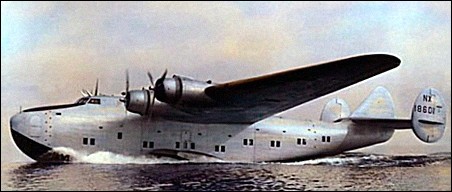
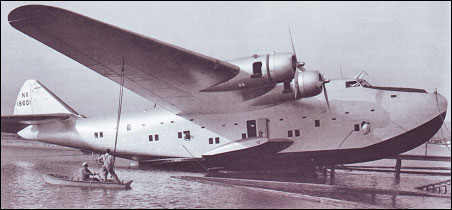
| As early as January 1935, Pan American Airways had signified to the US Bureau of Air Commerce its wish to establish a transatlantic service and, despite its ownership of the large Martin M-130 and Sikorsky S-42 long-range four-engined flying-boats, the airline wanted a new aircraft for the route.
Boeing submitted a successful tender to the Pan American specification and a contract for six Boeing Model 314 flying-boats was signed on 21 July 1936. The manufacturer used features of the earlier XB-15 heavy bomber, adapting the wing and horizontal tail surfaces for its 37421kg gross weight flying-boat, which could accommodate up to 74 passengers in four separate cabins. The engines were not the 746kW Pratt & Whitney R-1830 Twin Wasps of the XB-15, but 1119kW Wright GR-2600 Double Cyclones which gave the
machine a maximum speed of 311km/h. The fuel capacity of 15898 litres conferred a maximum range of 5633km; some of the fuel was stored in the stabilising sponsons, which also served as loading platforms.
The first Boeing 314 took off on its maiden flight on 7 June 1939, this original version having a single fin and rudder, later replaced by twin tail surfaces to improve directional stability. These proved to be inadequate, and the original centreline fin was restored, without a movable rudder. The aircraft was awarded Approved Type Certificate No. 704 and entered transatlantic airmail service on 20 May 1939, passenger service commencing on 28 June. At that time the Model 314 was the largest production airliner in regular passenger service.
Pan American ordered another six aircraft which were designated Model 314A, improved by the installation of 1193kW Double Cyclones with larger-diameter propellers, and additional 4542 litres of fuel capacity, and a revised interior. The first Model 314A flew on 20 March 1941 and delivery was complete by 20 January 1942. Five of the original order were retrospectively converted to Model 314A standard in 1942. Three of the repeat order were sold, before delivery, to BOAC for transatlantic service and operation on the Foynes-Lagos sector of the wartime 'Horseshoe Route'.

Of Pan American's nine Model 314/ 314As, four were requisitioned by Army Transport Command and given the military designation C-98. They were little used, however, and in November 1942 one was returned to the airline. The other three were transferred to the US Navy to join two acquired direct from Pan American; the airline provided crews for the US Navy's B-314 operations and the aircraft were partially camouflaged but operated with civil registrations.
BOAC and Pan American terminated Boeing Model 314 services in 1946 and the surviving aircraft were sold to American charter airlines
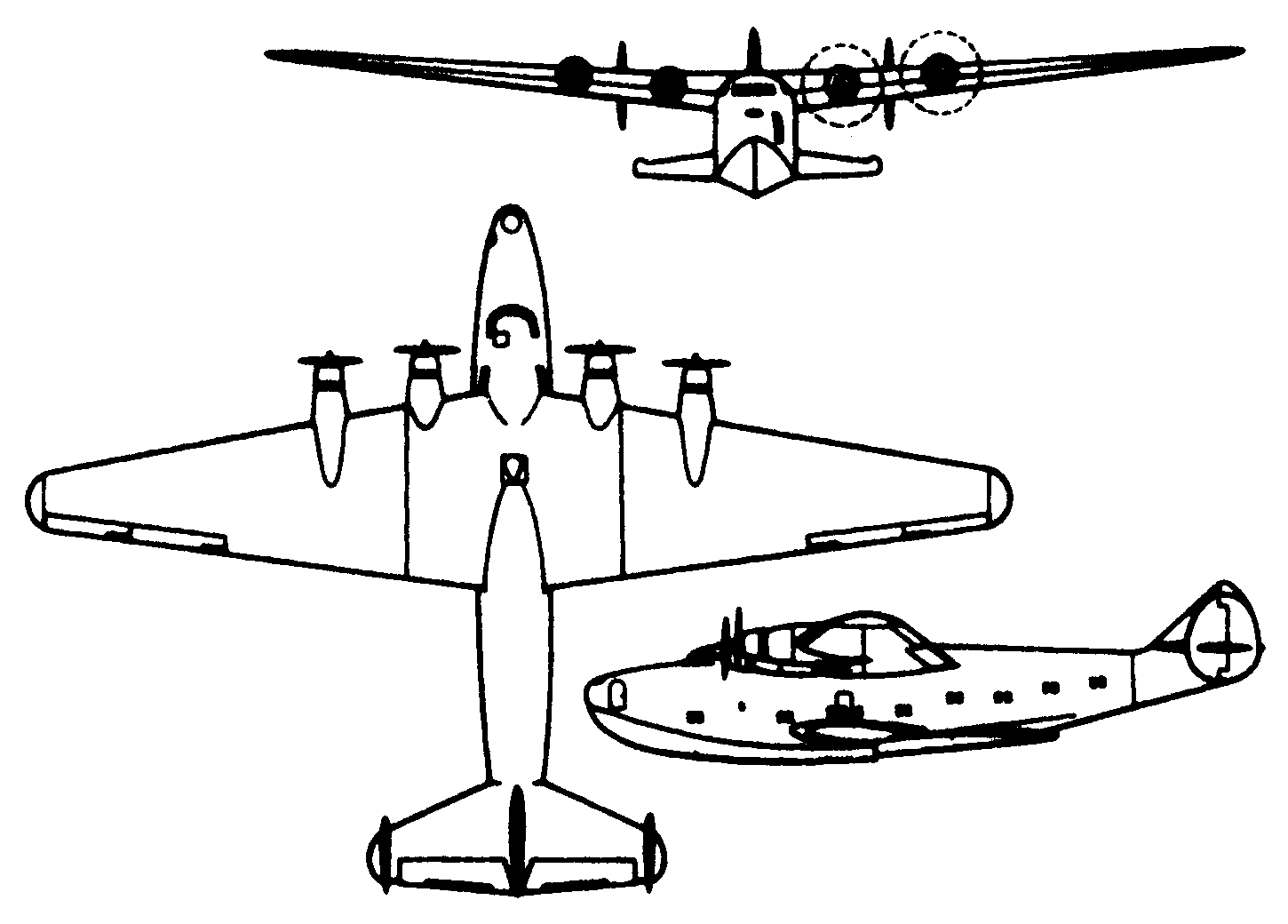
 | A three-view drawing (1450 x 1040) |
| MODEL | Model 314A |
| PASSENGERS | 74 |
| ENGINE | 4 x Wright R-2600 Cyclone 14, 1193kW |
| WEIGHTS |
| Take-off weight | 37421 kg | 82500 lb |
| Empty weight | 22801 kg | 50268 lb |
| DIMENSIONS |
| Wingspan | 46.33 m | 152 ft 0 in |
| Length | 32.31 m | 106 ft 0 in |
| Height | 8.41 m | 28 ft 7 in |
| Wing area | 266.34 m2 | 2866.86 sq ft |
| PERFORMANCE |
| Max. speed | 311 km/h | 193 mph |
| Cruise speed | 295 km/h | 183 mph |
| Ceiling | 4085 m | 13400 ft |
| Range | 5633 km | 3500 miles |
| WILLIAM WINTER, e-mail, 27.04.2017 17:04 i was hoping someone in and around the boing clipper world had a photo or new my grand dad Charles Wesley Winter , he was a radio, navigation man for Pan Am , i now he has a radion in the Spirit of St Louis , and knew linberg well reply | | DAVE HURSH, e-mail, 21.02.2016 23:47 i may be one of the few remaining lucky people who actually flew on a Clipper. It's a long story: my missionary parents sailed to Nigeria in '42 (by ocean freighter), where my eye-surgeon father founded Kano Eye Hospital. The U.S. State Dept. would not issue passports to children in '42 (I was 3 years old) since German U-boats were sinking too many unprotected ships. I stayed at a mission home in Canada for 2 years, then began a six-month journey with another missionary couple to join my parents. In late '44 we arrived in Natal, Brazil; it was the jumping-off point for US Army Air Corps bombers going to Europe, so I saw lots of B-29's. After3 months it's finally our time to get on a boat and board the Clipper -- which we did twice and got bumped for high-priority military people. Third time was a charm; we took off, flew for half a day, landed and refueled at Ascension Island, then arrived many hours later in Sierra Leone. I had my 6th birthday there, flew to Kano in a DC-3, and finally reunited with my parents. All those great Clipper memories and many more are still with me after 70+ years! reply | | Billy DeWitt, e-mail, 04.10.2015 04:29 There was one at the 1939 worlds fair on Treasure Island. Was in a hanger and we were up high and looked down on it.
I understand the last one was purposely sunk when it was forced down between Bermuda and NY.
The Navy used others for target practice.
I saw the mock up in Foynes. Closest we will come to one. reply | | ROSIE ROSENSTEIN, e-mail, 04.02.2015 05:31 B314 ONE NEEDS T VISIT THE FLYING BOAT B314 MUSEUM IN FOYNES IRELAND, NEAR SHANNON. YOU SURE WILL ENJOY.
ROSIE ROSENSTEIN
PAN AM 1958-1991 reply | |
| | Anthony, e-mail, 12.01.2015 05:23 Rafael, your model of the B-314 is amazing. Next to the PBY-5A it is my favorite flying boat. reply | | michael, e-mail, 17.06.2014 17:33 im looking for blue prints to build a balsa wood structure of the boeing 314 float plane ,,,, can you help or send me in the right direction reply | | John Howell, e-mail, 13.05.2014 02:29 I was with my family in San Francisco the summer of 1938 or 1939. We happened to be down near the bay when we saw the clipper take off. Everybody called it the China Clipper. It was something to see. I was 5 or 6 years old reply | | Larry Scrivener, e-mail, 18.10.2013 23:38 The old seaplane base at Foynes Ireland is a museum today, and has what they describe as a "full scale" portion of the B-314. It was built by the museum staff and other volunteers in the Republic, and that is a marvelous story in itself. Check their operating schedule before you go -- I did not, and experienced a serious disappointment on my last trip to the old sod. reply | | James, e-mail, 22.09.2013 18:37 When visiting the Naval Air Museum in Pensacola, Fla. about two years ago the tour took us past a building where aircraft were being rebuilt and through am open door I saw the largest Seaplane I have ever seen. It had the shape and contours that could only be a Boing Clipper. reply | | Phil Copeland, e-mail, 11.08.2013 00:00 Actually BOAC continued to use the 314 until 1948 for the Bermuda /USA service. reply | | Phil Copeland, e-mail, 11.08.2013 00:00 Actually BOAC continued to use the 314 until 1948 for the Bermuda /USA service. reply | | Renee Chernoff, e-mail, 04.05.2013 08:08 For those interested in the Pan Am Clipper, check out Ken Follett's book "Night Over Water". Its a great novel with incredible detail about the Boeing 314. reply | | KT, e-mail, 05.12.2012 22:28 My cousin's parents were on a clipper flight to lisbon from ny in October of 1941 and from honolulu to manila in April of 1941. I am wondering if anyone can tell me whether these two flights, or around this time, were the planes still the one class luxury standard or had they already been converted to the spartan military flights? reply | | glm, e-mail, 25.11.2012 19:30 Looking for technical drawings /prints for the Boeing 314. I'd like to recreate them in CAD for a scratch built balsa build. Any info or source would be much appreciated.
Thanks
Gary reply | |
| | Bruce Pattison, e-mail, 08.11.2012 23:09 My Dad, Romney (Pat) Pattison was a navigator on the Pan AM 314's and flew all over the world during the War. He told me many interesting stories of his flights. He later became the chief navigator for Pan Am. Does any one remember him? reply | | PAUL A. JOHNS, e-mail, 30.07.2012 02:54 Iwas with Pan Am for 10 yrs and flew the Boeing 314 clipper
on 20 pacific crossings as Pilot and Pilot Navigation officer.
Also on trips with Capt Ford.
The 314 was a great Plane and of my 220 pacific crosings they
stand out the most allthouh I AM NOW 99 YRS OLD BUT REMEMBER
THEM WELL reply | | Doug Ratchford, e-mail, 16.06.2012 04:48 The only surviving example of the big flying boats from that era is the Vought-Sikorsky VS-44 displayed at the New England Air Museum.
Ken Smith-I'd love hear from you about Capt Ford and the Pacific Clipper.
Don Bansen, if you have no use for those cable splicing tools, there are many vintage aviation museums that would be glad to put them to use. And value your skill with them too.
My dad was a PBY veteran and I love seaplanes
floats up!
Ratch reply | | eddy james, e-mail, 02.04.2012 09:46 I'd give the proverbial left nut to be able to own and afford to fly one of these magnificent pieces of history. reply | | Robert, e-mail, 15.12.2011 18:16 I recently saw some photos of the large models of the B-314 that Boeing built for display at Pan Am offices worldwide. They were cut away on one side to show the inside of the plane. Does anyone know where any of these are? Thanks. reply | | Phellonie Jackson, e-mail, 26.05.2011 23:11 Nice plane, I want to see one! reply |
|
Do you have any comments?
|
| 
COMPANY
PROFILE
All the World's Rotorcraft
|