In early 1942 Boeing initiated a design study to examine the feasibility of producing a transport version of its B-29 Superfortress. In due course the company's proposal was submitted to the USAAF for consideration and, because at that time the long-range transport was a much-needed type of aircraft, a contract for three prototypes was awarded on 23 January 1943. Identified by the company as the Boeing Model 367, and designated XC-97 by the US Army Air Force, the first made its maiden flight on 15 November 1944.
The XC-97 had much in common with the B-29, including the entire wing and engine layout. At first view the fuselage, of 'double-bubble' section, appeared to be entirely new, but in fact the lower 'bubble' was basically a B-29 structure, and so was the tail unit attached to the new (and larger) upper 'bubble'. On 6 July 1945, following brief evaluation of the prototypes, 10 service-test aircraft were ordered. These comprised six YC-97 cargo transports, three YC-97A troop carriers, and a single YC-97B with 80 airline-type seats in its main cabin.
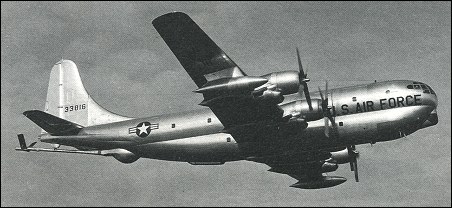
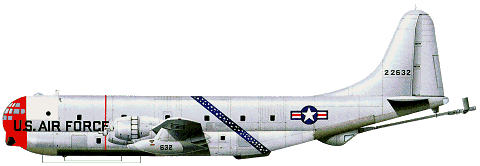
The first production contract, on 24 March 1947, for 27 C-97A aircraft with 2425kW Pratt & Whitney R-4360-27 engines, specified accommodation for 134 troops, or the ability to carry a 24,040kg payload. Two transport versions followed, under the designation C-97C and VC-97D, and following trials with three KC-97A aircraft equipped with additional tankage and a Boeing-developed flight-refuelling boom, KC-97E flight-refuelling tankers went into production in 1951. This version was powered by 2610kW R-4360-35C engines. The KC-97F variant which followed differed only in having R-4360-59B engines. Both the KC-97E and KC-97F were convertible tanker/transports, but for full transport capability the flight-refuelling equipment had to be removed. The most numerous variant, with 592 built, was the KC-97G which had full tanker or full transport capability without any on-unit equipment change.
When production ended in 1956 a total of 888 C-97s had been built, and many were converted later for other duties. The KC-97L variant had increased power by the installation of a 2359kg thrust General Electric J47-GE-23 turbojet beneath each wing to improve rendezvous compatibility with Boeing B-47s. KC-97Gs converted to all-cargo configuration were redesignated C-97G, and in all-passenger configuration became C-97K. Search and rescue conversions were HC-97G, and three KC-97Ls went to the Spanish air force, being designated TK-1 in that service. Several have served in many roles with Israel's air force.
Variants
C-97D: designation applied to the third YC-97A, the YC-97B, and two C-97As following conversion to a standard passenger configuration; the three VC-97Ds were subsequently redesignated C-97D
KC-97H: designation applied to one KC-97F, following modification for service trials as a tanker using the probe-and-drogue flight-refuelling system developed in the UK
YC-97J: final designation of two KC-97Gs converted for USAF use as flying test-beds, each with four 4250kW (5,700-shp) Pratt & Whitney YT43-P-5 turboprop engines
Boeing 367 / C-97 on YOUTUBE
Specification
MODEL
KC-97G
ENGINE
4 x Pratt & Whitney R-4360-59B radial pistone engines, 2610kW
I have a question about a KC-97 (#0253) based at Selfridge AFB until 1971 that supposedly was damaged from the pilot flying aerobatics and overstressing the airframe. My airplane-collector father, Walter A. Soplata purchased the plane from scrapper Ralph Huffman in the summer of 1971 after Huffman was awarded the winning scrap bid from the Air Force. In the last two chapters of my new book, "The B-25 in the Back Yard," I tell of cutting and hauling this moster fuselage home to Newbury, Ohio so my fahter could make a giant storage building with it. Huffman scrapped the entire wing and tail, but Dad got the rest. We were told during our time at Selfridge that a wayward pilot did some akro such as loops wit the KC-97 and it was sold for scrap due to that. The airframe was gutted of most parts including engines, landing gear, and most cockpit items. Many KC-97s and RF-101 Voodoos were operating from the base then in August 1971, and all that was fun to watch while working on the 97. Thanks, Wally Soplata
was stationed at Dow AFB Maine from April 62-oct-64 before reasignment to Viet Nam..attached to CAMRON and worked on KC97 engines (r4360-59bs)..remember winters of 62 and 63 as 2 of most severe in Maine.. enjoyed working on those old grease slingers, and getting mesmerized by the sound of those engines when they ran at certain rpms.. missed walking on those wings and the smell of those birds..in Viet Nam, worked on A1 /Es (with R3350-26w engs)C47s and Facs. (forward air control craft) Big contrast, going from frozen hell, to hot hell..
Reuven Was F /E in the Israeli Air Force, I flew c97 and b377 during 1979-1978.yes it was a wonderful plan with soul. we use to do air refueling to helicopters (H54) and fighters, with refueling baskets one on each wing.
Fred: I remember the demise of KC-97 685. Although it happened over 53 years ago, some of it still comes to mind. Not long after, I was informed that the aircraft cashed near Goose Bay, which appears to be partly correct. On a training flight down state, the body heater was found to be glowing. The AC ordered bailout. Of the crew of six, four made it. For years I could remember two of the names. now only one comes to mind, Childress. I was training as an asst. CC, SStg., Bill Metzger. Bill was a great NCO. Friends that knew in FMS and engine mechanics were Dave Hippley, Jim Shipley, Charles Cole and Dave Czhoski. And of course SStg. Bradley Jacobs., who I believe was from Nweburg, NY.at one time or another. He flew his own T-craft at Plattsburgh Airport and was a member of the Aero Club. We, Hippley, Shipley, Cole, Czhoski and myself knew Brad as "Jake the Snake". We had place in our hearts for Brad. Wish I could see them all again, at least know what be came them. Smitty fwschmidt@hotmail.com
Martin: I noticed your message from March 28, 2011. Are there any photos, pictures /pieces of the KC-97, #685 at Misstasinni Lake. Que.? My tools were on that plane December, 1962. fwschmidt@hotmail.com
Just stumbled across this site. After reading the comments, I was surprised that no who flew or maintained KC-97's at Schilling AFB was there. I worked them from SEP 1960 till I launched the last one out about OCT or NOV 1963. Reflexed in Elmendorf, AK, Edmonton Al, Canada, Harmon AFB Newfoundland, Malstrom AFB Montana Anderson AB Guam. A great airplane.
I am trying to assist a veteran who worked as a mechanic on the KC-97 file a claim for asbestos lung disease. The VA has denied his claim because they have no record of there being asbestos on that type of aircraft. I know the Wasp engine had asbestos components but I am looking for a copy of the TM or other evidence of brake components, insulation etc to help him with claim. Any help would be appreciated. Thank you
Bruce R Nelson age 76, seeking, e-mail, 19.04.2015 04:27
desperately seeking Sgt James E Davis of 1201 ATS out of Travis 1958-1960. Or anyone else wh may recall our flights in South Pacific including to Clark AFB /Siagon in 1959-60. Please e mail. Hope you are all well. I was a loadmaster Flight Attendant at 1201st Aur Tran Squardroon from 1958 to 1960-21. Pleas e mail.
I was an Engine mechanic on the C-97G with the New York Air Guard and I loved that R-4360 Eng I even had the opporunity to go to flight Engineers School at Westchester Airport NY passed that test and became a flight engineer, that started my love for that A /c, we had one of the best Flight Mechanics most all came from USAF with a lot of experience working on diffrent A /C in the early 60's we had fighters F86's moved from that to C119C then into C97's from that we moved to Stewart AFB Newburg NY and Into C5A and now finaly into C-17 I was retired in 1974 having injured my back, Miss the old Gang and all the great times that were had while serving
98BW Lincoln afb.A&E..while on launch I saw gas pouring out crew door. called in. Crew shut down engines, and egressed as gas poured out on them. We opened back door of our van and drove away as the crew ran and jumped in. And the fire trucks roared past us..So much for a dull night on launch.
I was stationed at Offutt AFB 1967-68, there were I believe 7 C-97s used for courier flights. One supposed to be LeMay's old bird- complete airliner interior including upper and lower lounges in rear and kitchen up front.
Jerry Clark, hope you return and read this one day. I was flightline mechanic on the 124s in Nashville from '69 to '75, overlapping your time in Knoxville. Similar stories for the 124 as what you have. The most distinctive thing I remember about your 97 is when one would land at BNA we could hear it coming long before it taxied over to the flightline because of the squealing brakes. The 124 had loud brakes, but nothing like "The Knoxville Birds" as we called them.
Crew Chief with the 384th ARS at Westover AFB, 1956 -1959 on KC-97G 53-220. Loved that plane. Spent 22 years in the AF and that experience was the most enjoyable. Worked the R-4360s on the B-36 (6th Bomb Wing), C-124, and the 4360-59B on the KC-97G. Loved that engine. Also worked the Wright R-3350-89A on the C-119 and the R-3350-34 /91 on the C-121s. Also great engines. But the KC-97G was the best plane and engine combination - good power, accommodating overloading as was often the case in SAC. Dow AFB Acft Cmdr (Capt. Carroll)flew 53-220 out of Harmon during a joint Max Effort. Wrote a letter commending the Crew Chief and assistant on the condition of the plane mechanically and the cleanliness of the plane throughout. Loved old 220 - a dream plane for a Crew Chief, who flew with it more often than not. Story... while I was in a PM insp. dock at Westover, the crew chief of C-97 55956 went looking for a replacement pilot's sliding window which was cracked on his plane (a VP). I got wind of it and quickly removed my sliding window, put it in the trunk of my car, and left the base. Sure enough, that ol' crew chief came to 220 in the PM dock looking, but couldn't find his replacement window. That plane was gone when I finally came back to the base next day - put my window back in, and towed my plane out of the dock - PM completed. Didn't like other folks messing with my plane. It was during that time that Specialized Maintenance came into the system - drove me crazy - but I, and my plane, survived.
I worked on the 97 at march afb and M almstrom afb Let me know if I can fill you in on any thing. I am looking for any info on the 377 tail # 8411 that gen old used. At March field
In response to Jerry Clark's comments concerning my father, Dean L Gambill, NCOIC of Flight Engineers at 134th ARG Knoxville, TN. Thanks for your kind words concerning my father, Jerry. He loved his work and relished sharing what he knew about the 97 with pilots as they joined our unit.
The KC97 , whether it was an E , F, G , or L model was a flight engineer's dream. Ask SAC's greatest FE on the 97, Charles Bos about the bird for he flew it longer than anyone else in the USAF !!!!!!! Almost a complete career. It worked a crew chief and other maintenance personnel to the bone to keep it in top shape.
I am presenting below and article I wroyte for an English aviation magazine on Operation Creek Party. It was great fun researching and writing.
Operation Creek Party - The KC-97L in Europe by Bob Archer
For eleven years, the air refuelling corridors above central Germany reverberated to distinctive rhythm of four Pratt and Whitney R-4360-59 Wasp radial engines. The aircraft flying these important training missions were Boeing KC-97L Stratofreighters, which had been given a new lease of life due to the insatiable requirements for additional KC-135 tankers to support the war effort in South East Asia (SEA). These Stratofreighters, which earlier in their careers had been designated as the KC-97G, (and affectionately abbreviated simply to "Strats") had once been the backbone of the aerial refuelling task for Strategic Air Command (SAC), until the last examples were withdrawn from active duty Squadrons at the end of 1965. The dependable, and well respected Strats began entering Air National Guard service in May 1961 for aerial refuelling tasks - with Illinois and Wisconsin being the first two ANG organisation to re-equip with the type. Initially the KC-97F was the version which joined the ANG, although their career was short lived, as surplus KC-97G models became available in appreciable numbers, enabled this latter type to begin reserve service from the latter part of 1962. Initially ANG KC-97s were flown primarily for operations within the United States, enabling additional Boeing KC-135 Stratotankers to deploy to SEA. However, the KC-97 was barely adequate to perform the refuelling task, as the Wasp engines struggled to maintain formation with the new jet bombers, such as the B-47 and B-52. Furthermore the Strat was virtually outclassed while refuelling the Century series fighters and the newer McDonnell F-4 Phantom, as all too frequently the tanker was required to transfer fuel while in a shallow descent. It has been suggested that the venerable Strat was close its maximum cruising speed, while the F-4 was close to a stall, so the descent refuelling mode offered an additional safety margin.
The possibility of ANG Stratofreighter tankers being stationed in Europe followed the successful deployment to Europe in August 1964 under Operation Ready Go of 28 ANG KC-97s refuelling 19 F-100s and 12 Republic RF-84F Thunderflashes on their trans Atlantic deployment. This was the first major intercontinental ANG operation, and reinforced the shortcomings of the KC-97. Apart from the difficulty maintaining an acceptable altitude, there was an ever present danger of a fully loaded KC-97 loosing an engine while departing a facility on a hot and humid day could have catastrophic results. An engine failure on such conditions would require the underwing tanks to be jettisoned, which was unthinkable due to the proximity of municipal airports located close to populated residential and business areas.
The solution was devised by personnel of the 108th Air Refuelling Squadron, Illinois Air National Guard at Chicago's O'Hare Airport. A team headed by aeronautical engineer Lieutenant Philip A Meyer investigated the possibility of utilising surplus General Electric J-47 jet engines taken from retired KB-50J /K Superfortresses, with installation on the hard points formerly used to mount the KC-97 underwing tanks. The J-47 engines offered an additional 5,970 lbs of thrust, which was a considerable performance boost during takeoff, and climb to altitude. Furthermore the new engines increased the tankers ceiling from 15,000 /20,000 to 30,000 feet [4,572 /6,096 metres to 9,144 metres]. The additional jets also enabled a modest boost of an extra 30 knots during refuelling missions, thereby improving compatibility with receivers. In addition an AN /APX-29 long range "rendezvous" radar was installed atop the fuselage in a large fairing.
Following a feasibility study, the blueprint was evaluated by Air Force Systems Command, who arranged for a contract with Hayes Aircraft Corporation at Birmingham Municipal Airport, Alabama. Hayes had considerable experience with maintenance and repair of multi-engined types, and had earlier performed a similar upgrade to the KB-50s. Paradoxically, stored KB-50s were the donors for the components necessary to improve KC-97 performance. Therefore the KC-97L upgrade was a fairly simple modification. The biggest stumbling block to the programme was funding. This situation was resolved by Tactical Air Command's commander, Gen. Walter C. Sweeney, Jr. who supported the ANG proposal due to SAC being unable to support his command's wartime air refuelling requirements. The ANG tanker force was subordinate to TAC in the event of mobilisation, and was therefore of considerable interest to General Sweeney. The prototype KC-97 modification cost $67,000 to complete, but this unit cost was reduced to $36,000 per aircraft for the remaining 55 KC-97L conversions. ...
I flew the KC-97 as pilot and copilot for the Tennessee Air Natuonal Guard at McGhee Tyson in Knixville jfrom 1971-1975. I had several hundred hours in it refueling in the US and in Europe. We along with. 5 other units ran an operation called Creek Party out of RheinMein in Frankfort, Germany and each unit had 2 weeks and then it rotated to the next unit for two weeks so that every 12 weeks we had a two week stint. We were on NATO active duty for Creek Party. We just refueled fighters and no large planes as our airspeed were too low for the larger planes. It took 14 hours flying time from Knoxville to Frankfort. We stopped going over at Goose Bay, Labrador and hit the European continent at Shannon Ireland, then to Frankfort. On the return, it would take 17 hours with stops in Keflavic, Iceland and Goose Bay to Knoxville.
We flew local missions out of Knoxville just about every day of the week. We refueled both Guard fighters and regular Air Force. We had plenty of pilots so we had pretty flexible scheduling. We hung a tag on a flight and scheduled ourselves most of the time. It was each pilots responsibility to get his requirements met for day /night refuelings, landings, instrument approaches and overwater nav time in. I actually flew about as much as many of my friends who were in the regular Air Force even thiugh I was part time. I flew most Wednesday Nd Friday nights, many Saturday and Sunday flights and participated regularly in Creek Party in Europe. We flew to Puerto Rico to Ramey Ir Force Base regularly during January and February of each year. We would land just after midnight in Friday night and get in 5 days pay for a weekend! We also brought back our limit of Bacardi rum. It was $1.89 per gallon if my memory serves me correct.
We were mostly concerned about oil use as we had more fuel than we did oil. On flights to Europe we had an extra 55 gallon barrel of oil that we could transfer to the oil used by the engines. On the walk around, it was common to have a drop of oil drip on you checking out the engines. We also had the jet engines, so we had 4 recipes and two jets. Jets could burn either jp4 or avgas. It was an oil hog!
I saw a post by Dean Gambill Jr. His dad was a Flight Engineer and the most respected one in our group. I flew with him a lot so Dean Jr., I thought a lot of your Dad and learned a lot about the airplane from him. He was a fine man.
It was one tough plane. I flew one through a hurricane on the way to Ramey one night and at the time just thought I was in a very bad class 6 thunderstorm. I had the engineer turn off the over wing lights as the wings were flexing on that plan an unbelievable amount and I didn't want to see them break off. They didn't and I thanked Boeing when I landed in Ramey for the strength they put in that plane. I was most worried about running into hail and smashing the inter coolers on the engine and loosing all 4 of them and having to fly with jets only. We were lucky and didn't run into hail, so we made it without damaging anything. We had been flying in the Bermuda Triangle and were glad to get to Ramey. We had some strange things happening with the radar on that flight and it was out when we came back to the US on Sunday so we had to island hop to Miami because it was out and got jumped by two Migs near Cuba. Just as we got to Miami and out of the Bermuda Triangel, the radar began working again. Strange flight!


 Wally Soplata



20
reply