|
| Increased-capacity versions of the highly successful Boeing Model 727 have been studied over the years, but despite several proposals none succeeded in attracting sufficient orders to warrant a production go-ahead. In the early months of 1978, however, the company announced that it proposed to develop a new family of advanced technology aircraft. Retaining the 7X7 designation formula, these three new designs carried the identifications Model 757, Model 767 and Model 777, the first of the three differing by retaining the same fuselage cross-section as the Model 727, whereas the Models 767 and 777 have a fuselage cross-section that is virtually mid-way between that of the Models 727 and 747.
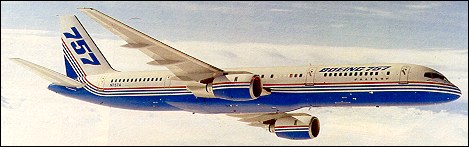
A short/medium-range airliner, having a typical capacity of 178 mixed-class, or 196 tourist-class, or a maximum high-density seating arrangement for 224 passengers, the Model 757 provides its operators with new standards of fuel efficiency, now a vital area in the economics of airline operations. The Model 757 is one of the world's most economical turbofan-powered airliners in the short/medium-range category, showing a fuel saving of 45 per cent per passenger by comparison with earlier medium-range aircraft. This results from the combination of a new advanced-technology wing, high by-pass ratio turbofan engines, and avionics equipment that enables the aircraft to be operated at optimum efficiency.
The development programme of the Model 767 was some five months in advance of that of the Model 757, principally because the go-ahead for its construction was given some eight months before that of the Model 757. Initial orders for this latter aircraft, which has the designation Model 757-200, were announced on 31 August 1978, comprising 19 and 21 respectively for British Airways and Eastern Air Lines, and after contract finalisation in early 1979, the company announced a production go-ahead on 23 March 1979. The five-month gap between the programmes was essential for Boeing's management and control of the almost simultaneous development of two new major aircraft, but the Model 757 enjoyed the benefits of work already completed on its wide-body sister, for there is a considerable degree of commonality between the two aircraft. However, some 53%, by value, of the Model 757 is being manufactured by outside companies, and major sub-contractors include Avco Aerostructures (wing centre section and fuselage keel), Fairchild Industries (overwing cabin section and wing leading-edge slats), Rockwell International (forward and aft fuselage sections) and Vought Corporation (fuselage tail cone, tailplane and fin).
Powerplant comprises two Rolls-Royce RB211-535C or Pratt & Whitney PW2037 turbofan engines, which are mounted in underwing pods, but the two launching airlines opted for Rolls-Royce
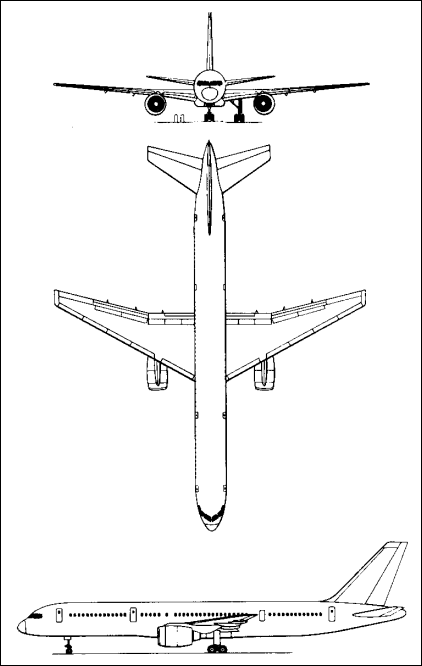
engines, and this was the first time that Boeing had introduced a new airliner with a non-American powerplant. Follow-on engines (RB211-535E4 and PW2040) are now available with greater thrust. The new-technology wing has less sweep-back than that of the Model 727, and the Model 757's fuselage is 5.97m longer. Landing gear is of tricycle type, each main unit having a four-wheel bogie, with twin wheels on the nose gear. The Model 757 is operated by a flight crew of two, or three optionally, and the advanced avionics available to them include an inertial reference system incorporating laser gyroscopes, a flight management computer system, and a digital air data computer. These integrate to provide optimum fuel efficiency when linked to automatic flight control and thrust management systems. This new generation avionics control is capable of handling an entire flight from shortly after take-off, includ-ing the landing if desirable, with the flight crew functioning as systems managers. The first flight of a Model 757 took place in February 1982, and orders and options for 632 aircraft had been received by the end of March 1990. A 757-200M Combi version is available, as is the 757-200PF Package Freighter and a corporate version.

| MODEL | Boeing 757-200 |
| CREW | 2-3 |
| PASSENGERS | 178-224 |
| ENGINE | 2 x Rolls-Royce RB211-535C turbofans, 166.3kN |
| WEIGHTS |
| Take-off weight | 104326 kg | 230001 lb |
| Empty weight | 59430 kg | 131021 lb |
| DIMENSIONS |
| Wingspan | 37.95 m | 125 ft 6 in |
| Length | 47.32 m | 155 ft 3 in |
| Height | 13.56 m | 45 ft 6 in |
| Wing area | 181.25 m2 | 1950.96 sq ft |
| PERFORMANCE |
| Max. speed | 944 km/h | 587 mph |
| Cruise speed | 900 km/h | 559 mph |
| Ceiling | 11700 m | 38400 ft |
| Range | 3985 km | 2476 miles |
| Moon, e-mail, 22.03.2015 19:54 Never worked on it but several acft. mechs. have said this was the best acft they have ever touched.Southwest really missed one when Boeing offered them at a discount to keep the line open.I'll bet they regret that discussion now.The 737-800 doesn't have the performance that is needed. reply | | Alex Heller, e-mail, 30.08.2014 17:26 I've ridden in one of these chicks transatlantic. even maxing out the range with a full load of luggage and pax the captain told me after the flight what i could describe years later as "smash off in that lambo like amocking". He told me about initially 7900fpm @MTOW up to 12000ft !!! this is the reason why that ride needed 13min for FL350 reply | | Scott Boyd, e-mail, 21.11.2011 06:06 I always thought it would have been better to shrink the 757 then lengthen the 737. The Landing gear allows a bigger fan and the wing is easy to modify.
Everyone I got to know who flew them had anything but praise. Cruise at 41,000 and watch the contrails pass underneath. reply | | James, e-mail, 21.11.2011 00:36 If it not Boeing I am not going.My 58 years as a A&P mechanic and still working,I started on B-47 in 1953 in the USAF,Then 707,720 at AA then on to 727,737,757 and 747s for to many other airlines.Now working on C-130s reply | |
| | Frank, e-mail, 05.04.2011 21:54 The 757 was not the first time that Boeing offered a foreign made engine. The 707 was offered with the RR Conway - very few sold - 90 percent chose the P&W JT-3D. reply | | Mick Skinner, e-mail, 08.03.2011 10:42 I set up the casualty maintenance section at BA for this Great airplane it followed the Boeing tradition of 'Built fine to last a long time.' As a Launch Customer of the airplane we had the usual problems of in sevice development and being one of the first Digital A /C it had many digital avionics problems but Mr Boeing soon got on top of them and assisted us to keep them flying.The many carbon fibre control surfaces also gave early problems and were not very lightening tolerant causing exit damage to the surfaces but again Mr Boeing soon fixed that. The Rolls Royce RB 211 Engines gave the A /C sports car like performance and enabled it to be at over 1000ft at the end of a runway a 747 would need to get airbourne. Overall a great member of the Boeing Family of A /C. reply | | Scott Boyd, e-mail, 31.10.2010 07:27 With the same fuselage and cabin diameter as the 707, 727 and 737 how the airline outfits it can definitely make a difference.
Living in Seattle and being based in SFO, LAX and various other places in California I jump seated on a lot of 757's as well as various 737 and MD-80 series planes. The jump seat in the 757 was by far the best. On the DC-9 series it was really cramped, which was good because if seats were open I got to sit in the back quite often on Alaska. The wiskey compass was in the rear bulkhead and a mirror on the panel was provided to see it, not enough room on the panel for it. reply | | Bob, e-mail, 26.10.2010 20:55 Re comments about passenger comfort in this aircraft: Seat design and row spacing is selected by the operator of the aircraft, not Boeing. An airline can buy and install as cheap or expensive a seat as they wish ... and install as many rows as they wish, as long as it's within the limits of electrical and oxygen lines in the overhead. reply | | Curtis Thompson, e-mail, 16.10.2010 06:56 The hugely most uncomfortable passenger craft I have ever fown on short of the Russian (xxyy) that flew us over the desert lines in southern-costal Peru. To be fair, the Russian craft performed perfectly and was never intended to provide comfort like the 757 was supposed to do. My chief complaints against the 757 (economy AND 1st class) are the grossly ill-configured seats as well as the seat space (economy).
I have flagge all future travel to never again (after a few painful trips) fly on a 757 again! reply |
| Donnie Smith, e-mail, 25.09.2010 10:47 Condor of Germany bought the first -300 model. UPS wanted Boeing to stretch it long before they decided to build the -300, but Boeing waited too late and sold very few of the -300s before production ceased completly. The 737-900 competed with about the same numbers of seats at a much reduced price.It was nice to see a retractable tail skid on the longer -300. reply | | Scott Boyd, e-mail, 23.05.2010 06:34 I did more research and there were 55 -300's built, 23 feet longer but reduced range since fuel capacity and landing gear were not upgraded. I've never seen one, that I know of. reply | | Scott Boyd, e-mail, 07.05.2010 06:22 There never was a 300 series. The 757 is a truly marvelous airplane that perfectly fitted the market between the 737 and wide bodies. The commonality with the 767 was a good idea, but never exploited.
Why the 777 and now 787 don't have the same software to do the same thing the 767 /757 did, or they don't either is something I don't understand. A type rating in a Lear covers all models, at least so far. It's purely software issues so why not update older versions to the same configuration. reply | | Searcher, e-mail, 23.04.2010 21:31 I came to the site today to find data on the 757-300. None is shown that I can find. reply | | Kiril, e-mail, 05.04.2010 00:24 I am able to offer Boeing 757 for sale. Contact me for more information.
E-mail: chochkov@aero-x.eu reply | |
| | Ned Dolan, e-mail, 07.03.2010 07:12 I don't think any 757s were operated with a 3 man crew nor did Boeing offer it in that configuration. reply | | Steve McEwan, e-mail, 21.06.2009 05:19 4400 hours as Captain on this one; absolutely the aeronautical love of my life. The ideal marriage of power and handling.
Plus, it's a good looking gal with a pretty face, long legs, and big...eh...engines! reply | | Craig Patrick, e-mail, 27.04.2009 06:13 Best looking aircraft Boeing ever built.
And re: Joseph H Peek comment, I have 622 hours on the fifty seven and I thought it was a bit twitchy in a crosswind! Apart from yhat I agree entirely. reply | | S Brittingham, e-mail, 25.09.2008 19:54 map of seating required reply | | Richard A Silva, e-mail, 27.04.2008 17:00 The heat from the tail is probably the auxiliary power unit. It provides electricity and other utilities before power up of the engines. reply | | Jon Grafious, e-mail, 24.08.2007 00:20 Do you know why there is always a heat /exhaust venting from the tail cone? I've always wondered!!! Thanks reply |
|
Do you have any comments?
|
| 
COMPANY
PROFILE
All the World's Rotorcraft
|




20
reply