|
| Frustrated in their efforts to acquire a fleet of strategic bombers for service with the Army Air Corps, US Army planners - who were devotees of the theories expounded by Brig Gen William 'Billy' Mitchell - inserted the thin end of an important wedge when they ordered a small number of YB-17 prototypes in January 1936, ostensibly for the nation's defence. Originating as the Boeing Model 299, the prototype was built as a private venture, Boeing gambling heavily on producing a winner that would bring a large military contract. It must have seemed to Boeing that their gamble had failed when, almost at the end of the military trials, the Model 299 crashed on take-off. Fortunately investigation proved that the aircraft had been flown off with the flying controls locked and safety of the basic design was not suspect.
It was not until 1938 that the USAAC was able to place an order for 39 production B-17B, the last of this batch entering service in March 1940. These were the first B-17 production aircraft to be equipped with turbocharged engines, providing a higher maximum speed and much increased service ceiling. Of the B-17C which followed, a batch of 20 were supplied to the RAF (designated Fortress I) and used operationally in Europe for evaluation, leading to improved B-17D and B-17E aircraft with self-sealing fuel tanks and revised armour and armament.
The B-17E was truly a flying fortress, armed with one 7.62mm and 12 12.7mm machine-guns for defence and able to carry a maximum 7,983kg of bombs. Most extensively built variant was the B-17G (8,680), being built by Douglas and Lockheed Vega as well as at the Boeing plant, Seattle. Pratt & Whitney R-1820-97 radial engines and improved turbochargers enabled the B-17G to operate at an altitude of up to 10,670m; and the addition of a chin turret below the nose (containing two 12.7mm machine-guns) provided better defence against the head-on attacks being launched by Luftwaffe fighter pilots in their attempts to reduce the numbers of Fortresses striking daily at strategic targets deep in German territory.
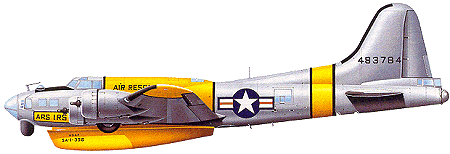
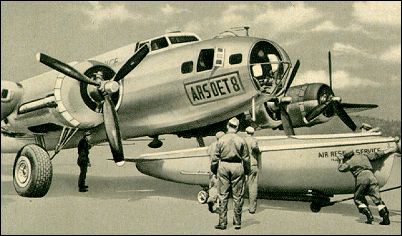
Special variants included the B-40 with up to 30 machine-guns/cannons, which was intended as a B-17 escort, but proved to be an operational failure; BQ-7 pilotless aircraft packed with explosives to be deployed against German targets by radio control, which failed due to unreliable control equipment; CB-17 and C-108 transports; and F-9 long-range B-17 equipped to serve as an air-sea rescue aircraft and able to deploy a lifeboat carried beneath the fuselage.
In Britain, more than anywhere else in the world, the B-17 evokes vivid memories of courageous aircrew who day after day - despite sometimes horrific losses - continued to attack targets in Europe until victory was won. For Boeing, their private-venture gamble paid off: a total of 12,731 Fortresses were built by the Boeing, Douglas and Lockheed team.
| CREW | 11 |
| ENGINE | 4 x Wright-Cycl. GR-1820-97, 885kW |
| WEIGHTS |
| Take-off weight | 32720 kg | 72136 lb |
| Empty weight | 24900 kg | 54895 lb |
| DIMENSIONS |
| Wingspan | 31.6 m | 104 ft 8 in |
| Length | 22.7 m | 75 ft 6 in |
| Height | 5.8 m | 19 ft 0 in |
| Wing area | 141.9 m2 | 1527.40 sq ft |
| PERFORMANCE |
| Max. speed | 438 km/h | 272 mph |
| Cruise speed | 250 km/h | 155 mph |
| Ceiling | 10700 m | 35100 ft |
| Range | 2980 km | 1852 miles |
| ARMAMENT | 13 x 12.7mm machine-guns, 8000kg of bombs |
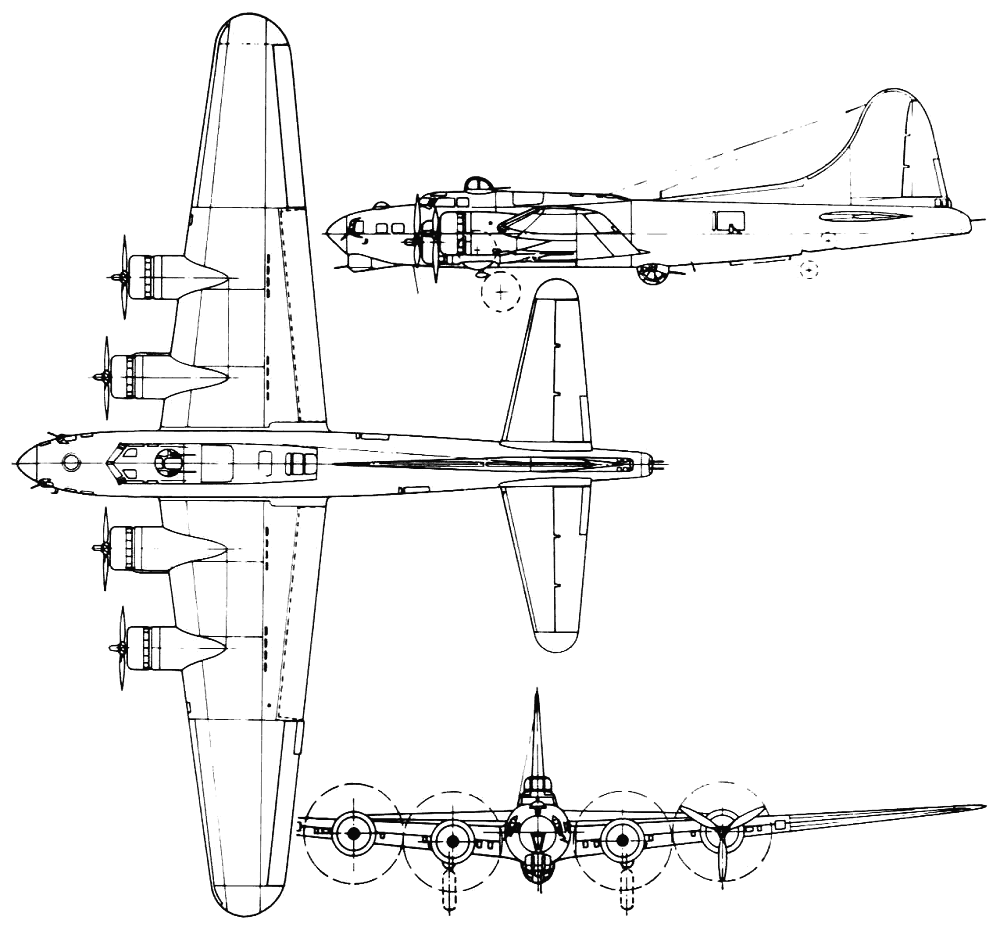
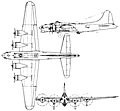 | A three-view drawing (1000 x 927) |
| C VIZZO, e-mail, 28.04.2025 15:42 Didn't they convert some B-17's for the wildland firefighting role? I've seen some pictures of them but can't find the model name. reply | | George Remlinger, e-mail, 02.11.2017 16:49 My uncle was part of the crew that flew the Golden Hind #26187. reply | | CDCox, e-mail, 23.05.2017 04:34 A good friend and ex prison worker Jack Dean Montague was a teenage B17 pilot . He is now 93 years and lives in Atascadero,Ca. reply | | Dennis Tyra, e-mail, 12.02.2017 04:21 As a kid living at Clark AFB, PI in the late '50s an all black B-17 could occasionally be seen on the ramp. It was said to be used for dropping agents into Red China. reply | |
| | JAY HODSHON, e-mail, 02.02.2017 16:25 I WROTE BACK IN 2011 ABOUT MY BROTHER IN-LAW LEO DEGRAW BEING KIA /MIA FRANCE 5DEC43 7 DIED 3 POWs I HAVE INFORMATION ABOUT THE B-17 MARY PAT & FIGHTING COCK, CHECK MY POST FROM 2011 FOR MORE! HODSHON1@AOL.COM reply | | JAY HODSHON, e-mail, 02.02.2017 16:14 MY BROTHER IN-LAW WAS KIA /MIA 5DEC43 FIGHTING COCK B-17 I HAVE A PHOTO OF HIS ORG. B-17 MARY PAT DROPPING BOMBS ON GERMANY QUESTION, HOW LONG DOES IT TAKE FOR A 500# BOMB TO HIT THE GROUND FROM 30,000 FEET OR DROP HEIGHT. THANKS JAY reply | | Morris Drees, e-mail, 05.09.2016 23:09 Flew them in the navy with a guppy radome. Forerunner of the RC121C reply | | Bob, e-mail, 04.08.2016 04:47 My uncle was a crew chief on a B-17. If I remember what my grandfather told me correctly, in north Africa, the military placed beacons on top of mountains and high hills so that at night aircraft could fly over them safely. According to my grandfather, some "unfriendlies" moved a beacon down the mountain and when my uncle's plane attempted to fly over the beacon, they instead flew into the mountain. Obviously, everyone on board was killed instantly.
My uncle was a very religious man and my grandmother was told that when they found his body some distance from the crash scene he had a smile on his face. reply | | Don Schaeffer, e-mail, 30.08.2015 21:50 As a little guy growing up during WWII, One of my families oft told stories was of my dad's cousin Robby [Robert Carle] who was a tail gunner in a B17. He was lost somewhere over the Pacific. Unfortunately, no information was forthcoming from the government at that time. I do remember cousin Robby's mom and dad who tirelessly sought some info. from any source. Their efforts were to no avail, and they like I'm sure many others went to their graves never learning anything of their loved one's disposition. Now an old man, I'll be eternally grateful for the sacrifices made by many for their countrymen and the world. Thanks guys! reply | | David, e-mail, 28.12.2014 04:28 A very close friend of mine just passed Dec 26, 2014 he was Capt. Leo Schwartz flew 52 missions in a B-17 lost many crew members on many of those missions. May he rest in peace. reply | | Leroy McVay, e-mail, 02.04.2014 19:41 No aircraft is better than it's engines. B-17 had the best engines available at it's time. In 1957 I was working on updated versions of the Wright 1820 and we loved them. Remember the B-29 almost didn't make it because of those Whright 3350 engines. reply | | John Peterson, e-mail, 18.01.2014 23:24 I was on a crew ready to go overseas just as the war in Europe ended. Two members of the crew still alive. reply |
| Basil L. Riccomini, e-mail, 09.08.2013 15:03 I well remember the B-17s of the 8th and the B-24s of the 9th in England. There was the constnt noise of airplane engines in the clouds as the USAAFs bombed by day and the RAF bombed by night I saw the B-17s return from there missions in terrible shape, how some of them were able to return to their bases was an act of God and the skill of the pilots. Many would crash on landing and catch fire and the ambulances and fire trucks would follow them down the runways. The losses of the planes and crew members were horific, but they went on their missions anyway. Because of them we do not have to speak German. They were all truly dedicated heroes. reply | | Fred Gregorich, e-mail, 19.02.2013 04:43 WWII AAC training field in Lewistown, Mt., I was told it's the only remaining WWII military training field left in tact. I've been there 3 time and all the original building remain including the large hanger, briefing building, all the activities buiding and even the little one where the Norden bomb sites were kept and guarded. My brother Ed was engineer on a B-17 at that field. He, with his crew went down one night in August of 1943 during an electrical storm. Eleven were lost due to the pilot electing to take off that nite without a horizon indicator. It had been removed for repair. That crew should never have flown that fateful night. In 1997 I visited the crash site and found my brother's one dog tag protruding from the ground in addition to many, many small pieces of that Big B-17. reply | |
| | Jiψν, e-mail, 16.10.2012 18:53 Please for help, (B) 17G 44-6640 463rdBG /information 775 BS reply | | Mark, e-mail, 20.09.2012 17:39 B-17
Πρόκειται για ένα τετρακινητήριο βαρύ βομβαρδιστικό αεροπλάνο που κατασκευάστηκε από την εταιρία Boeing για τις ανάγκες της Αμερικανικής αεροπορίας και παρουσιάστηκε το 1938. Χρησιμοποιήθηκε κατά τον Δεύτερο Παγκόσμιο Πόλεμο κυρίως για τον βομβαρδισμό Γερμανικών στόχων, ενώ συμμετείχε και σε βομβαρδισμούς στον Πόλεμο του Ειρηνικού εναντίων της Ιαπωνίας. Μπορούσε να πετάξει σε πολύ μεγάλο ύψος, σε μεγάλες αποστάσεις, μεταφέροντας μεγάλο φορτίο και μπορούσε να αμυνθεί σε εχθρικές επιθέσεις. Ήταν το αεροπλάνο με τη ρίψη περισσοτέρων βομβών από οποιοδήποτε άλλο, κατά τη διάρκεια του πολέμου
Το B-17 ενισχύθηκε με τέσσερα πυροβόλα όπλα των 12.7 χιλιοστών και ένα τον 7.62 χιλιοστών στην έκδοση B-17C. Η τελική του έκδοση B-17G περιλάμβανε και έναν περιστρεφόμενο πυργίσκο στο μπροστινό μέρος στον οποίο βρισκόταν ένα M2 Browning πολυβόλο, δίνοντάς του μεγαλύτερη ευελιξία στις κατά μέτωπο επιθέσεις. Η αξιοπιστία του, αλλά κυρίως ο βαρύς οπλισμός του για την άμυνα από επιθέσεις εχθρικών μαχητικών, του έδωσαν τον τίτλο του "ιπτάμενου φρουρίου" (flying fortress) και στη διάρκεια παραγωγής του, κατασκευάστηκαν από τη Boeing, περίπου 12.000 τέτοια αεροπλάνα reply | | Richard Taylor, e-mail, 01.08.2012 21:30 In 1945 my uncle, Flight Sergeant Victor Taylor, was piloting a B17 over the Bay of Biscay on a meteorological survey. When the flight engineer reported an engine fault Victor stabbed the prop feathering /engine cut button. He either pressed the wrong one, or else they were incorrectly wired, and ended up at 300 feet over a rough sea with two dead engines one side!
He was one of only three survivors and told me that the aircraft in which they were flying was in poor shape after many a bombing raid. reply | | Kevin Zimmerman, e-mail, 17.06.2012 03:02 Looking for info or images on "The Golden Hind" 26187 on tail reply | | George Townsend, e-mail, 08.05.2012 20:20 I was in high school in Missoula MT 3 /1 /1943. Dropped out and went to Seattle, worked at Boeing Building B17's (riviter)until June; then joined US Navy.
George B Townsend USMC (RET) reply | | Frank Nelson Lcdr USN Ret, e-mail, 09.10.2011 00:07 Following WW II the Navy obtained 17 B-17's, stripped the armament, installed an APS-20 radar with two scopes in the bomb bay and sent them to NAS Patuxent River designated PB-1W. Squadron VX-4 developed the airborne-CIC concept and I joined the squadron as an Naval Observer /Controller in May 1952 just before it became operational as VW-2 (along with VW-1 on the West Coast). The PB-1W was an important variant and deserves recognition here. Follow-on Constellations became barrier and weather recon squadrons and eventually AWACS but the concept was impregnated and nurtured in the bellies of Navy B-17s. reply |
|
Do you have any comments?
|
| 
COMPANY
PROFILE
All the World's Rotorcraft
|




20
reply