|
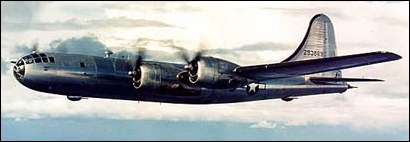
| The outbreak of war in Europe in 1939 made it essential that USAAC planners should at least talk about long-range bomber projects, and the initial identification of such was VHB (very heavy bomber). When it seemed likely that such an aircraft might have to be deployed over the vast reaches of the Pacific Ocean the identification VLR (very long-range) seemed more apt, and it was the VLR project which General Henry H. ('Hap') Arnold, head of the USAAC, got under way at the beginning of 1940.
Requests for proposals were sent to five US aircraft manufacturers on 29 January 1940: in due course design studies were submitted by Boeing, Consolidated, Douglas and Lockheed, these being allocated the respective designations XB-29, XB-32, XB-31 and XB-30. Douglas and Lockheed subsequently withdrew from the competition, and on 6 September 1940 contracts were awarded to Boeing and Consolidated (later Convair) for the construction and development of two (later three) prototypes of their respective designs. Convair's XB-32 Dominator was the first to fly, on 7 September 1942, but extensive development delayed its entry into service.
Boeing, because of the company's foresight, was much further along the design road in 1940, and being able to convince the USAAC that it would have production aircraft available within two or three years, had received orders for more than 1,500 before a prototype was flown. The reason for the advanced design state of Boeing's proposal was due to the fact that as early as 1938 the company had offered to the USAAC its ideas for an improved B-17, with a pressurised cabin to make high-altitude operations less demanding on the crew. While there was then no requirement for such an aircraft, the US Army encouraged Boeing to keep the design updated to meet the changing conditions of war. This was reflected by designs identified as Models 316, 322, 333, 334 and 341. The design for the XB-29 was a development of the Model 341, designated Model 345, and the first of the prototypes made its maiden flight on 21 September 1942.
The USAAC's specification had called for a speed of 644km/h, so the XB-29 had a high aspect ratio cantilever monoplane wing mid-set on the circular-section fuselage. Because such a wing would entail a high landing speed, the wide-span trailing-edge flaps were of the Fowler type which effectively increased wing area by almost 20%, thus allowing a landing to be made at lower speed. Electrically retractable tricycle landing gear was provided and, as originally proposed by Boeing, pressurised accommodation was included for the flight crew. In addition, a second pressurised compartment just aft of the wing gave accommodation to crew members who, in the third XB-29 and production aircraft, sighted defensive gun turrets from adjacent blister windows. The crew and aft compartments were connected by a crawl-tunnel which passed over the fore and aft bomb bays. The tail gunner was accommodated in a pressurised compartment, but this was isolated from the other crew positions. The powerplant consisted of four Wright R-3350 Cyclone twin-row radial engines, each with two General Electric turbochargers mounted one in each side of the engine nacelle.
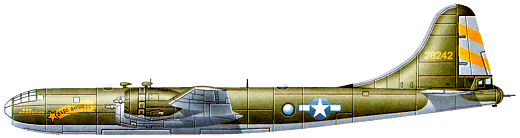
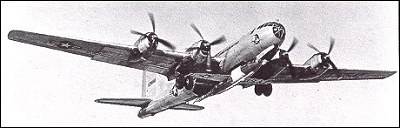
Prototype production was followed by 14 YB-29 service test aircraft, the first of these flying on 26 June 1943. Deliveries of YB-29s began almost immediately to the 58th Very Heavy Bombardment Wing (VHBW), a unit which had been established on 1 June in advance of the first flight. B-29 production was the most diverse aircraft manufacturing project undertaken in the USA during World War II, with literally thousands of sub-contractors supplying components or assemblies to the four main production plants: Boeing at Renton and Wichita; Bell at Marietta, Georgia; and Martin at Omaha, Nebraska.
B-29 production totalled 1,644 from Boeing's Wichita plant, with 668 built by Bell and 536 by Martin. The Renton plant produced only the B-29A variant, with slightly increased span and changes in fuel capacity and armament: production continued until May 1946 and totalled 1,122 aircraft.
The designation B-29B related to 311 of the aircraft built by Bell. These were reduced in weight by removal of all
defensive armament except for the tail guns, which were then unmanned, being aimed and fired automatically by an AN/APG-15B radar fire-control system. The production total of nearly 4,000 B-29s of all versions must be regarded as very large, having regard to their size and cost, and it is not surprising that they saw a wide variety of employment in the post-war years, operating under several designations. A number of B-29s were used operationally during the Korean War.
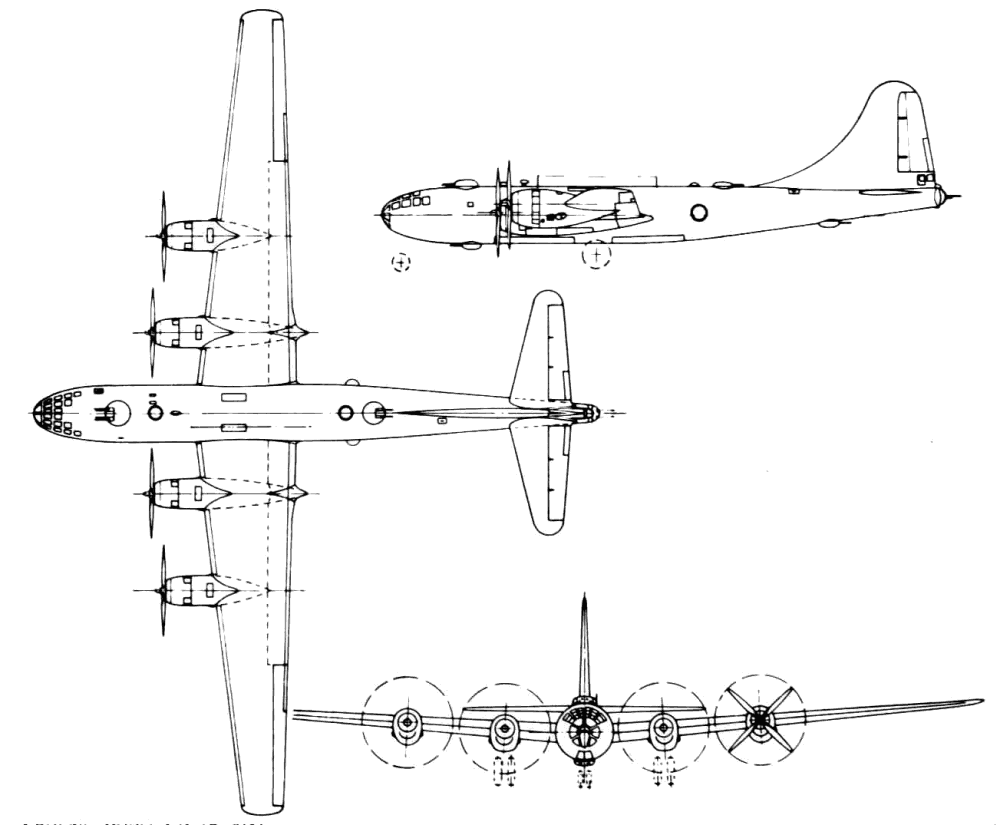
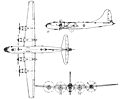 | A three-view drawing (1000 x 825) |
| MODEL | B-29 |
| CREW | 10 |
| ENGINE | 4 x Wright R-3350-23-23A/-41 Cyclone 18, 1641kW |
| WEIGHTS |
| Take-off weight | 56245 kg | 124000 lb |
| Empty weight | 31815 kg | 70140 lb |
| DIMENSIONS |
| Wingspan | 43.05 m | 141 ft 3 in |
| Length | 30.18 m | 99 ft 0 in |
| Height | 9.02 m | 30 ft 7 in |
| Wing area | 161.27 m2 | 1735.89 sq ft |
| PERFORMANCE |
| Max. speed | 576 km/h | 358 mph |
| Cruise speed | 370 km/h | 230 mph |
| Ceiling | 9710 m | 31850 ft |
| Range w/max.fuel | 5230 km | 3250 miles |
| Range w/max payload | 2880 km | 1790 miles |
| ARMAMENT | 11 x 12.7mm machine-guns, 9000kg of bombs |
| Earl Erickson, e-mail, 19.09.2010 21:12 I went to texas for school for b29s in 53 and was sent to england with the 582nd air resupply we did covert operations in europe.we had 12 b29s 4 C119 5 SA16s.we had 2 sister flights,581st in korea,580th in triple,the 29s were alot of maintenance but a great ship 763-234-6501 reply | | DUANE R. RATCLIFF, e-mail, 10.09.2010 01:39 I WAS ASSIT.CREW CHIEF,FLT ENG 352ND BSQDN 301ST BM WING STA SALINA KS 1949 & BARKADALE AFB SHREVEPORT LA.UNTIL JUL 54 CONVERTED TO B-47E JET BMER 1953 STILL HAVE NAMES AND TAIL NO,S OF ACFT, NAMES OF PERSONEL WE WERE THE BOX A ON VER. FIN WE WERE A BM CARRIERS WE COVERED EUROPE FROM ENGLAND. OUR HNGER NO WAS 12 BAFB ONCE AIRBORNE SHE WAS GREAT EXCEPT FOR 3350'S THE B-50 WA SUPER WITH 4360'S ENG'S BOEING WICHITA IS RESTOREING B-29 NAMED DOC TO FLY 316-682-6488 reply | | safety valve, e-mail, 30.06.2010 06:42 I have some ideas, thank you for sharing, I really like the safety valve reply | | Bill McElman, e-mail, 17.07.2010 16:48 Was in the 407th Periodic Maint Squadron serving the 407th Air Refueling Squadron at Malmstrom AFB back in '54-'56. The 29 was converted to a KB but the B-135's were coming on line and the '29 just wasn't fast enought to refule the jets fighters. Anyone still around from the old wing? reply | |
| | CHINESE WINGMAN, 08.08.2010 11:15 BRILLIANT NO OTHER SINGLE MAKE OF PLANE BOMBED THE EVIL JAPS BACK TO THE STONEAGE AND EXTERMIATED HUNDREDS OF THOUSANDS OF THEM IN THE LAST YEAR OF WAR! reply | | Jack Cramer, e-mail, 11.08.2010 23:36 Charles Chauncey (above) was pilot of "Goin Jessie", I was navigator. Jessie was the most famous B-29 in the Tinian community, including Enola Gay. In addition to never aborting, Jessie was picked to drop the 2,000,000 ton of bombs dropped by the AAF in WWII (Wakayama, July 9,1945).Chauncey failed to mention that our crew chief, Curly Klabo was awarded the Legion of Merit personally by Gen Spaatz! reply | | Harry George, e-mail, 07.06.2010 00:09 Hi to the person who asked for contact with any B-29 crew that flew POW missions at the end of WWII. I was an Aircraft Commander , 6th Bomb Group, 313th Wing stationed on Tinian Island in the Marianas Group up to about 1 November 1945 I flew several POW missions to Weisheen (sp?) China and Japan. We used Iwo Jima as our staging point. If anyone was on the ground in one of those awful looking camps be glad to chat with you by E mail. Better hurry, I turn 90 at the end of this month (June 2010) reply | | Phil Kaufman, e-mail, 19.08.2010 18:15 I was asst.crew chief with the 6091st Recon.I had the dubious honor of ferrying one of the last B-29s back to China Lake ca. to be used as target practice and experimental ordinance demolition tests.We were the "mothership" for several B-26s being returned to the states for a fate unknown...We did the navigation and had to make many island stops for fueling the B-26s..even though they had 500 Gal. tanks in the bomb bay. reply | | grady stoodt, e-mail, 21.08.2010 20:35 The B-29 was the largest plane in WWII, and it was the plane that delivered the A bomb. reply | | joe geruntino, e-mail, 18.05.2010 21:15 i believe that i was in the last b-29 outfit at griffis a.f.b.
in rome n.y. in 1958-59 the 4713th we were in adc ,our mission was early warning research if my memory is correct we had 12 b-29s which were replaced with b-57s i was transferred to otis a.f.b.to complete my hitch on rc-121d&h the 551st fm until april 1951 both a /c were great the confederate air force still flies a b-29 at air shows reply | | chet druelinger, e-mail, 27.08.2010 20:37 I WORKED B29S FROM 1947 THRU 1948 WITH THE 97TH BW 72ND RECN ANDKB29MS WITH 9TH AIR REFULING SQUADRON AT TUCSON AZ.AND MTN HOME IDA FROM 1949 THRU 1964 AT THAT TIME WE GOT KC97S BOTH WERE GREAT AIRCRAFT reply | | Chip Chaffin, e-mail, 28.08.2010 05:07 My grandfather helped build the B-29 at the Marietta Georgia plant. His job was mounting the machine-guns. reply | | Dick Doll, e-mail, 12.05.2010 05:56 I was assigned to the 19th Bomb Group (HQ) at Kadena AFB,
Okinawa from 52-54 - Korean War. I was the Engine (R-3350)
Buildup Inspector which included seven stages & ended up a
Power Pack ready for installation on B-29. Returned to
Randolph AFB, TX as B-29 Crew Chief till discharge Feb.55 reply | | Charles Scott, e-mail, 25.03.2010 07:07 I grew up about a mile West of Pratt Army Air Base which served, I believe as a modification site as well as housing the 502nd Air Base Squadron training aircrews who ultimately departed for India in 1944. I still remember attending the Base Open House in late 1943. I would see many flights of the aircraft every day as our house was under a right base leg for landing on what would have been Runway 13. A photo of the old airfield is found on its site at en.wikipedia.org /wiki /Pratt_Army_Airfield / I can still vividly recall the many flights made over our house over which these aircraft must have descended to less than 400 feet. As a result, the plaster in the ceiling of our farmhouse was cracked in many places. I remember the Army Air Corps gave my father about $50 to use for the new product, gypsum sheetrock. Long closed in 1945 as a military installation. there remains operational a powerful part of the old instrument system used at the time. It has been converted to a non-directional beacon (PTT) and is so powerful that once I was returning to Pratt from a symposium and I believe I recall tuning it in over a hundred miles away. The site now houses a very nice Veteran's Memorial at prattveteransmemorial.org / I treasured this memory of the B-29s and it later contributed my becoming a civilian flight instructor. I would invite any who read this to visit the wikipedia sites. Though many of the buildings are gone (some old barracks were cut down to one-story and moved to Pratt where people made them into homes) most of the streets are still there, and though this wanders some from the B-29 topic, some may find the wiki sites interesting which of course, leads to more B-29 information. I sure remember the sound of those low-flying Wright R-3350's. Never forget the contribution men flying this airplane did to end the war with Japan. reply | |
| | George Lockwood, e-mail, 18.03.2010 19:16 What a plane. To me it came 2nd after the P-38. I was crew chief on B-29s at Harmon Field on Guam from Dec. '44 thru Nov.'45. Worked P38's at oxnard field in Alburqye, New Mex. reply | | Greg Roth, e-mail, 02.03.2010 00:22 I am looking for what position an airial observer would do in regard to b29s. My father - Roy D. Roth - was with the 20th Air Force on the ground but had the wings of an airial observer. I think he flew across the hump a lot but I don't know why. Maybe to get injured b29s back. reply | | michael gold, e-mail, 25.02.2010 02:28 Trying to locate a Michael Caroll B-29 Gunner from the end of the combat crew training at Randolph around 1952. Would have gone to Kadena from Randoplh. Originally from upstate New York. (Newburgh) reply | | Eddie Stough, e-mail, 24.02.2010 03:34 Lots of time on the B-29. Crew Chief, Dock Chief, Flight Chief and Flight Engineer At Randolph AFB. reply | | Charles, e-mail, 04.02.2010 09:04 My Dad logged 1145hrs in the B-29 out of Maxwell Field, Ala; MacDill, Fla; Castle Field (Merced), Calif; Morrison Field, Fla; Fairfield-Suisun, Calif (Castle, Morrison & Fairfield were all with the 55th Recon VLRW). Then from Sept '47 to Sept '49 at Anderson AAF, Guam (20thAF - FEAF 93rdBS, 19thBG), As I understand, these were mostly "Show Of Force" missions (Guam-Tokyo-Guam runs). Can anyone verify this?
Dad was a 1st Lt. Aircraft Commander at the time. Jake S. Bishop Jr. (Ret 0-4 1961. Dec 1970).
Does anyone remember flying with him? If so, please contact me via e-mail. reply | | Bob Wilkenloh, e-mail, 03.02.2010 19:09 I was a left gunner on a B-29 and flew 30 missions over Korea with the 345th from Yakota. The B-29 was a great bomber. The only problem using it in Korea was that the RCT gunnery system was not made for use against jets. It was great for use against prop driven fighters. That is why they went to night missions. reply |
|
Do you have any comments?
|
| 
COMPANY
PROFILE
All the World's Rotorcraft
|