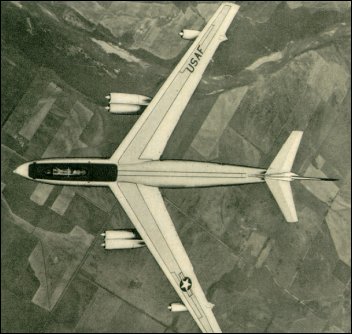
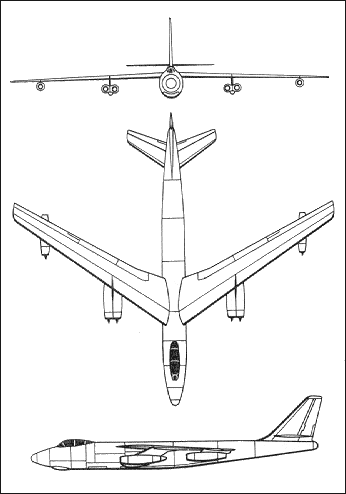
The B-47's production was spurred in 1944 by the War Department's demand for jet bombers. In contrast to the B-45, and other concurrent proposals, the B-47 design, as finally approved, included radically new features. Foremost were the aircraft's thin swept wings which, coupled with 6 externally mounted jet engines, promised a startling, high-speed bomber, probably capable of carrying out effective operations for the foreseeable future despite an enemy's fighter air defense. Undoubtedly, the B-47 lived up to expectations. More than 2,000 production models were bought, and some B-47 versions, true production models or post-production reconfigurations, remained in the operational inventory for nearly 2 decades. Yet few aircraft programs witnessed as much development, production, and post-production turbulence as the B-47 did. To begin with, there were arguments about cost and plant location and after 1947, complaints by Boeing that the newly independent Air Force had laid additional requirements that changed the concept of the overall program. Also, the secrecy which shrouded the development of atomic weapons, long after the atomic attacks on Japan, increased the difficulty of preparing the B-47 to handle every new type of special weapon-a problem shared by the B-36 and B-45. Ensuing events only compounded the initial disarray.
As it had for the B-36, the Truman Administration's stringent financial restrictions worked in favor of the B-47. Pressed for money, the Air Force decided to buy more B-47s instead of purchasing additional B-50s or future B-54s, since neither one of those rather expensive bombers had any growth potential. Hence, even though the B-47 was yet to fly, the initial production order of 1948 was increased in mid-1949. The subsequent Korean War, rising world tensions, and mounting urgency to build an atomic deterrent force raised the tempo of the B-47 program. In December 1950, the Air Force foresaw a monthly production of 150 B-47s, but still recommended changes, making it almost impossible to settle on an acceptable type. Other factors made matters worse.
The B-47 was the first USAF bomber to receive a weapon system designation, a move prompted by the Air Force recognition that the rising complexity of weapons no longer permitted the isolated and compartmented development of equipment and components which, when put together in a structural shell, formed an aircraft or missile. However, this was as far as the B-47 benefited from the new developmental philosophy. The Boeing air-frame was built without adequate consideration for its many crucial components. In turn, the components, subcontracted or furnished by the government, were behind schedule and when provided, did not match the sophistication of the high-performance B-47.
In 1951 alone, the Air Force took delivery of 204 B-47Bs, none of which were suitable for combat. The aircraft's canopy was unsafe; the B-47B had no ejection seats (a deficiency shared by 200 successive B-47s); the bombing and navigation system was unreliable; a new tail defense system was needed; and the jet engines were creating unique development problems such as fuel boil-off at high altitudes, which reduced the aircraft's range-already shorter than anticipated. In sum, the hasty production of an aircraft as revolutionary as the B-47 proved to be costly, generating extensive, unavoidable modification projects like Baby Grand, Turn Around, High Noon, and Ebb Tide. Yet once accomplished, the B-47 modifications worked.
Finally deployed overseas in mid-1953, the B-47s totally replaced the obsolete, atomic-carrier B-50s by the end of 1955, when new B-47 production models were delivered that could carry larger fuel loads and thus had greater range. After the B-47 demonstrated that it was rugged enough for low-altitude bombing, some of the aircraft were again modified to satisfy a new set of requirements levied in 1955. These modifications also worked, and in 1957, the Air Force publicly demonstrated its new low-altitude, strategic bombing tactics, an achievement marking the beginning of an era in aeronautics.
Despite its convoluted start, the B-47 program proved successful. The aircraft served in various roles and was involved in many experimental projects, some connected to the development of more sophisticated atomic weapons, like Brass Ring, or with the development of air refueling or other endeavors of great significance to the Air Force. Strategic Air Command's last B-47s went into storage in early 1966, while a few converted B-47 bombers and reconnaissance models kept on paying their way for several more years, remaining on the Air Force rolls until the end of the 1960s.
My father, Domingo Delgado Garcia, was stationed at Lincoln between 1956-1960. He was a B-47 Flightline Mechanic, who worked on the tail side radar /gun system of the B-47. He has some nice pictures of his tour of duty there. He is 85 years old today.
Greetings. My name is Joe B. Nunez and was a Crew Chief on the B-47 stationed at Davis Monthan. I served from 1956 -1960. Would love to hear from others that were stationed there at the time.
Good morning Joe; I was in the 43 rd and then 303 rd A & E squadron in camera section from Feb 1956 to July 1959. I very likely met you at some point as I worked on the planes. Hot days and cold nights on that flight line. Did two rotations to Guam. I married a girl in Tucson and stayed here after discharge. My wife has Nunez on one side of the family, could they be related to you. Do you remember the night that the JATO bottles fired on one of the planes? I was working on the plane just behind it and the Captain told everybody to run. Take care and best of luck.
Was stationed at Greenham Common UK 9 /51 to 9 /53. The base was resurrected from WW II, 1946 closing. The runways were reconstructed for the B47 which showed up, end of 53 or 54. We were all shipped out as SAC took over in 9 /53. I went to Berton Wood & later to Moleworth. Finally got home in Oct.1954. I found out later Greenham Common had Nukes on it, evidently that's what the bunkers were for with AC. The prime minister, Thather had to close the base in 1980 due to protests. Quite history for such a miserable place.
I was a jet engine mechanic on the B-47s at Mt. Home Air Force base from 1962 to 1966. I would like to hear from anyone who also served there during this time period.
Jeri White Shlemon, e-mail, 08.03.2022 Lyle Curtis
Lyle Curtis sir,
Unbelievable but I just received your email from a year ago. My father was Jerry Don White...assigned to Lockbourne AFB in 1957, 1958 - did you serve with him?
I was a copilot at Forbes from 1961 t0 1964. I went commercial in 1967. I used the design problems of the B-47 to teach new commercial pilots the "why" of many systems which evolved from the B-47. I taught Mostly Boeings: 707, 727, 737, 757 and the DC-9. I enjoyed flying the B-47, but most of our time was spent standing alert!
just rememberd that the movie STATEGIC AIR COMMAND WAS FILLMED PARTLEY AT MACDILL WHEN I WAS THERE IN 52 .IT FETURED JIMMY STUWART AND JUNE ALLISON,BUT I NEVER GOT TO MEET THEM.YOU CAN STILL FIND IT IN VIDEO RENTAL STORES ON VCR TAPE.
I was stationed at MacDill in 1951 when we got the first 47's assigned to the AF.at first I was a ramp rat in the AP's guarding them and then I went to tech school in Amarillo AFB for airframe repair.i WAS THEN BACK TO MacDill ASSIGHNED TO THE 306TH FLD MAINT SQDN AND WORKED ON 47 'S we had a lot of problems with trailing edge ribs and flaperons.we also had trouble replacing the belly radomes ,they never seemed to fit when we reinstalled the new ones ,kind of a "if it don't fit, force it'.I was transferred to SEDALIA AFB '(now Whitman)340th bm.wing the last 9 months of my tour of duty in 1954.and married my wife from Tampa FLA. while stationed at Sedalia AFB AND WAS DICHARGED DEC. 7 1954. Many times I have wished I would have re-upped but at the time we were living at the poverty level as an a /2c,I got my 1 /1c rank a few days before mustering out.TOO LATE!
Hi to Tom Poston and Royal Melcher i was stationed at Hunter AFB from July 1956 until October 1959. I remember when that accidentall firing of the 20mm tail cannon fired into a parked B47 behind it on the ramp. I was an Airframe Repairman in the 2nd Field Maintenance. I was a tug driver that hauled the JATO bottles to the Planes on the loading area. I also remember the midair collision of a B47 from McDill and a F86 in Feb 1958 the B47 crew got permission to jettison a Mark 15 7600 lb Nuke into Tybee island sound. The F86 pilot bailed out and the B47 landed at Hunter. I would like to hear from anyone in the 2nd Field Maint. sguadron especially George Gorski from Winter WI or Ron Heck from WV
I read all the comments....very interesting. I was a crew chief in the 93rd Bomb Sqdn, 19th Bomb Wing at Homestead and Pinecastle AFB's 1955-1958 on 51-1338 and 51-2221. I was with 221 on.a special flight from Homestead at Nouasseur AB in Morocco when I was severely injured in an auto accident and never recovered enough to return to my squadron and was medically discharged in Sept. 1958. My airplane was one each good one, but did suffer chronic landing gear problems after being severely damaged landing short of the runway during a rainstorm at Abilene (later Dyess) AFB during a hurricane evacuation........terrible conditions, no fault of the pilots, Major V.L.. Pfantz and Capt. M. K. Walker. AOB was Capt. R. K. Reynolds....Terrific Crew!
Flew back seat RB-47E, 90th SRW at Forbes AFB, Topeka and Ben Guerir in Marrakesh FR Morroco 1954-1955. Loved this forgotten airplane. Flew B-29s during the forgotten war in Korea. I will not forget, however, the fond memories I have for the great maintenance crews and pilots I served with.
I was stationed at Channault AFB in 1958 when a B-47 jumped the chaulks, caught fire and caused leakage from the nuclear weapon on board. Does anyone have any information about this incident? Appreciate your help.
I always look at this website hoping to see someone I know I was at Walker,PeaseLincoln and tdy to spain and England.Illnever forget being at Upper Heyford when JFK was going to blow up the world over Cuba.Good times and bad times.
A /2c rank frozen never progressed.1957-1960 Pease AFB 100th BW arrived as a Bomb Nav mech was transferred to ECM.I remember the flight line as a very dangerous place to be and I was on that flight line for 3 1 /2 years. TDY to Brize Norton and northern Africa. Served with a great bunch of guys Would like to hear from anyone that served at Pease including the 509th.
SMSGT Clarence E. Greenawalt, e-mail, 19.05.2016 04:25
I began maintining the B-47 aircraft in 1953 at Lockbourne AFB,Ohio.(376th Bomb Wing). In 1957 I became a crew chief and qualified for "hazard duty pay" (Flight Pay)of $55 per month.I flew for the next 8 years til transferring to Lincoln Nebraska(98th Bomb Wing).I was sent tdy to Davis Monathan Air Base,Az. to assist the civilians in moth balling 42 of our B-47's.Then in 1965 while at Lincoln Mac needed maintenance men as the C-141 was coming into being so we all got orders and I ended up in Kadena , Okinawa.I'll never forget the love I had for the B-47 aircraft.So many great memories !
Jeri White Shlemon, e-mail, 18.09.2021 SMSGT Clarence E. Greenawalt
Dear Mr. Greenwalt,
I hope I am not too tardy in responding to your post of 2016...I am the daughter of Jerry Don White, an airman assigned to Lockbourne AFB I am certain (at least) in the year 1958 (the year I was born and my BC and all other facts confirm this truth).
Fast forward to today 9 /18 /2021.
SMSGT Clarence Greenawalt it would be an honor to hear from you.
PS: My father, Jerry D White died at 30 years of age of a very strange autospy finding - massive coronary attack and had the insides of a 90 year old man...1969...I was so young and no one in our family understood the real truths.
Jeri White Shlemon, e-mail, 11.09.2021 SMSGT Clarence E. Greenawalt
Perhaps, Mr. Greenwalt, you are still living...my father was Jerry Don White, and was A1 Airman in 1957-1959 Lockbourne AFB...My father died at age 30 of very unusual circumstances. After leaving AF in 1959, he went on to work for a DoD contractor...LRMS...Geotech...interesting, I (his daughter) work for Raytheon Technologies (for past decade), formerly Hughes Aircraft, E-Systems and truckload of contractors...all roads lead to me, my father and SAC - a very peculiar set of circumstances.
It would so please me if you were still living on this plane...would be extremely interesting to speak with you Sir.
Dick Weigman, 5 /17 /16. I flew RB -47's and EB-47's at Lockcourne AFB, Columbus Ohio Aug 1954 to May 1964. Accruded about 2,500 hrs in the beauty and was one among a few 1stLt Instructor Pilots. I loved flying this beauty, but had nothing but respect for the classy lady or she'd bite you real hard in the behind in an instant of disrepect. The swept back wings were nothing to joke about especially on this aircraft. The only swept back bomber of it's kind, if I'm not mistaken. She's one of the classic aircraft on the clasic postage stamps.
Jeri White Shlemon, e-mail, 11.09.2021 Dick Weigman
Dear Sir,
I am the daughter of a Veteran USAF, AF1 Jerry Don White, stationed out of Lockbourne AFB in 1956-1959. He was assigned to SAC. My father died at age of 30 years of age of an extremely strange disease. He left 4 children and a wife (my mother). In 1960, he worked for DoD Contractor GEOTECHNICAL (LRMS) and prior to his sudden death, worked for Merrill Lynch Pierce Fenner & Smith (that's a whole different rabbit trail)...I, his firstborn daughter, am employed by Raytheon Tech, formerly Intelligence Information & Systems (formerly Hughes Aircraft, E-Systems and incredible list of DoD contractors - endless)...as fate would have it...I have been privy to an extreme amount of information for which I would never compromise my position within my company. I possess information and truths for which I cannot turn back...my entire life's mission is to get the truth out...help people (descendants, survivors...or whatever)...I'll never stop....perhaps I'll be blessed in hearing from you.
I was A /1c asst crew chief on A /C 0060 at Wichita AFB {Mc Connel) 1952-53.3520 Maint Sqd.It was a great experience. We trained the first pilots who then went to the SAC bases. It was great time in my life.
My father, James E. Kitchens (Kit) passed away a couple days ago. I heard a story from my brother about him riding in the "suicide seat" and having to climb down with a rope around his chest to stomp on the landing gear so it would move enough for the hand-crank to engage, all during final approach. Dad served from '47 to '67. If anyone knew my dad, and has any stories about him, please feel free to contact me at kekitchens at Hotmail dot com. Thanks.
I was a Bomb /Nav tech at Little Rock assigned to 70th A&E and also 384th A&E 1960 to 63. Enjoyed my time there. Cross trained to F105 Fire Control and then to Itazuke and Yokota in Japan.


 Lyle Curtis



Good morning Joe;
I was in the 43 rd and then 303 rd A & E squadron in camera section from Feb 1956 to July 1959.
I very likely met you at some point as I worked on the planes.
Hot days and cold nights on that flight line.
Did two rotations to Guam.
I married a girl in Tucson and stayed here after discharge.
My wife has Nunez on one side of the family, could they be related to you.
Do you remember the night that the JATO bottles fired on one of the planes? I was working on the plane just behind it and the Captain told everybody to run.
Take care and best of luck.
reply