|
| Most post-World War II bombers evolved from military requirements issued in the early or mid-forties, but none were produced as initially envisioned. Geopolitical factors accounted for the programs; the military threat, varying in degrees of intensity through the years, never ceased to exist. While these factors justified the development of new weapons, technology dictated their eventual configurations. Strategic concepts fell in between, influenced by circumstances as well as the state-of-the-art. Thus the B-36, earmarked in 1941 as a long-range bomber, capable of bearing heavy loads of conventional bombs, matured as the first long-range atomic carrier. The impact of technology was far more spectacular in the case of the B-52, affecting the development of one of history's most successful weapon systems, and the concepts which spelled the long-lasting bomber's many forms of employment.
As called for in 1945, the B-52 was to have an operating radius of 4,340 nautical miles, a speed of 260 knots at altitude of 43,000 feet, and a bombload capacity of 10,000 pounds. Although jet propulsion had already been adopted for the smaller B-45 and B-47 then under development, the high fuel consumption associated with jet engines ruled against their use in long-range aircraft. But what was true in 1945, no longer applied several years later. After floundering through a series of changing requirements and revised studies, the B-52 project became active in 1948. Air Force officials decided that progress in the development of turbojets should make it possible to equip the new long-range bomber with such engines. The
decision, however, was not unanimous. Money was short, B-52 substitutes were proposed, and it took the deteriorating international situation caused by the Korean conflict to ensure production of the jet-powered B-52-the initial procurement contract being signed in February 1951.
While technological improvements received top priority when new weapons were designed, untried technology was a tricky business. Hovering over the B-52 weapon system was the specter of the B-47's initial deficiencies. As a result, the B-52 was designed, built, and developed as an integrated package. Components and parts were thoroughly tested before being installed in the new bomber. Changes were integrated on the production lines, giving birth to new models in the series, a fairly common occurrence. Yet, in contrast to the usual pattern, B-52 testing only suggested improvements, and at no time uncovered serious flaws in any of the aircraft. In fact, Maj. Gen. Albert Boyd, Commander of the Wright Air Development Center, and one of the Air Force's foremost test pilots, said that the B-52's first true production model was the finest airplane yet built.
Initially flown in December 1954, the B-52's performance was truly impressive. The new bomber could reach a speed of 546 knots, twice more than called for in 1945, and could carry a load of 43,000 pounds, an increase of about 30,000 pounds. Still, most of the early B-52s were phased out by 1970, due to Secretary of Defense Robert S. McNamara's mid-sixties decision to decrease the strategic bomber force. However, the later B-52G and H-models, and even some of the earlier B-52Ds, were expected to see unrestricted service into the 1980s.
By mid-1973, the B-52s had already compiled impressive records. Many of the aircraft had played important roles during the Vietnam War. Modified B-52Ds, referred to as Big Belly, dropped aerial mines in the North Vietnamese harbors and river inlets in May 1972. In December of the same year, B-52Ds and B-52Gs began to bomb military targets in the Hanoi and Haiphong areas of North Vietnam, where they encountered the most awesome defenses. Although the B-52s were often used for purposes they had not been intended to fulfill, after decades of hard work they remained one of the Strategic Air Command's best assets.
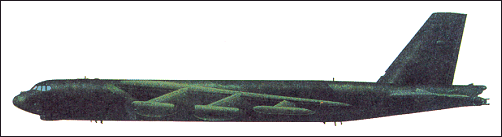
| CREW | 6 |
| ENGINE | 8 x turbo-jet P+W TF-33-P-3, 75.7kN |
| WEIGHTS |
| Take-off weight | 221350-226000 kg | 487996 - 498247 lb |
| Empty weight | 111350 kg | 245486 lb |
| DIMENSIONS |
| Wingspan | 56.4 m | 185 ft 0 in |
| Length | 47.6 m | 156 ft 2 in |
| Height | 12.4 m | 41 ft 8 in |
| Wing area | 371.6 m2 | 3999.87 sq ft |
| PERFORMANCE |
| Max. speed | 1070 km/h | 665 mph |
| Cruise speed | 900 km/h | 559 mph |
| Ceiling | 18300 m | 60050 ft |
| Range w/max.fuel | 16000 km | 9942 miles |
| Range w/max payload | 11800 km | 7332 miles |
| ARMAMENT | 4 x 20mm machine-guns, 34000kg of bombs and missiles |
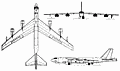 | A three-view drawing (1000 x 592) |
| Arnold Brylski, e-mail, 08.03.2022 04:57 Ellsworth AFB 59-63 AFSC 32370G reply |
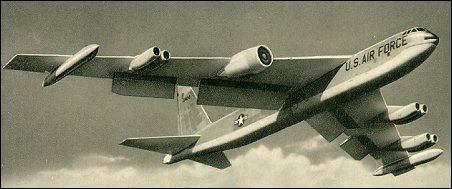
| Ned, e-mail, 05.06.2020 19:52 Participated in several raids into Hanoi area in Dec '72 as a co-pilot. Approaching from the south /southwest could see a glow in the sky far ahead. Getting closer things became more distinct---missiles racing into the sky, explosions everywhere. It was the biggest fireworks show I ever saw and thought there is no way we are going to get through. The Charge of the Light Brigade came to mind --- "cannons (missiles) on the left, cannons on the right------. Missiles by the dozen were coming up. I ducked instinctively when some came too close and detonated in an orange ball. Saw a couple of Buffs go down---large mass of fire with bits of aircraft in the middle. Strangest sight was an aircraft flying off our right wing at same altitude. I've often wondered if it was a Mig relaying our altitude /heading to AAA controllers on ground. Checked aircraft over real good during postflight expecting to find some holes but nothing. reply | | GeorgeGordon, e-mail, 12.03.2020 16:21 The picture you show must be the GE test bed aircraft. I flew the same configuration B-52E for PWA; 60-636 reply | | Rod Hurtuk, e-mail, 21.02.2017 05:05 I was at WPAFB from '62-'64. 4043rd and 17th Bomb Wing (H), and thereafter went to SE Asia "64-"65. Later, after discharge, enrolled at UCONN, and took a pt job at Kaman a /c, at Windsor Locks' Bradley field, building subcontract flaps for C5a's. At that time I saw this B52D in hangar, a /c 56-0636, I believe. I had previously worked on it at wpafb. Sometime in the winter of 1968 is the closest I can get to the time, but the a /c was a test mule for P&W turbine development at that time. reply | |
| | Sue, e-mail, 14.01.2017 22:29 I am seeking information about Major Jim W Miller. I know he flew B52s from Guam in the early to mid 1960s. Just looking for stories, acquaintances. reply | | melvin mcdonald, e-mail, 02.11.2016 15:03 I was at Walker AFB from 1960 to 63. Bomb /Nav on B-52E's. Wish you could find out more about that model. reply | | Don Seib, e-mail, 28.09.2016 04:59 I was the lead engineer for the maker of the A3A MD9 tail defense system for the B52 and wrote the Flightline Maintanance Digest for it. I still have a copy of it. It was a maintenance horror: with well over 500 vacuum tubes, it had a MTF of eight hours.It had four 50 caliber machine guns. A four jet fighter escort was a far better defense. reply | | John Walton, e-mail, 09.04.2016 16:27 The strange picture of the B52 with the starboard inner engines replaced by a single (possibly) turbofan engine is probably fur to the airframe being used as a test bed for in-flight engine testing of a new type of engine. U.S. engine manufacturers have tried for some time to get the FAA to accept on-ground testing in environmental chambers as a replacement for actual flight tests, but they still find the unexpected during these in-flight tests.... reply | | David, e-mail, 17.06.2015 21:27 Worked on the B52H 0005 in the climatic hanger at Eglin AFB and several AFB around the country after that. Remember a B52G took off at Lambert St. Louis with it's ab on, black smoke and very loud. Behind it was the B52H, very quiet and lifted off with nose slightly down. It was amazing to see. Have a picture of 0005 in climatic hanger if any one interested. I was working for Emerson Electric at the time. reply | | Carlin, e-mail, 07.05.2015 03:11 I was with the 28th OMS at Ellsworth AFB from Sept. 1959 until Dec. 19th, 1962. I was a ground crew member, and asst. Crew Chief, and then a Crew Chief on a B-52D. I worked on 6693, 6697, 6629, 6630, and I think one other one. As a passenger, to get my flight time in for my flight pay, I flew on a B-52D for about 200 hrs. Most of the fights were 8-12 hours long. I went on a 3 month TDY trip to Alaska as Crew Chief On a KC-135 for a friend who didn't want to be away from his pregnant wife. He Crewed my B-52 while I was gone. I loved flying so much that when I got out of the USAF I got my commercial pilots license and became an AG Pilot (Crop Duster) for 34 years. After over 15,000 flying hours I retired and live on a farm with my wife. I Always remember the good times I had in the USAF and loved the B-52. reply | | Vernon kerksieck, e-mail, 04.05.2015 04:37 Was refueling a b52 aborted,I dove in between revetments when it blew.b 52 was taking off then aborted in heavy rain, the b52 I was told actually hydroplanes on the runway then slid off the side tearing outer engine causing fire. All crew got out .the helo accounted for all except the tail gunner so he made another pass with control tower telling him it was to risky ending up going anyway which blew the chapter out of the sky. The tail gunner ran the other way from the a /c reply | | Josh, e-mail, 06.04.2015 05:56 the bomber in the pic has 1 engine that does not match reply | | MERRITT LAWLESS, e-mail, 09.02.2015 22:20 I reread my post of 02-09-15 and dicovered a gross mistake. It is easy for a soon to be 84 year old to inadvertantly interchange the power plants on a B-36 with those on a B-52. The 30 B-52 air craft turned the sky dark over Ramey with 8 burning times 30, a total of 240 jet engines in play. Although schooled and trained in Naval aviation, I was truly impressed with that display of airpower. Merritt reply | | Merritt Lawless, e-mail, 09.02.2015 03:14 I was assigned as the ARMA Tech Rep supporting the ASG-15 tail defence system on the B-52G's at Ramey. I reported to the 72nd in January of 1961. The ASG-15 was the most complicated and thus demanding system that I encountered in my Tech Rep career. It had a total of 64 Major and Minor sub modes of operation. I never professed to know all of them. The Arma closed circuit TV Bench arrived during my stay. The ARMA cam driven self evaluators for the system had not been introduced prior to my departure. Just simply requiring self evaluators should give some one a clue as to the complexity of the ASG-15. The Arma Tech Rep that I relieved had convenced the shop personnel that the Turret Mockup test fixture could not lock on and track a test set signal, in that it was confronting spurious signals inside a metal building. I did not buy that and obtained a detailed aligment procedure. After getting the "tracking"vectors proper, the turret (track radar) locked on and properly tracked the feed horn of the test set as it was pushed across the path of the turret. A "roar" went up in the shop. Technicians of that era (working on the ASG-15) may find this interesting. A B-52 reported that the ASG-15 would not turn-off /shutdown. It was near the end of the day, I took the proper, unclassified manuals home that night and traced out and pinned down the problem. That is not difficult, in it's self, it only requires tracing through a lot of schematic pages. The following morning I told the troops to pull the Aux Central, that they would find pins 4 and 5 of Relay K-345 welded together. And that the welding of the pins probably took place due to a power surge. The look on their faces was priceless and they were eager to pull that AuX Central as fast as possible. That was no easy or desirable task, in that, the Aux Central was mounted in the aft compartment of the B-52 high on the starboard bulkhead as I recall. It was large /heavy and had it's share of cannon plugs. After eagerly removing the Central and confirming the problem, one of the Techs walked over and sort of sheepishly said you were right.
Jim Beath, your comments on the minimal interval take offs could not have been clearer. I witnessed that same thing at Ramey, 30 B-52G's takeing off one after the other. I don't know if the Russians had the capability to look down on that during the cold war, if so they got a real view of airpower that day. The air over Ramey turned black with those six turning and four burning . A total of 300 engines come to think of it.
The Airmen in the shop had a sence of humor. They modified my name on the check-out board to read Money Bags Lawle$$. Were it should have read M. B. Lawless. They probably did that because I owned a fairly sharp looking 1959 Pontiac and it was our in the parking lot along side of their CO's Caddy. They were a great group of guys to work with. They helped me celebrate a promotion that Arma gave me after I proved that I could hold down the job at Ramey. They held it at the Officers Club. During the course of the evening one or more of the dudes keep filling my gin and tonic glass with extra gin, as I held it to the side as I talked. I should not confess this however they delivered me to my home just out side of the base, feet first. My company Arma lost the contract to a competitive company and I had to depart after 18 months.
That Officers Club at Ramey has a unique inscription on the front entrance door, the longitude and latitude of the airbase. The crews of aircraft operating out of Ramey were no doubt well aware that they were essentially operating from a fixed "carrier", the relatively small island of Puerto Rico. Ramey is located at the extreme north west corner of the island. There was a vast expance of water surrounded them. While there as a Philco Tech Rep supporting the B-36 I attended a unique party at the Officers Club in the 56 /57 time frame. They had one man life rafts spread out on the floor, no chairs, no tables. There was a bottle of wine in each raft to be share by the husband and his wife while seated in the rafts. That was a clear indication that they were truly aware of the dangers they faced and I am sure their wifes and family shared that concern. My wife and I visited Ramey approximately 5 years ago. The high security fence is still in place. There is still some aircraft activity , transports I believe. There are no gates to enter the main part of the base. We stopped at the old Officers Club, the unique print of Lat and Long is still on the front door. They have a motel in one of the old BOQ's if one wishes to visit Ramey. It all brough back a lot of memories. Sorry for the length of these comments. I do hope that some of the folks that I crossed paths with will drop me an e-mail.. That would be great. Merritt reply | |
| | Craig Alderman, e-mail, 03.02.2015 04:37 Flew the B52G out of Wurtsmith MI from 1975 to 1981, loved flying the BUFF. reply | | bob hazelton, e-mail, 25.01.2015 20:21 A different view, I was an RBS controller, 6 tours at Loring Nike site, home area Camp Drum Watertown. Other tours RBS Express, Missouri, Pennsylvania, Indiana and final stop Matagorda Island.Prior overseas was Matador missile Makung Penghu Pescadores. I can say all the paper plots and electronic tones were great, the thing that made me a true believer were the live drops at Matagorda Island where even the turkey roost were blown up.The true display of professional B52 crews were amazing. Glad to be involved in their training and mostly glad they returned to talk about it. SAC was a great outfit. Thanks guys...Bob Hazelton reply | | Steven Wood, e-mail, 23.01.2015 17:58 Frank Delzingaro, Major when CC of 416th OMS, good to see your presence. I was under your command, 1973-75, till i reassigned to FTD @ Griffiss. You were a fair Commander, with a good sence of humor. reply | | richaRD BYRD, 19.01.2015 03:57 B52D BOMBER WAS THE US AIR FORCE BOMBER IN THE WORLD reply | | Jim Carter, e-mail, 13.01.2015 17:52 Flew the Buff out of Grand Froks during 1967 - 1971. Flying was great but alert sucked. Have a couple of exhilarating stories, including rat reaching a F-101 north of Greenland. In the cold artic weather, the Buff's VVI pegged thru FL 270. Thirty minutes later, the chick got us. His radio conversation to us was highly memorable. Flew back to the CONUS at FL 550. NY City is quite a sight from that altitude.
Hey, D Rogers - greetings! reply | | pat patton, e-mail, 07.01.2015 02:56 Is there a picture available on the B52 dedicated "STATE OF MICHIGAN? reply |
|
Do you have any comments?
|
| 
COMPANY
PROFILE
All the World's Rotorcraft
|




20
reply