|
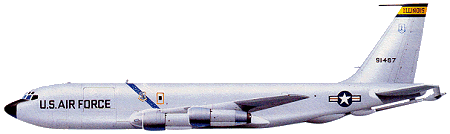
| In August 1954, the USAF announced that it intended to procure a number of tanker/transports developed from the prototype Boeing Model 387-80 which had first flown a few weeks earlier. These were allocated the designation KC-135A, and the first of them made its initial flight on 31 August 1956; 10 months later, on 28 June 1957, the first was delivered to Castle AFB, California. Since that time a family of variants has been produced in large numbers for service with the USAF, mainly as tankers (Stratotankers) or cargo transports (Stratolifters). Two modified KC-135As are used by the US Federal Aviation Administration (FAA) to check navigation aids throughout the United States.
This military version of the Model 367-80 is identified as the Boeing Model 717: it differs primarily from the later Model 707 by having a smaller-diameter fuselage, deletion of cabin windows, reduced size and weight, and accommodation for 80 passengers or an equivalent weight of cargo on the main deck. All equipment for the tanker role is carried on the lower deck, or normal cargo area, and includes the pivoted 'Flying Boom' refuelling gear. This was modified subsequently by the provision
of an adaptor to allow for probe-and-drogue refuelling of Tactical Air Command and US Navy/Marine Corps aircraft. Power is provided by four 6123kg thrust Pratt & Whitney J57-P-59W turbojets.
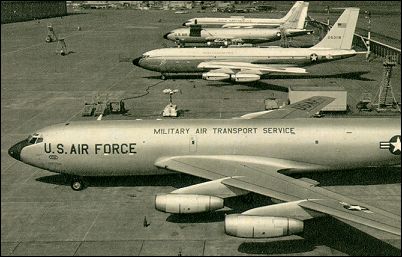
The Model 717 Stratolifter family differs from the foregoing by being equipped specifically to serve as long-range transports. These have the refuelling boom deleted, but there is a structural similarity between these two basic tanker/lifter types, with interior changes in the latter providing accommodation for up to 126 troops, or 44 stretchers plus 54 sitting casualties. Galley and toilet facilities are provided at the rear of the cabin, and provision is made for an alternative all-freight role. The initial version was the C-135A with turbojet engines, first flown on 19 May 1961, and delivered to MATS on 8 June 1961 to become the USAF's first strategic jet transport.
Now, almost 30 years later and with 820 delivered, it is inevitable that there are a number of variants, including specially-built versions and conversions, and brief details of these are given below. Recent modifications include structural strengthening and re-engining with CFM56 turbofans with increased thrust and reduced fuel consumption.
| CREW | 4-5 |
| PASSENGERS | 126 |
| ENGINE | 4 x turbo-jet P+W TF-33-P-5 |
| WEIGHTS |
| Take-off weight | 125000 kg | 275579 lb |
| Empty weight | 47000 kg | 103618 lb |
| DIMENSIONS |
| Wingspan | 39.9 m | 131 ft 11 in |
| Length | 41.0 m | 135 ft 6 in |
| Height | 11.7 m | 38 ft 5 in |
| Wing area | 226.0 m2 | 2432.64 sq ft |
| PERFORMANCE |
| Max. speed | 970 km/h | 603 mph |
| Cruise speed | 650 km/h | 404 mph |
| Ceiling | 10700 m | 35100 ft |
| Range w/max.fuel | 14800 km | 9197 miles |
| Range w/max payload | 4900 km | 3045 miles |
| Laura McLaughlin, e-mail, 07.09.2020 22:23 Anyone know what the KC135A carried from Guam to Okinawa in 1070-1972? reply | | Mary Kunkowski, e-mail, 22.01.2018 06:05 Spent a few years as a Boom Operator on the KC-135A w /J57 engines I think (1978-1980). Having hearing loss issues that I am trying to get the VA to award. Any information about ambient noise levels, etc. would be most appreciated. Thank you reply |
| Danita Stromley, e-mail, 04.08.2016 00:53 I help I was trying to email Don Barker that was in the airforce from (1971 to 1980) that was station at Pease and that was also at U-Tapao.. And Spencer Johnson. But for some reason having a hard time being able to find the emails.
Also would like help from anyone that was a crew for a KC-135 tanker that was on the Young Tiger Mission, My dad is having some health issues that is having to do with agent orange. Where he was on the crew of the tanker they are saying he was not exposed but he slept in tents along the runway in U-Tapao and he also did the tringle.. I also have gotten Hogdkins twice now that is stemmed down to the agent orange. I had to have a stem cell transplant.. So if anyone can help me please email at stromleydanita@yahoo.com
Thank You So much!! reply | | ADIN LANGILLE, e-mail, 05.05.2016 23:27 Looking for info on J57 & TF33 engines noise.I am fighting the VA for a hearing disability. reply | |
| | Kirk, e-mail, 09.06.2015 09:19 Well, the last comment on here was 7 years ago. These old birds are still taking off and landing, and passing gas, of course. I guess I'm glad to be part of a long legacy of Tanker maintainers. reply | | Anthony Hernandez, 30.03.2015 19:37 Make sure you check your "other" message box on FB for a message from me after you request membership. Looking forward to seeing some new Crew Dawgs. reply | | Anthony Hernandez, 30.03.2015 19:33 USAF KC-135 CREW CHIEFS VIA FACEBOOK, GOOD INFO AND PICTURES. reply | | Charles Thompson, e-mail, 27.02.2015 04:34 Looking for anyone who was on k c 135 between 1963-1967 from Carswell Airforce Base, Fort Worth, Texas. Suffering hearing loss and ringing in the ears.Possibly caused from noise levels enroute to Anderson AirForce Base, Guam.Would like to hear from anyone. reply | | David T. Rule, e-mail, 06.12.2014 23:44 I was stationed at Kadena AFB May 1965 to Nov 1966 F-105 Jet Eng Shop. On May 19, 1966 we were walking to the Eng shop around lunch time. The road we were on was higher then the runway so we had a good view of the KC-135 on its takeoff roll, and we could see the heavy rain at the end of the runway, then the explosion and fire. I was on the Disaster Team, I went back to the barracks got on my motorcycle went to the crash site, there was a AP at the end of the runway he told me to go back I told him I was on the Disaster Team looking for SGT ? he told me to go in but be careful. I saw the Gard at the ammo storage gate he was alive but in Shock. Then body parts and bodies.there was nothing I could do. I went back to the Jet Eng Shop waiting for orders,none came. I told my Sgt I did not want to do that anymore.One of the worst days of my life. reply | | George, e-mail, 02.12.2014 04:02 Crewed A-Frames @ Grand Forks AFB from 76 to 79. Tail #58-008 "8balls8". How about two back to back 'black last name initial" flights. Remember thinking about attempting a third but decided every QC white hat within 2000 miles would show up if I did... reply | | Tom Poole, e-mail, 26.11.2014 03:08 I was the crew chief on 60-0320. I've been around the world so many times and have met so many great people. I retired in 1997 and just want to give a shout out to everyone from wurtsmith afb and altus afb and to everyone I've had the priviledge to meet over the years! reply | | George Haloulakos, CFA, e-mail, 25.06.2014 21:17 The KC-135 enabled Boeing to bet the entire company on a program that simultaneously helped win the Cold War and also launch the commercial jet age [707]. Detailed cost break-downs and order information on this aircraft are covered in chapter 1 of my new book. Here is the info.:
HIGH FLIGHT
Aviation as a Teaching Tool for Finance,
Strategy and American Exceptionalism
By George A. Haloulakos, MBA, CFA
ISBN: 9780-1007-2738-0
Order your copy online at: ucsandiegobookstore.com
Or by phone: 858-534-4557
"Partial proceeds support aviation heritage" reply | | Martin, 29.04.2014 11:02 I was stationed at Travis in 1963,what you was on probley was a C-135B reply | | george linhares, e-mail, 28.04.2014 00:30 I was Air Force personnel deployed to Southeast Asia (Thailand) in 1966. We left Travis AFB in what I think was a KC-135 retrofitted with seating facing backwards. I remember we had engine trouble over the Pacific, was told by someone we lost an engine. We landed at Hickam and after the plane was worked on for days we left in a C-141. Is there any way to verify that it could have been a KC-135? reply | |
| | George, 19.04.2014 17:54 8,419 hours as an Inflight Refueling System Operator /Instructor /Evaluator on "A's" and "E's" from 1978 to 2008. I was on the aircraft (A model)that accidentally landed at Phillip Billard Municipal Airport in Kansas, instead of Forbes Field which was 11 miles further down the road on the same heading. The airplane had been stripped down for the depot, so the op weight was only about 100k. We had min fuel (again, for the depot's request) so maybe 125k was the gross weight for takeoff. We jumped off the ground at about 2,500'. We proceeded to Forbes, traded airplanes with the depot guys, and when we landed back home, the group commander had driven the crew bus out to get us. Dead silence on the drive back into ops. We get inside the building, and the colonel looks at the P, CP, and nav, and says "You three, in my office!" He looks at me and says, "Go home George."
It was an okay life. reply | | Ron Hughes, e-mail, 17.04.2014 05:18 Worked on KC's & sometime EC's , mostly recovery for 9 months at Ellsworth SD , Prior to that stationed at Hickam, HI working C-124's. Does anyone know how they did the fuel load when they refueled the SR-71, since the SR used different fuel than the KC. What would have been normal fuel load ? Seems 132,000 - 138,000 comes to mind . What type of engine did the Q model KC have ? How did the SR ever fly slow enough to refuel from the KC ? reply | | spencer johnson, e-mail, 08.03.2014 00:01 I'm trying to find anyone that may have flown with my dad in the kc-135 59-1444 he was either the assistant crew chief or crew chief of that bird. He was stationed at Kincheloe AFB and Utapao. Any info would be appreciated thanks reply | | orville, e-mail, 15.11.2013 19:49 The Kc135A & Kc135Q were the back bone of the USAF for many years.Thank God for the flying crew chiefs that word 20 hour days on deployments to SEA & Spanish Tanker task force.Without the men Bombers Fighters Recon. Cargo planes could not do thier mission. Now many of the brave men suffer hearing loss and a ringing in the ears due to the j57 engines. The engines had the worse noise level at 165db twice the max. Level acc. today. If any of you crew chiefs are having this trouble E-mail me and Ill forword some info to you. reply | | Thomas, e-mail, 21.07.2013 21:33 Does anyone know what they did with the Q model 135s when they stopped using them to refuel the SR 71? I was a Crew Chief at Beale from 77 to 80. reply |
| Bill Collins, e-mail, 23.04.2013 14:08 I was a crew chief on the KC i35 aircraft (pick up new from Boeing) at K.I. all of them were A frames I though a 10,000 foot Grd. run was normal, lots of TDY's and alert tours in the seven years I had the plane. the only reason I stop crewing, to much rank. Best job of my 30 years. Ray I remember that. reply |
|
Do you have any comments?
|
| 
COMPANY
PROFILE
All the World's Rotorcraft
|


 Thomas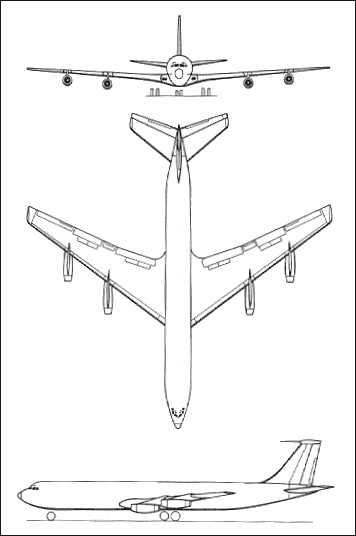


20
reply