|
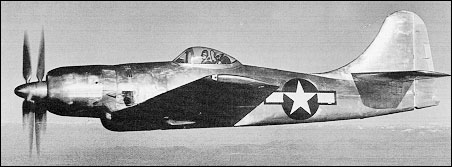
| US Navy carriers operating in the Pacific during World War II were, like similar vessels of any nation, very vulnerable to air attack. When the changing fortunes of war made it clear to the US Navy that a day could dawn when they would need to attack the Japanese home islands, concern was expressed at the need to deploy these vessels within easy range of large numbers of land-based aircraft. If, however, the US Navy had available a long-range fighter/fighter-bomber, then it might be possible to engage the enemy without the need to bring the carriers within striking range of land-based defence aircraft.
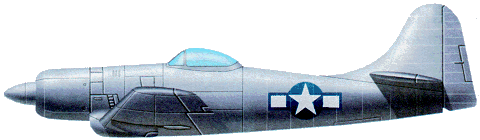
The requirement for such a category of aircraft was communicated to Boeing, which immediately began its design under the designation Boeing Model 400. Submitted to the US Navy, Boeing's design study was sufficiently interesting to warrant the award of a contract for three XF8B-1 prototypes on 4 May 1943. The first of these aircraft made its initial flight during November 1944, and was immediately seen to be the largest single-seat piston-engine fighter to be built in the USA. In fact, it subsequently proved to be one of the most powerful single-engine fighters to be developed by any nation involved in World War II, for its powerplant consisted of a Pratt & Whitney XR-4360-10 radial piston engine, which had four banks of seven cylinders, the 2237kW power output being used to drive two three-blade contra-rotating metal propellers.
Only the first prototype was completed and flown before the end of World War 11, but although the remaining two prototypes were completed and handed over after VJ-Day, the overriding interest in the development of turbine-engined aircraft meant that further test and evaluation of the XF8B-1s was abandoned.
| MODEL | XF8B |
| CREW | 1 |
| ENGINE | 1 x Pratt-Whitney R-4360-10, 2237kW |
| WEIGHTS |
| Take-off weight | 9302 kg | 20508 lb |
| Empty weight | 6132 kg | 13519 lb |
| DIMENSIONS |
| Wingspan | 16.46 m | 54 ft 0 in |
| Length | 13.18 m | 43 ft 3 in |
| Height | 4.95 m | 16 ft 3 in |
| Wing area | 45.43 m2 | 489.00 sq ft |
| PERFORMANCE |
| Max. speed | 695 km/h | 432 mph |
| Cruise speed | 306 km/h | 190 mph |
| Ceiling | 11430 m | 37500 ft |
| Range | 4500 km | 2796 miles |
| ARMAMENT | 6 x 12.7mm machine-guns or 6 x 20mm cannons, 1450kg of weapons |
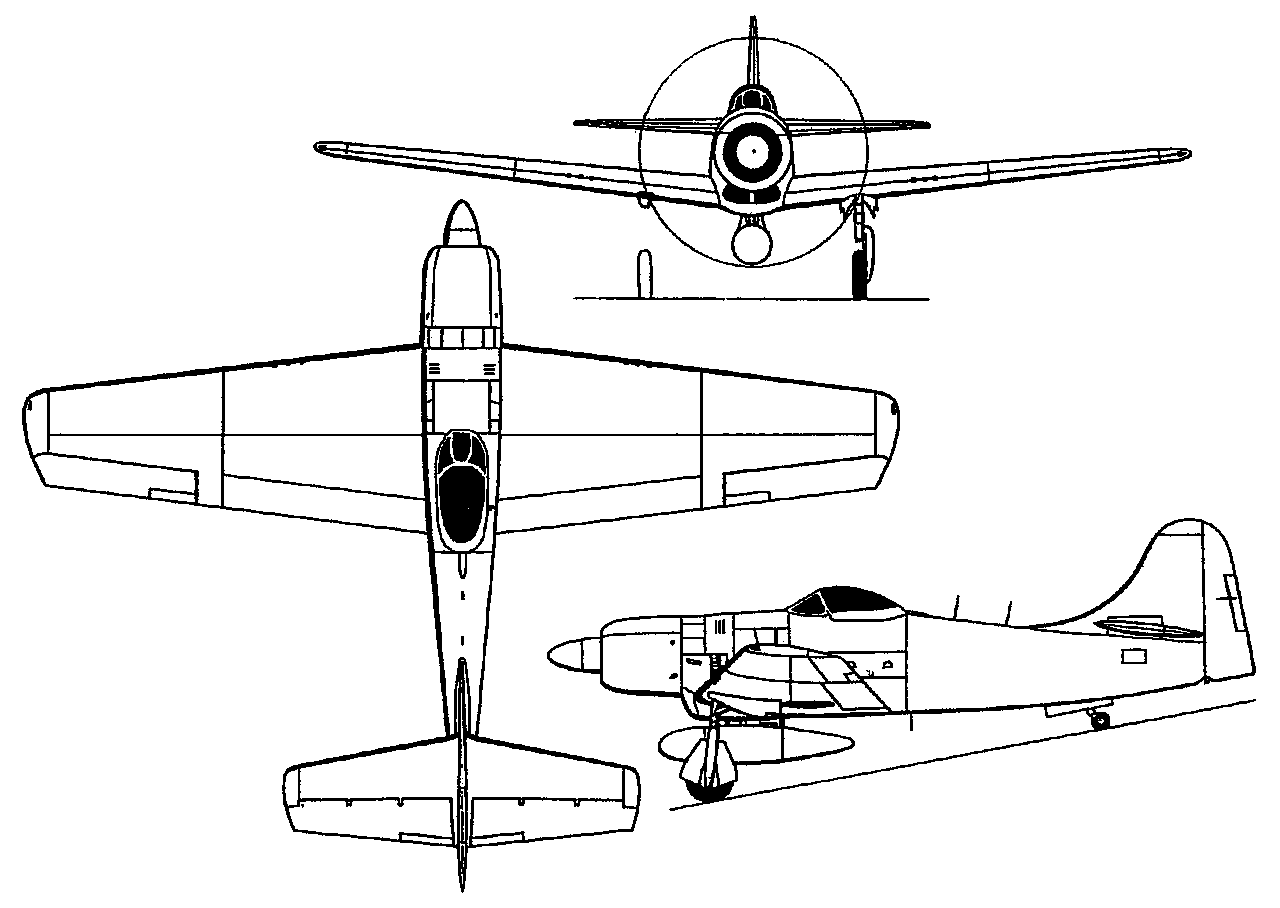
 | A three-view drawing (1280 x 908) |
| Stewart Da ies, e-mail, 16.03.2020 07:54 neoconshooter@live.com
The size of the plane was required to meet the bomb load and range required.given the bomb load of two or three torpedoes@one tonne each,plus enough gas to get there and back, it is a small plane. reply | | BHH, 23.11.2014 06:20 Jesus. 54 feet of wingspan for a CARRIER FIGHTER?! Even without it's inferior climb rate (as compared to the Bearcat), I wonder how Boeing thought the Navy would be OK with that. 54 feet was a torpedo bomber to them. reply | | Willie Utterback, e-mail, 15.01.2013 08:20 A great Fighter bomber. A little bit before its time. The Navy didn't want to launch P-51s off carriers to protect B-29s bombing Japan. They wanted their own fighter bomber. The range of the XF8B (2400 NM) would allow them to bomb Japan from 1000 miles away and return to the carrier. Jap fighters wouldn't be able to catch it at its top speed of 430 MPH. Only 3 planes were built (2 after the war). Tested by the USAF until 1950, they were outmoded by Jets, both fighters and bombers. I did not think this fighter was too big and it reminds me of a composite of all the great WW2 fighters (except for the counter rotating props). To me it looks like a Corsair, a P-51, and a P-47 all rolled into one. reply | | steve, e-mail, 14.06.2012 00:40 Probably best thought of as a sort of single-engined Mosquito. That 1450kg bomb load comprised two 1600-lb AP bombs carried internally; i.e. with minimal drag - though two 1000-lb SAP (same volume) would likely have been a more useful weapon load.
As an anti-ship weapon, it would have carried a bigger bombload than the TBF or SB2C, but with much higher performance, hence ability to penetrate defenses. However, the antiship mission largely faded with the end of the IJN as an effective force; the Soviet Navy posed a much different threat. The remaining attack mission was covered by the fighter-bombers on the one hand and the AD and AM on the other. And the fighter future belonged to the jets. reply | |
| | Klaatu83, e-mail, 09.06.2012 18:03 What do you get when you ask a manufacturer of airliners and bombers to build a fighter? You get a really BIG fighter, as shown here, far too big and unwieldy for the job. This single-seat fighter had the same wingspan, 3 feet more length, an empty weight 3000 lbs heavier, and a loaded weight more than a ton heavier, than the Grumman Avenger 3-seat torpedo bomber! reply | | daxiong, 20.06.2011 07:12 Only the first prototype was completed and flown before the end of World War 11, but although the remaining two prototypes were completed and handed over after VJ-Day, the overriding interest in the development of turbine-engined aircraft meant that further test and evaluation of the XF8B-1s was abandoned. reply | | JuJu McJippins, 02.05.2007 15:42 It's a bizarre looking thing....i'm sure it was practical...that damn jet age sure destroyed a few odd looking prop fighters bristling with contraprops and multi hardpoints (just look at the Skyshark!)
the R-4360 with contra's must have sounded pretty unique....
perhaps a B-36 on one engine! reply | | Rob Pastman, e-mail, 14.03.2007 01:16 Re: Boeing XF8B. Cooool. I'm an aviation buff and I have always had a soft spot for Boeing. Never even heard of the XF8B. And I thought I was a buff. I don't have a computer and use this one at my library. I just poke around until I find something good. The virtual air museum is great!! Have you seen Admiral U. Furashita's web site? It has links to alternate history sites. Check the one for the B-49 alternate history. Rob reply |
|
Do you have any comments?
|
| 
COMPANY
PROFILE
All the World's Rotorcraft
|