|
| In 1971 the USAF began to put together the specification of a new transport as a possible replacement for its fleet of Lockheed C-130 Hercules aircraft. The Hercules design had originated from a specification of just 20 years earlier, and in putting together its requirement for this new transport, the USAF planners had in mind the very important development in powerplants and aerodynamics which had taken place since 1951. In early 1972 requests for proposals were sent out to nine US manufacturers, and those of the Boeing Company and McDonnell Douglas Corporation were selected for competitive evaluation under the respective designations YC-14 and YC-15.
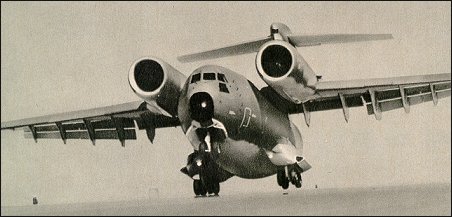
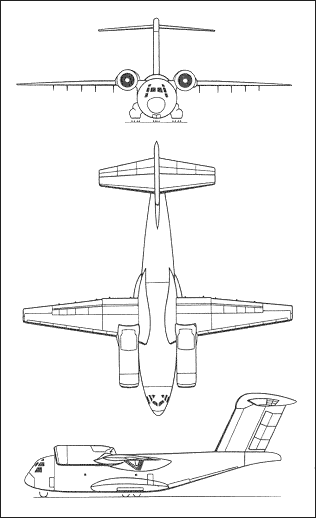
Before the allocation of designations, the USAF specification had the identification AMST, signifying Advanced Military STOL Transport, and the emphasis required from the successful contenders was -concerned primarily with STOL (short take-off and landing) capability. The Boeing Model 953 design for STOL performance was based on the use of a supercritical wing, developed by NASA from the wind-tunnel research of Dr Richard Whitcomb, which provides highly efficient performance from the wing at high subsonic speeds. To this wing Boeing added an advanced wing upper-surface blowing concept, mounting the twin engines above the wing so that their efflux was exhausted over the wing. With the wing's leading-edge and Coanda-type trailing-edge flaps extended, the high-speed airflow from the engines tended to cling to the upper surface of the wing/flap system, and was thus directed downwards to provide powered lift.
The YC-14 first flew on 9 August 1976, and soon proved to have admirable performance. Maximum payload was 150 troops or 36,742kg of freight in conventional operations, while for STOL operations from an airfield of less than 572m the payload was still a useful 12,247kg.
At the completion of testing, in the late summer of 1977, the YC-14 prototype was returned to Boeing for continuing development, if the company so wished, but no further government funding for development or procurement was forthcoming.
| CREW | 2-3 |
| ENGINE | 2 x GE CF 6-50D, 226.9kN |
| WEIGHTS |
| Take-off weight | 97977 kg | 216003 lb |
| Empty weight | 54000 kg | 119050 lb |
| DIMENSIONS |
| Wingspan | 39.3 m | 129 ft 11 in |
| Length | 40.1 m | 132 ft 7 in |
| Height | 14.7 m | 48 ft 3 in |
| Wing area | 163.7 m2 | 1762.05 sq ft |
| PERFORMANCE |
| Cruise speed | 750 km/h | 466 mph |
| Range w/max.fuel | 740 km | 460 miles |
| Dave, e-mail, 24.11.2016 23:19 My father was Chief of Flight Controls Systems for the YC-14 in the 1970s and he loved working on that airplane. Never forget when he came home the day it was canceled. The Air Force changed the specs after the airplane was in flight test which doomed the project. reply | | Steve Gough, e-mail, 08.12.2015 00:52 I began working at Boeing Aerospace Company's Visual Fight Simulator in Kent, Washington, in October 1972. I worked on the flight simulator development and pilot training for the YC-14. I recall waiting for several days for good weather for the maiden test flight. The test pilot, Ray McPherson, continued flying the simulator each day, until the phone call came that the weather was good. We all jumped in a car and followed Ray to Boeing field where we watched the YC-14 lift off on its maiden journey, accompanied by two chase planes. It was a thrill for us when Ray landed and said the craft flew just like the simulator. Ray was an incredible pilot and great aerodynamics engineer to work with on the plane development. The other pilots would comment that you could give Ray a rock to fly and he would make it look good. I believe the co-pilot that day was Dale Rantz. reply | | Ray Cox, e-mail, 25.11.2015 05:20 In the late 1970's I was working for Pacific Telephone on Edwards AFB. One morning while driving south west on Rosamond Blvd a Boeing YC-14 came across the road at a 90 degree angle from my right. It was going so slow you would think it was hanging motionless in the air by a "sky-hook". The normal landing pattern on Rodger's dry lake is parallel to Rosamond Blvd, but this guy was landing on the lake from the side. It was only 200 feet in front of me and maybe 500 feet high. He had his Flaps down and seemed to be floating on the air like a balloon. What an airplane! reply | | Robert Sherman, e-mail, 02.07.2013 20:59 I was stationed at Langley AFB, VA from late '76 to '79. I saw the YC 14 preform in '77 or '78. Have awesome pictures from that display. reply | |
| | Matthew Jochums, e-mail, 06.05.2013 18:11 Hello,
I was wondering if anyone here knows the dimensions of the interior cargo hold for the bird? I can't find the information anywhere on the internet. If you could help me out, I greatly appreciate it.
Thanks. reply | | Greg Taft, e-mail, 20.02.2013 02:02 I was a Boeing Quality Assurance Inspector and worked on this aircraft as it was built in the Developmental Center in Seattle. It was a great engineering, planning, and manufacturing team effort that we all took great pride in being a part of. We enjoyed watching it being assembled and then we standing outside when it made its' first flight.
It was a great project and deserved better. The Carter Administration was one of the poorest ever. reply | | David Baker, e-mail, 06.01.2012 09:02 I was stationed at Edwards AFB during the AMST Program. Both the YC-14 and YC-15 aircraft were very capable, and we witnessed many test operations while the competition was in progress. The YC-14 was hangared adjacent to our building (Base Operations) and we included that hangar on our occasional tours we gave transient flight crews. Boeing didn't mind, as long as we let them know ahead of time. The YC-14 is deceptively large. If you view the aircraft from a distance, it looks comparatively small, but up close, it's huge. I sat in the cockpit of the YC-14, and it had some fairly normal instrumentation. I was impressed with the ergonomics of the cockpit design, and the visibility was outstanding. I remember the YC-15 heading to Yuma for testing, and the YC-14 being flown to AFMC Headquarters in Dayton, OH (Wright Patterson AFB)to be included in the Air Force Museum after the program was cancelled. The entire AMST effort was overshadowed by the Space Shuttle ALT Program, and hardly anyone noticed those funny looking cargo planes were gone. reply | | Lewis Godfrey, e-mail, 02.08.2011 21:59 Sometime during my assignment to Davis-Monthan AFB, AZ (Sep 1977 - Sep 1980), I watched both the YC-14 and YC-15 prototypes land to be prepped and put into the Boneyard reply | | dawang, 18.06.2011 13:58 The flight demo was even more impressive than the "new" F-16 from GD. Jimmy Carter just couldn't shut down the Georgia based Lockheed C-130 line to buy this most impressive acft. reply | | Bob Macklin, e-mail, 25.02.2011 19:16 The problem along with Mr. Carter; the YC-14 was a two engine airplane and the Atlantic and Pacific were four engine oceans at that time. reply | | Don Beierwaltes, e-mail, 27.12.2010 22:13 I saw the YC14 and the YC15 during competition at Pope AFB and the YC14 out performed the 15. reply | | Richard Black, e-mail, 22.12.2010 17:06 Saw this impressive aircraft in the open air display area (75 acres) of the Pima Air & Space Museum in Tucson, AZ, loacted just outside Davis-Monthan AFB. (Tail No. 01873) The only way to get a true sense of its enormous size is to stand next to it. It is huge. reply | | Mike Garner, e-mail, 25.11.2010 16:47 I was on the test team for this aircraft from start to finish. The plane was the most awsome aircraft I ever flew on or had the oppurtunity to work on. Tsgt retired reply | | Boone Barnes, e-mail, 08.08.2010 23:18 Was a nav on C-141's and was part of a crew which accompanied the YC-14 to the Paris airshow. I was also a SME (subject matter expert)during the C-17 accuisition and made several trips to the McDonald Douglas plant in Long Beach from Hq MAC. The C-17 was a Douglas design and only became a Boing aircraft because Boing accuirered McDonald Douglas. reply | |
| | Chuck Sweet, e-mail, 25.03.2010 17:44 This was a very impressive airplane, but the design process employed by Boeing to develop it was even more impressive. This prototype airplane, along with the YC-15 developed by Douglas Aircraft Corp, led directly to our fielding of the C-17 - which is one of our most effective military transports. reply | | william K. De Kine, e-mail, 08.03.2010 19:53 Took this and the 15 to mildenhall for the paris air show, great performer reply | | Jack Nisen, e-mail, 08.02.2010 20:03 Jimmy Carter put the program in the trash? What a jerk. Stick to peanut farming and pounding nails you fool. reply | | PLANE FAN, e-mail, 20.04.2009 05:11 From the intro..In early 1972 requests for proposals were sent out to nine US manufacturers,... Who whould the other 7 manufactures have been at that time? reply | | Eric Bishop, e-mail, 10.03.2009 22:04 I have seen the yc14 in the arizonia desert and wow is she big for her size. reply | | Paul Bacon, e-mail, 01.07.2008 06:23 If you like this one, go check out the Russian Antonov AN-72 - it's a knock-off of the YC-14 with an interesting design history. reply |
|
Do you have any comments?
|
| 
COMPANY
PROFILE
All the World's Rotorcraft
|