|
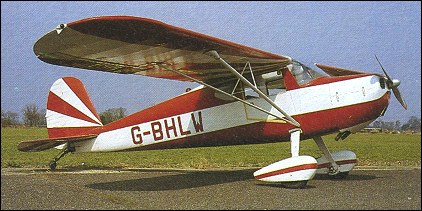
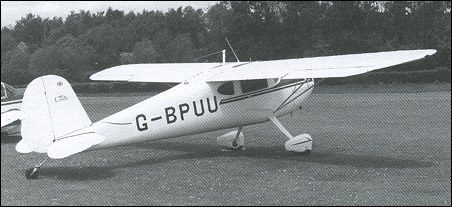
| The Cessna Model 120 prototype, first flown on 28 June 1945, represented the company's attempt to capture a share of the post-war market for personal lightplanes. A two-seat cabin monoplane with a strut-braced high-set wing, it was the progenitor of derived models that ramained in production until the late 1980s. Structure was all-metal, except for fabric-covered wings, the landing gear was of fixed tailwheel type introducing cantilever spring steel main
units, and the enclosed cabin provided two seats side-by-side and dual controls as standard. Powerplant comprised an 63kW Continental engine, and the higher power of this unit by comparison with competing types, plus a low
price tag, ensured that Cessna gained an unexpectedly large measure of sales success.
The Model 120, a basic aircraft, was complemented by a 'de luxe' Model 140 which provided as standard manually actuated trailing-edge flaps, extra cabin windows and a full electrical system. When production of the Models 120 and 140 ended in 1950 more than 2,200 Model 120s and 5,000 Model 140s had been built.
| MODEL | Model 140 |
| ENGINE | 1 x Continental C-85-12F flat-four piston engine, 63kW |
| WEIGHTS |
| Take-off weight | 680 kg | 1499 lb |
| Empty weight | 408 kg | 899 lb |
| DIMENSIONS |
| Wingspan | 10.01 m | 33 ft 10 in |
| Length | 6.4 m | 21 ft 0 in |
| Height | 1.91 m | 6 ft 3 in |
| Wing area | 14.82 m2 | 159.52 sq ft |
| PERFORMANCE |
| Max. speed | 193 km/h | 120 mph |
| Cruise speed | 169 km/h | 105 mph |
| Ceiling | 4725 m | 15500 ft |
| Range | 724 km | 450 miles |
| Obaviator@gmail.com, 18.12.2016 16:54 Just started restore project 46 140 looking fore some parts reply | | Richard Johnson, e-mail, 15.04.2016 21:08 Started flying in 1960 in a Cessna 140 N76130. Tail draggers are great to learn to fly in. I have over 3000 hours now and I am still adding time. reply | | fred georges, 31.01.2016 22:37 Yeah, bought a 140 about 4 years ago for $4500, been sitting at the Seward Alaska Airport stagnating, lower end had 50 hrs, needed a top end cause it sat so long, topped it, now have 400 plus hrs. on it and just when I think about selling it I kick my self, great fun, cheap, flying machine.N72495, just "PLANE" fun. Had a Stinson 108-1 years ago, still wish I had it along with the 140, a guy needs a squadron of a /c!!!!!!!!!!!!!!! reply | | Gary, e-mail, 03.03.2015 03:02 I started to learn to fly in 1962 in a Piper Colt. I hated that plane, and regarded it as treacherous. I moved over to a Cessna 140, for which I paid $2500 in 1962, and found a home. It was a terrific plane to learn to fly in. Affordable, but since it was a tail dragger, you had to really learn HOW to fly or you could find yourself in a very bouncy landing, or even a ground loop! Took my Private exam in that same 140, and then traded up to a 172, and eventually a 182. But I still remember that lovely little 140, and wish I still had it. It did everything you could ever ask a plane to do. A very forgiving plane, too! Perfect for a mistake-prone student. or an old, seasoned pilot with thousands of hours under his belt. I should never have sold it! reply | |
| | Burt Stevens, e-mail, 30.01.2015 03:01 Bought N90053 4 yrs ago, can't find a more fun airplane to
fly. Wife likes it better than her Yak-52. inexpensive to operate and insure. performance is fair even in summer.
Based at KVGT. reply | | Lloyd F. Hawkins, e-mail, 07.08.2014 17:15 took my check ride 11 /29 /52,in a 140, N1956N,sweet airplane,wish I had it back reply | | ROY CARLSON, e-mail, 30.12.2013 06:39 Bought n5393c (1950 140a) in 1987 and still flying it as much as possible from 61d Plainwell MI. It has a lycoming 0235 engine ( 108 HP )from a Piper colt. It is a joy to fly. reply | | Robert Conroy, e-mail, 22.07.2013 07:21 I learned to fly in northern Saskatchewan, Canada, in 1966. Not long after, I purchased a 1948 Cessna 120X, registered as CF-FLL, and flew it about 500 hours over the next four years or so, when I was lured away to a 172G. My 120 was unusual: it had oversized (not tundra) tires, and a Beach Flotorp wooden controllable pitch prop. The prop was controlled by a small crank on the instrument panel. The engine was too small to take full advantage of full coarse pitch, but I could go down hill the last thirty miles before landing at well over the usual maximum speed. It also enabled me to take off from the dirt, gravel or grass surfaces from which i generally flew in about 1 /3 less length than a normal prop.
I also had skiis for it, and flew quite a bit in winter. The heater would keep my feet and a patch of windshield clear. I loved every minute of it. reply | | Barry, 18.07.2013 18:07 Both models illustrated are still extent on the British register to this day. reply | | don Smith, e-mail, 10.06.2013 02:43 I was stationed at Glynco, GA during period 1960-1963. The aircraft during much or all of this period was owned by Roy Riser, who was a Connie pilot At Glynco. I did my night checkout in it and flew it once to Jax for some parts. It was a fine ship. reply | | Harry Lanahan, e-mail, 13.02.2012 01:01 Bought N77126 a 140 in 1968 learned to fly and enjoyed every minute in that plane. What a great plane if you didn't want to go too far too fast. reply | | Herb MAINS, e-mail, 02.11.2011 02:33 I have a 1950 140A, it is the most fun to fly in and out of grass and dirt airports.
It is inexpenseive to own and fly. reply | | Robert C Harold, e-mail, 06.06.2011 21:41 I owned 1947 Cessna 120 for 14 months in 1962 & 63. Took the flight test in it. Spend 15-20 hours learning how to do wheel landings, and then the exam never ask for a wheel landing. They can be wild at first. reply | | John C. Nash, e-mail, 29.04.2011 10:28 Ihad a Cessna 120 license N72997 Used to fly it from MSP
to Ann Arbor, Michigan where I worked. Had a full instrument panel and operate in all inclement weather.
Love my aircraft and felt terrible when I sold it. reply | |
| | David E. Tyre, e-mail, 04.03.2011 18:20 Owned a Cessna 120, N77488, back in 1967. Bought it from my flight instructor for $2000. Took my private check ride in it at Statesboro, GA. Check pilot was a Roy Riser. After he signed my log book, he told me to check my maintenance manuals. Turns out he owned the airplane when he was in the Navy, stationed in Rhode Island! I sold it to a LTjg stationed at Glynco in 1969 for $1800. Located the plane at California, Missouri. Belongs to an elderly farmer there. Updated and looks really great! Still flying, to! Sure wish I had that plane. One sweet flying machine! reply | | David Hoffmann, e-mail, 19.02.2011 21:24 I got my private pilot's license at age 17 in a C-140 (64N) at Austin, TX. Have fond memories of that 'tail dragger'. reply | | jimmie d. havlin, e-mail, 15.02.2011 06:30 Owned and restored 1946 , C-140, Emron white and blue, sold it back to the Guy I bought it from yrs later...kicked myself ever since, loved that little bird, easy 3 point, fun to fly...a great econo -low and slow reply | | jimmie d. havlin, e-mail, 15.02.2011 06:29 Owned and restored 1946 , C-140, Emron white and blue, sold it back to the Guy I bought it from yrs later...kicked myself ever since, loved that little bird, easy 3 point, fun to fly...a great econo -low and slow reply | | Bob Kaplan, e-mail, 10.12.2010 20:34 Back on August 31, 1947 I flew a solo cross country from Donovan Hughes airport, Staten Island, NY to Washington National Aiport, with a Airboy battery radio, slept on a couch in the mezzanine. Got up in the morning and flew back to Donovan Hughes. That's how little air traffic there was then. It was Cessna 140 NC72211, checkout by Woody Wittman, Instr. #97729. I retired from USAIR Airlines in 1990 after flying 32,000 hours. reply | | Chris Overson, e-mail, 08.12.2010 03:09 These are great old airplanes. I own 89334 SN 8362 and just got done doing a ground up restoration. Changed every nut bolt, wire, cable, and tube on the airplane, re-skinned parts of the fuselage and recovered the wings and put in a low weight leather interior. . Parts of it had 7 coats of paint on it including day glow orange!! Somebody told me that for a short time in the late fifties there was a directive that civilian airplanes have day glow orange wing tips and tails but that few owners did it before the fed reversed the order. Got the empty weight down to just over 900 lbs and it flies great. It even has the engine that came with it from the factory. reply |
|
Do you have any comments?
|
| 
COMPANY
PROFILE
All the World's Rotorcraft
|