|
| In 1953 Cessna introduced a more powerful partner for the Model 170: using the same wing and flap system as the Model 170B, the new Cessna Model 180 featured a completely new fuselage and tail unit, plus an additional 60kW delivered by the 168kW Continental O-470-A flat-six engine. At. the same time a fully adjustable tailplane was introduced, obviating the need for elevator trim tabs. Most significantly, the additional power available for the Model 180 permitted an increase in maximum take-off weight from 998 to 1157kg with the same wing area of 16.16m2. In the late 1970s the Model 180 was available in two forms: the basic Model 180 Skywagon, and the improved Model 180 Skywagon II with a factory-installed avionics package. During 1981 production of the Model 180 ended after well over 6,000 had been built.
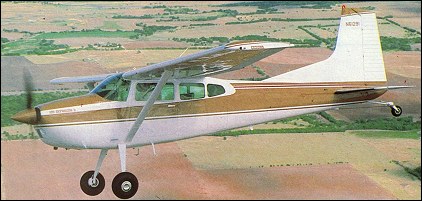
In July 1960 Cessna flew the prototype of the Model 185 Skywagon. This was in most respects similar to the Model 180 apart from the provision of extra power in the form of a 224kW Continental IO-520 engine. Like its predecessor the Model 185 was a six-seater, and was made available in basic form as the Model 185 Skywagon, and in more advanced form as the Model 185 Skywagon II. Greater versatility is conferred on the two Model 185 versions by their ability to carry under the fuselage a detachable glassfibre Cargo-Pack, capable of carrying some 136kg. The Model 185 Skywagons can also be fitted with Sorenson spray-gear for agricultural work, and like the Model 180 Skywagons can be fitted with alternative ski or float landing gears.
By February 1980, 4,000 Model 185 variants had been delivered and when production ceased, in mid-1985 4,356 Skywagons had been built, including 497 U-17A/B/C military versions.
In 1971 Cessna introduced an extremely versatile version of the Model 185 in the form of the AGcarryall. This was designed principally for the agricultural role in the widest possible sense, being able to demonstrate spraying procedures, ferry people and equipment, serve as an agricultural pilot trainer, and act as a backup spray aircraft in peak periods. It failed to attract sufficient sales and production ended in 1979 after 108 had been built.
During 1962 the USAF sought a suitable light utility aircraft for supply to countries eligible for MAP aid. Cessna's Model 185 was selected and ordered under the designation U-17, more than 450 being supplied. These comprised the U-17A with a 194kW Continental IO-470-F flat-six engine, followed by the U-17B with a 224kW Continental IO-520-D. The final U-17C production version had a Continental O-470-L engine which had a carburettor instead of fuel injection.
| MODEL | Model 185 |
| ENGINE | 1 x Avco Lycoming IO-360-A1B6D flat-four piston engine, 149kW |
| WEIGHTS |
| Take-off weight | 1520 kg | 3351 lb |
| Empty weight | 769 kg | 1695 lb |
| DIMENSIONS |
| Wingspan | 10.92 m | 36 ft 10 in |
| Length | 7.81 m | 26 ft 7 in |
| Height | 2.36 m | 8 ft 9 in |
| Wing area | 16.16 m2 | 173.94 sq ft |
| PERFORMANCE |
| Max. speed | 286 km/h | 178 mph |
| Cruise speed | 274 km/h | 170 mph |
| Ceiling | 5455 m | 17900 ft |
| Range | 1576 km | 979 miles |
| K. L. Jones, e-mail, 25.06.2026 21:05 I flew a Cessna 185 back in the early 90s for the state of Alabama,an early one which had an IO470 260 hp Continental.
Later a C180 with the 0 470. By far the 180 flies much better than the 185. Much sweeter flying machine. I now own a C 180. Never will get rid of it! reply | | Revd Andrew MacKenzie, e-mail, 28.05.2017 12:21 I was an RAF airframe fitter in Nairobi from 1961-63. I worked in my spare time with Missionary Aviation Fellowship with their engineer, Jum Stack, repairing an extensively wrecked 180. It had crashed in, I think, the Sudan, wrecking the forward end of the fuselage and landing gear. It had bee brought back to base at Wilson Airport overland. A very satisfying project indeed. reply | | Manny Puerta, e-mail, 08.03.2017 21:13 I have owned my 1971 A185E since 2000. The engine info outlined here is incorrect. The first 185 had a Continental IO-470 for the first few years, then a Continental IO-520. They never had a 4 cylinder installed.
The useful load on the later IO-520 powered versions is impressive. Mine, with the ART WingX wing extensions adding 175# to the gross weight, is almost 1700#. With long range fuel I have flown 6.1 hours @ 150 MPH and was able to fly final at 50 MPH. Not many general aviation single engine aircraft have that combined capability. reply | | Elbie Mendenhall, e-mail, 19.10.2013 00:04 I've flown many Cessna 180's /185's since 1960, but never one with a 4 cylinder Lycoming, maybe they were flying a Doyn Cessna 170 up-grade!
I love the Cessna 180 /185 series. reply | |
| | Chas, e-mail, 20.03.2013 01:26 more piccies of the 180 would be wonderful reply | | Kurt J. Jaeger, e-mail, 31.01.2013 15:25 I flew the 185's in Liberia from 1960 till 1963. It was the very best airaft on the jungle strips. Going in and out was something to behold. Great load carrying capability. We always had the versions with the Continental 300HP. The biggest asset was the manual flap system. Although we lost a few due to bad handling or weather in the raining season, it safed many a take-off or landing in those extremly short and rough airstrips in the Liberian tropical bush.
For me it is still the best aircraft to handle with heavy loads and going in and out of strips of a few hundred feet only. reply | | Bruce Davis, e-mail, 30.08.2011 22:57 I flew a 1957 C-180A with a O-470 K /L engine on EDO 2879 floats for 2000 hours all over Ontario and Quebec. Great airplane. Wish I still had it. As for the IO-470 in the 185, it does not stand up anywhere near as well as the IO-520. As for the O-470J, I would really rather have an O-470R (preferable) on an O-470K /L. reply | | Peter Neenan, e-mail, 17.06.2011 18:36 I flew the 185 on Edo floats 800 hrs in the swamps of S Louisian. Absoloutly the best float plane every made and finest fishing machine, too. reply | | Don, e-mail, 11.05.2011 17:15 I'm looking at getting a 1965 C185 w / an IO-470 engine. If anyone has any positive /negative feedback for me, I would greatly appreciate it. reply | | Bill, e-mail, 24.03.2011 05:18 In 1965 the standard engine was the 470. In 1966 either the 470 or the 520 was offered. In 1967 the 520 was standard to end of production. From Int'l 180 /185 Club Manual reply | | Doc Clement, e-mail, 08.02.2011 23:36 I owned a 1974 C-185F and use it to fly the bush in Alaska form 1975-1983 working a 135 contract for Placid Oil based out of Fairbanks. Before I flew the 0-1 Birddog in Vietnam and had over 100 mission in North Vietnam and you can read about them in "A HUNDRED FEET OVER HELL" by Jim Hooper. reply | | Doc Clement, e-mail, 08.02.2011 23:35 I owned a 1974 C-185F and use it to fly the bush in Alaska form 1975-1983 working a 135 contract for Placid Oil based out of Fairbanks. Before I flew the 0-1 Birddog in Vietnam and had over 100 mission in North Vietnam and you can read about them in "A HUNDRED FEET OVER HELL" by Jim Hooper. reply | | Ron, e-mail, 06.02.2011 01:20 I had a 1976 180J. One of the best memories of my life was flying the 180, Fabulous aircraft reply | | jim, e-mail, 13.01.2011 00:53 I'm glad I found this web site and to read the positive remarks about the cessna 180 185 planes .I was looking for info about a 1955 cessna 180 with the 0470J engine and would like some feed back , and What one would be worth on floats Cheers Jim reply | |
| | Bob Palmquist, e-mail, 11.11.2010 01:15 I flew my 1977 C-185 in Alaska for 9 years off beaches, sand bars and bush strips. Great plane, adjust your load to the length of the beach and it would carry anything you could get in it... A really fun workhorse. reply | | Bob Leonard, e-mail, 27.10.2010 09:01 Really enjoyed flying the C-180 on Floats in Alaska. Along with the 150-Super Cub, both were excellent bush planes. reply | | Dallas Smith, e-mail, 14.10.2010 07:47 Flew the u-17A&B out of Nha Trang, RVN as an AF Advisor to the VNAF. It was used primarily for psy war missions (bullshit bombers)and was later used for adjusting naval bombardment from tin cans operating off the coast south of Quin Yon. (Can't remember that spelling.) A tough little bird. reply | | Roy M. Jones, e-mail, 07.10.2010 05:18 They are an great aircraft, I had 3 1955's, one of which had the Norton kit on it, with beta propeller, Bus Landry still talks about that aircraft, had an 1964 180, 1977 185, Love to strap one on again, love taildraggers, just finished rebuilding Cessna 140 for my son to learn in. After he gets some time in it, we will look for an 180 /185. you can go any where in it, bush or big airports.
an Great machine reply | | Richard W., e-mail, 24.09.2010 17:10 The author needs to correct the engine for the 185. The early ones had Continental I0-470 engines and the later models had the Continental I0-520. Never had a Lycoming I0-360 engine. reply | | Afshin, e-mail, 19.05.2010 15:30 Dear Sir,
if there is posible i want to have fatigue loads and blocks load of Cessna 185.
best regards
Afshin reply |
|
Do you have any comments?
|
| 
COMPANY
PROFILE
All the World's Rotorcraft
|