|
| In 1952, Cessna initiated the design of a new five/six-seat twin-engined light monoplane designated Cessna Model
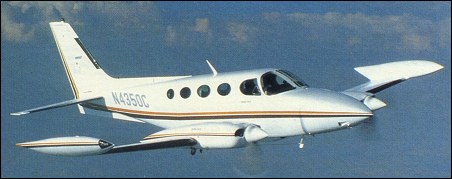
310. The prototype flew for the first time on 3 January 1953, proving in production form to be a popular twin. Of low-wing configuration and with tricycle landing gear, the prototype was powered by the 168kW Continental O-470, an engine developed originally for military use under the designation E225. Its use to power the Cessna Model 310 was one of its first civil applications, early production aircraft having the more powerful 194kW IO-470. Good identification features of the design at that time were the two wingtip fuel tanks, then representing the entire fuel tankage.
Production deliveries began in 1954, with steady product improvement continuing year by year. A de luxe version with turbocharged engines, air-conditioning and an oxygen system as standard was introduced in 1966. This was then named the Turbo-System Executive Skyknight being known also for a short period as the Model 320, but later marketed as the Turbo
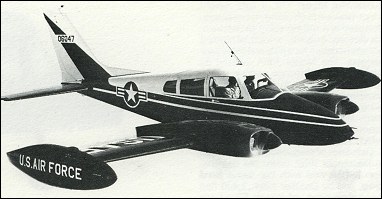
T310. Final versions were the basic Model 310 with 213kW Continental IO-520-MB engines, the structurally identical Model 310II which incorporated a factory installed avionics/equipment package, the Turbo T310 with TSIO-520-BB powerplants and the Turbo T310 II with the same additional equipment fit as the Model 310 II. In the mid-1950s, following competitive selection, a slightly modified version of the Model 310 was ordered for light cargo-liaison duties with the US Air Force under the designation L-27A, subsequently redesignated U-3A A total of 160 were built followed by 36 U-3Bs equipped for all-weather operation, and all were nicknamed 'Blue Canoes'. When production finished in 1981, 5,241 commercial examples of the Model 310 had been built, including a small number for the French air force, plus the 196 delivered to the USAF.
In December 1971 Cessna announced the introduction of the pressurised Model 340 developed from the Model 310. Powered by twin TSIO-520-NB engines each giving 213kW, the 340 incorporated the wing and tricycle landing gear developed for the Model 414, married to a new pressurised fuselage, but using the tail of the Model 310. This was followed in the mid-1970s by the Model 340A equipped with 231kW engines and later by the similarly powered Model 340A II fitted with comprehensive factory-installed avionics allowing IFR operation. In 1978 Cessna introduced the Model 340A III equipped with an improved avionics package including colour weather radar and this version remained available until 1985 when the type was taken out of production, by which time 1,287 had been delivered.
A lightweight unpressurised version of the Model 340 was off ered to the market in 1979 as the Model 335, later available as the improved Model 335 II version, but production ended in 1980 after only 45 had been built.
| MODEL | Model 310 |
| ENGINE | 2 x Continental IO-520-MB flat-six piston engines, 213kW |
| WEIGHTS |
| Take-off weight | 2495 kg | 5501 lb |
| Empty weight | 1523 kg | 3358 lb |
| DIMENSIONS |
| Wingspan | 11.25 m | 37 ft 11 in |
| Length | 9.74 m | 32 ft 11 in |
| Height | 3.25 m | 11 ft 8 in |
| Wing area | 16.63 m2 | 179.00 sq ft |
| PERFORMANCE |
| Max. speed | 383 km/h | 238 mph |
| Cruise speed | 267 km/h | 166 mph |
| Ceiling | 6020 m | 19750 ft |
| Range w/max.fuel | 2840 km | 1765 miles |
| Paul Soper, 24.02.2020 01:41 I owned a 1968 320 and it was a Pilots dream. I remember a fine day boarding it when a new Beech owner made a snide remark about me flying an antique and being 4th in-line behind the New Beech Bonanza. Did a “close” flyby and rocked the wings of the antique in front of him as I climbed out with my turbos leaving him in my vapors at the Durango Co airport my 320 was FAST and a Dream come true for an old Okie from Oklahoma. Boomer Sooner and PROUD OWNER OF AN ANTIQUE 320 in 2003. reply | | Paul Soper, 24.02.2020 01:41 I owned a 1968 320 and it was a Pilots dream. I remember a fine day boarding it when a new Beech owner made a snide remark about me flying an antique and being 4th in-line behind the New Beech Bonanza. Did a “close” flyby and rocked the wings of the antique in front of him as I climbed out with my turbos leaving him in my vapors at the Durango Co airport my 320 was FAST and a Dream come true for an old Okie from Oklahoma. Boomer Sooner and PROUD OWNER OF AN ANTIQUE 320 in 2003. reply | | Sky Haskell, e-mail, 31.01.2012 23:33 Had two 310's, the last a turbocharged version.Wonderful airplanes Only one episode in hundreds of hours, a blown engine over Baja.Continental provided new engine and crew to site and installed.Incredible experience. Flew out one week to the day later.... reply | | Scott Boyd, e-mail, 31.12.2011 22:42 I flew a couple different 340's when I worked in Gallup NM in the 80's. I also flew 310's and T-310's, various 414's and 421's for a number of years.
Flew just like any other 310 I flew and nice and fast up high. I liked the later 310's better to fly, the turbo's were a necessity in the Four Corners, though I flew non-turbo's for some owners occasionally. Without turbo's on a 100 degree day a non turbo is a single, with any payload at all. reply | |
| | Bill Hesse, e-mail, 31.12.2011 12:40 For last eight years,have owned a 1979 Cessna 340A with the Ram IV conversion, plus Q tip props, aviation intercoolers, micro vortex generators 203 gal. fuel and two relief tubes for pilots and passengags.
Must say: This is the most bang for the buck in the big blue sky.
Flight levels in shirtsleeve comfort without a hose in the nose. and it flys better than when it came out of the factory new 33 years ago. reply | | Dave Ingle, e-mail, 05.10.2011 22:45 From out of the blue of the western skies comes.... SKY KING! Loved watching that TV show as a kid. Really pretty airplane, very modern looking for its time. Sill very sleek appearing today. reply | | Ron Little, e-mail, 10.03.2011 15:50 In 1964, flew a 310C over 600 hours day, night and weather
raced and beat DC-3's flown by airlines at the time.
Farmington, NM to Baton Rouge, LA in five hours. No auto-
pilot. reply | | sbergren, e-mail, 01.02.2011 04:34 had 2 320s and my present 340 for 27 years. 320 fun and fast, have to fly them. 340 big easy. does everyting right. reply | | john davis, e-mail, 18.12.2010 02:06 Flew the 310L back in the 60's & 70's. Lots of fun and enjoyed my time in it. One winter day in Ohio, had so much ice that I had "bugles" on the tip tanks (you old timers will know what this is). Plane kept on going and I have never forgotten that day! Also flew a conversion out of the KBNA area - had the IO 520 engines on it! boy did that baby go... we didn't sweat anything. reply | | Bob Leonard, e-mail, 27.10.2010 09:08 Enjoyed flying a C-310Q far down the islands of the Caribbean. Will do long legs at a good X-country speed. Honest twin which hauls a good load. reply | | Ray L., e-mail, 28.09.2010 07:47 I got a good number of hours in the right seat as an Air Traffic Controller doing ride-a-longs on U-3As (Cessna 310s just like in the picture above) flying chase for U-2s. We were acting as their safety pilot during practice instrument approaches.
On one occasion one of our two U-3As were left parked just below the tower, when the ground crewmen came to move it to its hanger he tried to start the wrong engine. After cranking and resting the engine at least four times I keyed the radio and asked if he was on frequency, he responded and I advised him that the pilots manual instructed that the other engine be started first since it was closer to the battery.
The crewmen thanked me and cranked the other engine which started immediately. Probably still wondering how a controller knew that. We had the full U-3A manual in our tower library and I had read it more than once. reply | | Don Slone, e-mail, 13.04.2010 23:35 I have a 58 310B and love it. I get an easy 165 to 170 knots cruise at 19-20 gph and can carry a load. It would cost well over $600,000 to get a new multi today that can haul that load at that speed. What a deal! (and a classy airplane to boot ... Sky King would be proud) reply | | Billy Winters, e-mail, 26.02.2010 19:55 March 10, 1998 I was flying my 340 from L.A. to Paris, TX, at around 11:30 P.M. I landed in El Paso, TX to refuel. After refueling and filing a flight plan to Paris, I was informed that to expect "rime ice" between 8,500 and 13,500 feet, then clear skies above. I had filed for an altitude of 21,000 feet. After takeoff I climbed up toward 21,000 and sure enough after passing through 8,000 feet I encountered "rime ice" all the way through 14,000 feet. After breaking out at 14,000 feet the sky was beautiful, a full moon and unrestricted visibility. I was just climbing through 17,000 feet when all at once a "loud boom" and a "ball of fire" shot out of my left engine. The airplane started to shake violently, since there wasn't a lot of activity going on in the air at that time of night, the "unexpected" explosion was quite a shock to say the least. I was 35 miles east of the El Paso airport. I notified El Paso departure of my problem after I "feathered my left engine" and started a slow turn around to my right. I was cleared to land back at El Paso and so I leveled out on one engine at 15,000 feet until the very last minute before I had to head down (through the rime ice once again) in order to land in El Paso. The plane preformed just wonderful on one engine and I descended down through the ice and landed in El Paso with one engine. The next morning I has the mechanic at Cutter Aviation check my airplane out and he discovered that I had "blown a turbo charger" much to my relief that I had not ruined an engine. The airplane was a joy to fly and to own. What a great airplane the Cessna 340 was. reply | | Scott Boyd, e-mail, 16.02.2010 06:06 I got my multi in a tuna tank 310 and flew most of the later models. Most of my time was in the later 60's turbo 310's but I flew 340's quite a bit too. I always liked the 320, kind of an upscale 310 they built for a few years.
I also flew a non-turbo 310 for an individual, along with another pilot. Great to fly and only had one close encounter: The other pilot took the owner to Mexico and back. When he put the gear down it went down in about half the normal time, but showed three green lights.
The battery was fried and one of the voltage regulators on one of the engines was found bad. The gear was swung numerous times and seemed to be good.
On the next trip I stop en-route to the Bay Area and everything is fine, put the gear down and I can hear it but not feel it. Out over the bay to try it one more time then crank it down. It went down and we landed in Oakland as planed.
Took a couple of weeks to fix, new landing gearbox, the machined stops had been damaged, or bent by the runaway generator. reply | |
| | Steve Zeigler, e-mail, 20.01.2010 15:39 If you remember the TV show, "Sky King" - the second craft that they named "Song Bird" in the story line, was a Cessna 310B - a beautiful thing to behold. reply | | Al, e-mail, 26.09.2009 18:32 What was the last year of Production for Any Cessna 310?
Thank you! reply | | Paul R. Flow, e-mail, 11.05.2008 21:43 I was a Corporate Pilot for about 20 years, flying Cessna 310's,320's and 411's.First one was 1948 Model with straight tip-tanks. Later ones were slanted.The 320 first came with straight tanks also.All good airplanes, but not a "Sunday Pilot's" plane. Had to be flown all the time(unless it had an auto-pilot). reply |
|
Do you have any comments?
|
| 
COMPANY
PROFILE
All the World's Rotorcraft
|