|
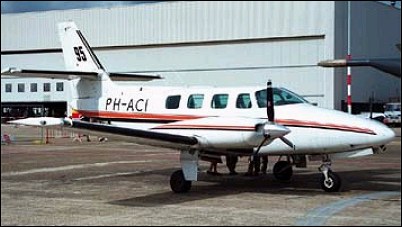
| On 14 February 1978 Cessna flew the prototype (N303PD) of a new lightweight twin-engined aircraft which it then designated Cessna Model 303 Clipper. In this prototype form it was a four-seat aircraft of low-wing monoplane configuration with the wing incorporating a super-critical aerofoil section. Other features included retractable tricycle landing gear, swept vertical tail surfaces with a long dorsal fin, extensive use of bonded construction and power-plant comprising two 119kW engines. Before the certification programme began it was superseded by a new Model T303 which reverted to conventional construction, had six-seat accommodation, was powered by two turbocharged engines of increased output, and had acquired the new name Crusader because the earlier title of Clipper infringed a US trademark.
Cessna claimed the Crusader was the first lightweight twin of its class to have full IFR avionics and equipment as standard, and that handling of the aircraft benefited from the high set tailplane, coupled with unusually, counter rotating engines, which minimise engine torque effect. Production model Crusaders were certificated in August 1981, and first deliveries followed in October. When production ceased in 1986 297 had been delivered.
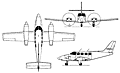 | A three-view drawing (1000 x 607) |
| MODEL | T303 |
| ENGINE | 1 x Continental TSIO-520-AE + 1 x LTSIO-520-AE turbocharged counter-rotating flat-six piston engines, 186kW each |
| WEIGHTS |
| Take-off weight | 2336 kg | 5150 lb |
| Empty weight | 1499 kg | 3305 lb |
| DIMENSIONS |
| Wingspan | 11.9 m | 39 ft 1 in |
| Length | 9.27 m | 30 ft 5 in |
| Height | 4.06 m | 13 ft 4 in |
| Wing area | 17.58 m2 | 189.23 sq ft |
| PERFORMANCE |
| Max. speed | 400 km/h | 249 mph |
| Cruise speed | 363 km/h | 226 mph |
| Ceiling | 7620 m | 25000 ft |
| Range | 1889 km | 1174 miles |
| T303 seller, e-mail, 11.08.2023 01:03 The original prototype aircraft, N303PD, will be sold without engine on 8 /25 /2023 in Tulsa, Oklahoma.
See gov deals dot com and search Cessna T 303. reply | | Ronald T MOORE, e-mail, 11.05.2021 17:46 i owned and flew N1919V a 1984 Crusader for nearly 20 years and loved every moment of that fine aircraft. it was surprisingly roomy with tons of comfort for passengers. I would love to have it back but the IRS frowned on me using it for my business after I sold the company which made the cost to continue stupid. reply | | Aircharter Picard, e-mail, 07.08.2012 03:00 Great aircraft with good short TO and LDG capabilities and low empty weights. A little weak brakes, however sturdy gear. Dependable engines, only their starter drives are a mess.
A real pleasure to fly.
air-charter-picard.de reply | | Brian Groves, e-mail, 06.03.2012 16:15 Owned N6498V since Jan 1990. Absolutely fabulous aeroplane! reply | |
| | sandeep Pradhan, e-mail, 17.12.2011 18:24 One of the Finest model aircraft reply | | John Cutcliffe, e-mail, 13.05.2011 08:18 My e-mail address denotes my great appreciation for the wonderful times in my 303. Could not have a single improvement for the purpose intended. GREAT AIRPLANE reply | | Christiano Casanova, e-mail, 05.08.2010 02:12 not fast but great why stop a good thing reply |
|
Do you have any comments?
|
| 
COMPANY
PROFILE
All the World's Rotorcraft
|