|
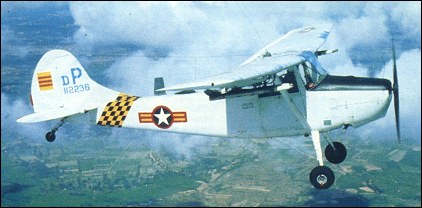
| In the late 1940s the US Army issued a specification for a two-seat liaison and observation monoplane. From the submissions received from manufacturers that of the Cessna Aircraft Company was declared the winner and in June 1950 an initial contract was awarded for 418 examples of the aircraft, which the company identified as the Cessna Model 305A.
Cessna's design was based upon the successful Model 170, a light-weight strut-braced high-wing monoplane, powered by a 108kW Continental flat-six engine, which provided accommodation for a pilot and three passengers. The Model 305A differed by having the aft fuselage redesigned to give a clear view to the rear and by the provision of transparent panels in the wing centre-section, which formed the cabin roof. A wider access door gave room to load a standard stretcher, for which support brackets were installed.
Deliveries of production aircraft began in December 1950, under the designation L-19A and with the name Bird Dog, and by October 1954, 2,486 had been delivered, of which 60 where diverted to the US Marine Corps which designated them OE-1. An L-19A-IT instrument trainer version was developed in 1953, TL-19D trainers with constant-speed propellers appeared in 1956 and improved L-19E, of higher gross weight, was the final version to bring total production of Bird Dogs to 3,431. With rede-signation in 1962, the US Army's L-19A, TL-19D and L-19E aircraft became O-1A, TO-1D and O-1E respectively. The US Marines' OE-1 became O-1B and this service also acquired 25 of the higher-powered O-1C. US Army trainers, derived from standard production aircraft, had the designations TO-1A and TO-1E.
Bird Dogs were operated in small numbers during the Korean War, but the US Air Force acquired many of the US Army's O-1s for use by forward air controllers in Vietnam; former TO-1Ds and O-1As were redesignated O-1F and O-1G respectively when equipped for this role. In addition to being supplied to many nations, O-1s were also built under licence by Fuji in Japan.
| MODEL | O-1E |
| ENGINE | 1 x Continental O-470-11 flat-six piston engine, 159kW |
| WEIGHTS |
| Take-off weight | 1089 kg | 2401 lb |
| Empty weight | 732 kg | 1614 lb |
| DIMENSIONS |
| Wingspan | 10.97 m | 36 ft 0 in |
| Length | 7.85 m | 26 ft 9 in |
| Height | 2.22 m | 7 ft 3 in |
| Wing area | 16.16 m2 | 173.94 sq ft |
| PERFORMANCE |
| Max. speed | 209 km/h | 130 mph |
| Range | 853 km | 530 miles |
| Alan Fleming, e-mail, 10.05.2025 02:45 I was in the 74th RAC from November 13, 1966 to November 1967. I was the crew chief and flew with Capt. STAFFORD.
I was asking "WHO WAS LEAVING WITH MY AIRPLANE" in September as the plane was leaving the base. The pilot was a newer one, Lynn Huddleston and I was told thr guy in the rear seat was a. "Special Forces Major."
Actually the WALL lists him as "Smith, Sergeant".
We flew 3 days searching for him after they never returned. We flew in Vietnam. Some time later (20 years) the Moving Wall as I remember said the plane had been found in Laos. A farmer said the plane crashed and one person was dead and one was alive.. The alive had a gun and was killed.
We searched in Vietnam as at that time we weren't allowed in Laos.
Since maybe now 40 years ago I've never seen anything on the "WALL". I haven't looked again at the moving wall. The moving wall was in Sanford, FL and we drove up to see it.
Over the years all I had were phone numbers of the guys we served with. Of course mom and dad died or the guy moved. Now the people have emails. We didn't have that as a way to catch up with people.
I lived in Chicago ghen. My wife and I moved to Titusville FL several years ago.
My TI was Larry Braband. We connected later in life. He became a pilot after leaving the service. He and 2 other pilots were killed when a plane HD was ferrying to Germany out of Chicago hit a ridge in Nova Scotia. reply |
| John L.Roberson, e-mail, 16.07.2024 21:37 Was a o-1 bird dog crew chief at phu loi 1971-72.cpt Whatley was cdr.was sent to Tay Ninh ,74th Rac,aloft 6.and had to evacuate back to phu loi
Hey reply | | Simon Collins, e-mail, 07.04.2024 16:55 I'm from the UK and work for a company that own an O-1G that (according to records) flew with the 219th between Oct 1979 and Dec 1971 at Camp Holloway. It's serial number is 51-12471, and C /N is 22913.
We would love to hear from anyone who remembers that particular aircraft or who flew it. We will be taking it to air shows and fly-ins and would like to tell the story about it's time with the 219th. Headhunters.
It's had an interesting time since then. It went to the South Vietnamese Air Force in Dec 1971, and then in 1989 it was "found" in Bien Hoa by some Australians who took it back home and restored it. It was painted in SVAF colours and eventually ended up with us at Biggin Hill, UK.
It sits with our fleet of airworthy Spitfires, and other warbirds, including a Harvard, Hawker Hurricane, Messerschmitt Bf 109, P-40 Warhawk and a P-51 Mustang.
It's fully airworthy, and in immaculate condition.
Any information that anyone can pass to me would be gratefully received. If any of you who recall this Bird Dog find themselves in the UK on vacation and would like to look at the aircraft, then please contact me.
Regards
Simon Collins
Biggin Hill Heritage Hanger, UK reply | | "Bill" Herschel Hicks, 2nd pla, 10.04.2017 06:27 I was delighted to find the entry in the "61-80" from Steve "Wolf" Wygal, my toommate in the old French built barracks in Kontum VN. I was in the 219th, at first in Camp Holloway in Pleiku for my first year, then for a 6 Mo. extension at Kontum. (I requested Kontum because it was rumored they had hot water showers)
I was a crew chief with as many as 6 Birddogs. I loved that plane mainly because it was fixed wing, and simple compared to the UH-1s I'd been working on previously in the maintence platoon with the 170th AHC. As I had the longest time yet in country at the 170th. I was sent to Vin Tauto learn how to service the mini-gun on the new observation helicopter that was to replace the Bird Dog. At that time, there were only 3 Hughes 500s in country. One was in Siagon for use by an upper rank officer, the 2nd had crashed, and the 3rd was for mechanics training in Vun Tau. So I ended up at the 219th in the misplaced position as company armerior and (acting) munitions sargent working for the company supply Sgt. it's here I began to understand how ex-PFC Wintergreen ("Catch 22" book) could end up running the Army. Life was interesting.
I went for a 6 mo. extension at Kontum because I really wanted to work on Birddogs and tired of sitting in hydronic fluid repairing UH-1 helicopters.
Steve Wygal and I shared a room, commuted to the airfield in a M151 "jeep" that had been cut in half for the scrap yard, and rewilded together again by some enterprising person who had long rotated back to "the world" Life was good in sleepy Kontum at the end of the runway, I got my crewcheef wings, got enough rear seat time in an O-1 to get an air medal,
and have the snot scaried out of me during the Tet Offensive.
My second to the last day in Kontum, I finally saw a Hughes 500 show up and got a ride in one.
It was a real treat to find Wolf Wygal's entry. I hope my entry catches up with him. Greetings also to Stewart Duckworth, Arther Conley,
Herschel Hicks (11 /66 to 6 /68)
Saratoga Springs, NY reply | |
| | Tony Tissot, e-mail, 26.01.2017 01:18 My favorite aircraft at the Ft. Bliss Flying Club in 1976. The only 0-knot GS landing I ever did at Fabens (?), TX reply | | Steve B, e-mail, 02.09.2016 15:36 I have acquired an O-1 Birddog that was with the 41st Tactical Wing,110 Liason Squadron with the South Vietnam Air Force based in DaNang. Their is no data plate. Anyone with information of this Squadron or who could have worked alongside this unit please let me know? Thanks reply | | Tim Flynn, e-mail, 04.08.2016 06:47 Aircraft was primary trainer in OFWQC when I was at Ft Rucker, Al, Aug 64 to Apr 65. During that timeframe three units were formed to go to Vietnam: 219th, 220th and 221st Airplane Survelliance Light. I ended up in the 219thHeadhunters (HH38) in July of 1965 at Pleiku, VN. Then to AhnKe to support the 1st Cav just arriving in country and a brigade of the 101st Abn Div doing clearing operation. All our training at Ft Rucker paid off and we were flying day and night to the point of nearing running out of fuel at night to provide recon and radio relay. A few of my FA OCS brothers were now doing FA observer work on the ground with the 101st and were under fire a number of times. We expected to be overrun at any time, but not to be. We were operating out of a PSP airstrip with many mines still surrounding the airfield left over from when the French were there. From there I went to QuiNhon and the MACV compound. A far cry from living in a tent with many holes in it so you could see the starlight sky. Went to Bong Song in support of MacV troops supported by our Special Forces unit on a rotational basis and almost bit the bullet one week from going home while supporting the SF unit and their VNAF forces. They were about to be ambushed when I did a wing over with my trusty O-1D and did a NAp of the Earth move. The VC were definitely there and some came out of the tree line and stitched my plane - fortunately not my body or my observers. Did an immediate climb and wingover as I armed my 4 HE rockets and flew directly back at them and salvoes all four at once. The O-1 seemed to stop in mid-air for a second and all hell broke loose. I immediately landed back at the dirt strip and refueled. The seven rounds in the aircraft were not in a vital spot so I took a VN observer on board with me to bring their 105 Howitzers into action. Apparently he was the junior guy and barfed in his helmet and could not speak much English. Using my crayon, I wrote on the window of the "birddog" firing directions he could transmit to his battalion and we finally got steel on target and the ambush was avoided. Come to find out this was my 2Lt, VIetnamese observer's first flight! It was one of my last as I was grounded when I got back to QuinNhon and left the following week to return to Pleiku and process out for home. The O-1D was a great aircraft to fly for the many type missions we were asked to fly in that hostile environment. Much more stable than the O-1A we trained in and the variable pitch prop an added bonus. With 60 degrees of flaps and a headwind you could land in 100 feet, etc. reply | | Henk - Vintage Flight Foundati, e-mail, 01.05.2016 00:43 Looking for info on 51-4545. This is our latest project for our foundation and we are looking on all the info we can get. She started her career with the NY army nat guard in 1951, that is all we got so far.
Any help is much appreciated! spillone at gmail com reply | | Vic "Wild Bill" Hickok, e-mail, 08.04.2016 04:43 I went to Ft Rucker AL for 67A10 and 67B20 schools Sep - Dec 1965. I was assigned to the 219th Avn Co (HEADHUNTERS) as Crew Chief and had about 20 hours of rear seat flying, earning my Aircraft Crewnman Badge (15 combat hours) . I had run-up and taxi orders. I became the POOL person for refueing the aircraft and maintaining POL supplies for the company. The 219th was the largest single engine fixed wing aircraft company in the US Army with 48 birds. In my 20 year Army Carreer, it was the only time I was around the Bid Dog, although I did serve in units with U-8 and U-6 aircraft. A truly remarkable aircraft, I was sorry to see it retired from the Army before I was retired! reply | | Jim George, e-mail, 31.12.2015 05:25 I forgot to add that my call sign was Aloft 23. reply | | Jim George, e-mail, 31.12.2015 05:14 Graduated OFWAC 67-15-2 then I went to Phu Loi in Dec of 67. Spent a week there getting my in country orientation and was sent out to Xuan Loc to support the 54th Artilley Group. I flew 1224 hours supporting them and had some scary times and some interesting times. I flew with some great guys. I was 21 and I think that I was the youngest pilot there. Managed to see the Bob Hope show in 67. The Birddog was a fun and dependable airplane to fly. I would love to fly one again. reply | | Scott Boyd, e-mail, 23.05.2015 06:42 Flew the Bird Dog for three years from Gunnison Colorado for the CAP in the early 70's. Flying a few hundred feet over a lot of mountain tops was much better then in the Super Cub, the 182 did ok and if you had to go somewhere it was faster. The Bird Dog went about 90kts. reply | | tedbohne, e-mail, 21.05.2015 22:17 this aircraft was never meant as a liaison aircraft. the construction of the cockpit is that of a FAC. reply | | Menko Christoph, e-mail, 18.03.2015 22:33 I grew up in Germany, and the L-19 /O-1 was the very first aircraft I saw in my life. It was at an US Army Airfield called "Waldheide", in the mid to late fifties. This former Army Airfield was located on a hillside near Heilbronn and Neckarsulm, in the German State of Baden Wuertemberg. I was always fascinated watching the Bird Dogs take off and land, and I always wanted to become a pilot myself. I'd be interested if anyone in this group ever flew into or out of Heilbronn Army Airfield in the late 1950s, which later became a Pershing II missile site (known as Fort Redlegg), after the airfield was shut down or closed, some time in the early to mid sixties (?). BTW, I immigrated to the USA in 1963, joined the US Air Force, and eventually learned to fly T-41s at the Beale AFB Aero Club in California. reply | |
| | James Hill, e-mail, 14.01.2015 19:06 Flew the O1 in III Corps as a FAC assigned to the South Vietnamese Airborne. Flew out of Tay Ninh for combat ops - great airplane, fun to fly, loved those 60 degree, power off landings into PSP strips. reply | | Pete Kelley SP-4, e-mail, 19.12.2014 09:47 Mech.9 /11 /60 to 9 /11 /63. H-34s Ft-Knox, H21s K-6 now Camp Humphreys had a lone l-19 and H-13 across the pad and last duty Assg. Ft. Monmouth Aviation Section worked at Monmouth County Airport, now Alliare where we had almost every aircraft used for Photography and Radios aircraft with funny pods and antennaes. I was Mech. for several O-1s and three Tl-19 Ds. Plugged Camera mounts on a few O-1s, had to repair a few Carb Air Valves used to crack along the shaft through them, Brake cylinder mounting point inside inspection plate Starboard side, Brakes, plug changes, Oil changes Boxes of an3-4 bolts nuts and washers on Heater Muffs, tweak the mags and 1 red X Flap, smooth out nicks in props taxi to run up area radio check and I or other mech. that worked on it would go for check ride, keep us honest. Last official duty there as crew on Flight of 3 TL-19,Ds. from. Monmouth County to Stockton Army Depot VFR with oil changes at army hangar Peterson AFB Co., the reason for my presence on that trip. I was back seat with 2nd Lt on I think 1st long adventure he had ever been on was in Artillery section Ft Monmouth, they had two L-19s that were always in Hangar. I learned about tuning in a frequency and centering the needle that trip and what happens when U lean the mixture 2 much while flying over grand canyon, no Oxygen going over Pikes Peak to Farmington New Mexico, Clean sand off aircraft after dust storm in Hill City Kansas previous night, and if I remember right a airport attendant there hand propping one aircraft with a dead battery. Using up entire runway at Peterson AFB 3 times trying to get the bird stuck to the runway and about a 15 foot triple bouncer at little strip Fresno Ca. thought I would find the gear stuffed through the fuselage, What an adventure that was. Shortly after I was discharged the section was moved to Lakehurst where it remained till the end. I call 1960 to 1963 the grey area, no 1 had mentioned Ft. Monmouth now no more, so I entered my 2 cents. 4 what it's worth put all the flight controls in 1st four A model Cranes at Sikorsky when I got out. reply | | Bill Rugg, e-mail, 17.12.2014 22:10 There isn't much more to say about the L-19 Bird Dog, except it's the best air plane that Cessna ever built. Go to 100' Over Hell, a book written about the Bird Dog..Anyway, the Bird Dog is, the toughest dog in the fight. Took a lot of punishment and brought you back.
Bill Rugg
183 RAC 1967 Dong Ba Thin, RVN reply | | Rod Stewart, e-mail, 09.08.2014 22:24 Flew Army 'Dawgs" for 219th, 183rd and 220th in Vietnam. See some familiar names and places here. Would love to lay hands on one of my old birds. Bless those who have found, fixed and fly the few who survived. reply | | Chris Schaefer, e-mail, 09.05.2014 02:25 So who among those who took flight training at Rucker had Jay Gould for an instructor? reply | | Ray Caryl, e-mail, 12.01.2014 18:55 902 combat hours in I-Corps, Vietnam with the 220th RAC "CatKillers" 7 /67-7 /68 then back to "Mother Rucker" for 18 months as an IP. The Bird Dogs I flew NEVER let me down...just had to lean the hell out of 'em in Vietnam 'cause we had to run 115 /145 and they ate sparkplugs like mad if you didn't. Too bad we had to give them all away to those military flying clubs where they proceeded to crash most of them...terrible waste! reply |
|
Do you have any comments?
|
| 
COMPANY
PROFILE
All the World's Rotorcraft
|




Alan,
If you get this email can you try to contact me?
This is about Lynn Huddleston
Gary Soloway
gary@soloway.biz
615-812-3357
reply