|
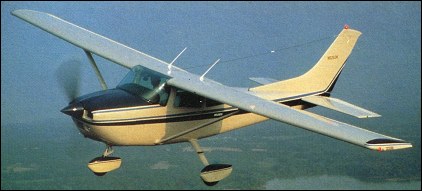
| The Cessna Model 170 and its immediate successors of the same family have the double distinction of being the best-selling series of lightplanes of all time, and also the most widely produced aircraft series yet developed, well over 30,000 examples having come off the production lines by the 1980s.
The origins of the series stretch back to 1948, when Cessna introduced the Model 170, itself little more than a four-seat, re-engineered development of the earlier Model 120. The Model 170 proved popular, but the type's real success started in 1953 when Cessna introduced the Model 170B: this was powered, like its predecessor, by the 108kW Continental CO145-2 air-cooled piston engine, but incorporated the slotted Fowler flaps pioneered for Cessna's Model 305. With these efficient flaps the field and low-speed performance of the Model 170 were improved radically, and all subsequent Cessna aircraft of the type have been designed round similar flaps.
In 1955 the company developed the Model 172, which was essentially a Model 170B with detail improvements and the tailwheel landing gear replaced by a spatted tricycle unit. The improved ground safety of the new variant proved immediately attractive, and in 1956 some 1,170 Model 172s were sold, compared with a mere 174 of the Model 170B, whose production was terminated.
In 1958 Cessna brought into production the Model 175. This was in effect the latest version of the Model 172 with a number of improvements (free-blown windscreen, glassfibre speed fairings, etc) and a 131kW GO-300-C geared engine driving a constant-speed propeller. In 1959 a de luxe version of the Model 175A was introduced as the Skylark, but the Model 175 / Skylark type was dropped from production in 1963.
At the same time as the de luxe version of the Model 175 appeared as the Skylark, a similar de luxe version of the Model 172 was introduced under the name Skyhawk. Further improvements were made in 1960, with the provision of a new rear fuselage (slimmer and with rear windows) and a stylish swept vertical tail. These modifications were also applied to the Skyhawk and the Skyhawk II, which featured yet more comprehensive equipment, adding sophisticated navigation and communication equipment to blind-flying instrumentation found in the Skyhawk. In March 1956 Cessna announced a new Model 182, which was an addition to the standard fixed-gear family, but powered by a 172kW Continental O-470-S. It was available in Standard, Skylane and Skylane II versions.
Since that time there has been continuing development and several changes and versions available in 1982 included the Model 172 Skyhawk and Skyhawk II, the Cutlass RG and Cutlass RG II which is basically a Model 172 With retractable landing gear, the Model 182 Skylane/Skylane II which is available also in Turbo Skylane and Turbo Skylane II with a 175kW Avco Lycoming O-540-L3C5D turbo-charged engine, and in Skylane RG and Skylane RG II and Turbo Skylane RG and Turbo Skylane RG II retractable landing gear equivalents.
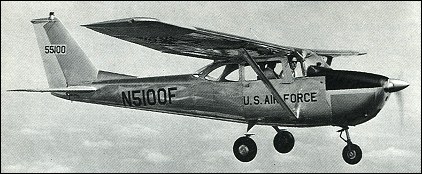
The Model 172 also appealed to the US military and in July 1964 the US Air Force ordered 170 standard Cessna 172Ks powered by 134kW Continental O-360 engines for the Air Academy, and these were designated T-41A. In August 1966, the US Army bought 255 Model R172Es fitted with the more powerful 157kW IO-360D fuel injection engine, as the T-41B Mescalero. These were followed by similarly powered T-41Cs for the US Air Force, and export version, designated T-41D, for a number of other air forces under the Mutual Air Programme. Total production of the military T-41 series reached 864 built between 1963-83, and by the end of 1987 production of the 170, 172, 175 and 182 Models had reached over 60,000 including their civil and military derivatives.
| MODEL | Turbo Skylane RG |
| ENGINE | 1 x ) Avco Lycoming O-540-L3C5D flat-six turbocharged piston engine, 175kW |
| WEIGHTS |
| Take-off weight | 1406 kg | 3100 lb |
| Empty weight | 815 kg | 1797 lb |
| DIMENSIONS |
| Wingspan | 10.92 m | 36 ft 10 in |
| Length | 8.72 m | 29 ft 7 in |
| Height | 2.72 m | 9 ft 11 in |
| Wing area | 16.16 m2 | 173.94 sq ft |
| PERFORMANCE |
| Max. speed | 346 km/h | 215 mph |
| Cruise speed | 320 km/h | 199 mph |
| Ceiling | 6095 m | 20000 ft |
| Range w/max.fuel | 1909 km | 1186 miles |
| John, e-mail, 04.04.2015 23:52 As the Northern Alaska Census Pilot, I flew myself and other Field Reps to the bush villages of Interior Alaska and the North Slope in a 1967 C182K, on a monthly basis for 30 years. Well equipped with 3 axis autopilot, full IFR and good GPS, she never gave me a lick of trouble over thousands of hours. She had long range tanks and Flint Aero tip tanks and ran on regular auto gas. I once flew her from Fairbanks down to Port Angeles, Washington non-stop -- took eleven hours. Safe, easy to fly, and practical... Clyde Cessna really knew his stuff. reply | | Richard Weber, e-mail, 17.03.2015 23:06 Bought my 172 N5152A 1954 model in 1968 for $5200 had old coffer grinder radios lots of fun when caught in the Smultz over the Allegheny's at night in a snow storm but low and slow brought us down in Bellefonte Pa. Flew it until 1978 and sold it in Maine For $5300 flew like and angel not like the 1970's models which flew heavy on the controls reply | | Charlie Hinson, e-mail, 27.02.2015 04:35 Serving as a missionary in Liberia, I uncrated a brand new 1960 Skyhawk straight off the ship, assembled it, and flew it 4,500 hours over the jungles without an accident. The best wings in the air. Wrote a book about it. Wish I could afford one now. reply | | George Gould, e-mail, 24.01.2015 18:38 According to the NTSB the Cessna 172 has the best aviation safety record of all aircraft reply | |
| | Al Jan, e-mail, 02.09.2013 20:32 I, too, came to this site looking for the Cessna Cardinal. What gives? reply | | John Aiton, e-mail, 20.02.2012 18:35 WOW, not a word about the Cardinal 177RG. With the larger engine it's a great AC. reply | | Connie McCullough, e-mail, 11.10.2011 19:25 Have a '58 C-182 that my dad and I have owned for 20 years. In beautiful shape. Soloed at 16 in a C-172 in 1969. We've owned a C-185 and a Piper Tri Pacer, but none are better than the C-182. There's a reason it's considered the safest A /C in the GA fleet! reply | | Steve, e-mail, 08.08.2011 19:26 For 15 years I owned a Cessna 175 with the Avcon conversion(Lycoming 0360 and constant speed prop)that made it a mini C-182. I used it as a trainer for Private, Commercial, and Instrument certification in addition to personal use. It was based in Gunnison, CO, elevation 7,700 msl. With 2 or three people and full tanks, it would perform better than most Cessna 182s at that elevation. It was a great airplane. reply | | J. Van-Fleet, e-mail, 05.03.2011 23:12 Not a word about the 150. Most pilots learned to fly in one. reply | | Terry Clayton, e-mail, 24.02.2011 00:10 Bought my 182 in 1968 "NEW" for $20,000.
Flew it for 1800 hours and sold it and the new owner trashed it in 1 year. See NTSB N42184 reply | | John Cummings, e-mail, 26.01.2011 02:35 Wow! A huge A /C after 100 hours in a C150. John K7LM reply | | Jim Faix, e-mail, 25.01.2011 04:01 Restoring a 1956 C-172 right now. s /n 29178. Hope to fly it soon. Just sitting in it is fun. I can only imagine how much fun I'll have once finished with the annual. Many hours in a C-150 and now I own it's big brother. reply | | Scott Boyd, e-mail, 18.01.2011 22:55 I used to fly this old judge from Cortez Colorado to Northeaster Utah in a 175. The 175 always made weird noises and especially scary at night, especially when the Judge lit his cigar every few minutes.
Never really had a problem, but that geared engine, and it's history didn't inspire a lot of confidence.
I was much happier in the T-210 or T206, but he wouldn't spring for them and nobody wanted to buy the 175 so my boss worked out a deal. reply | | Merl Short, e-mail, 04.01.2011 17:30 I presently own a 1977 HawkXP with the 210 HP Continantal engine.
Bought it in 1993 c /w 2300 Pk floats, had a 1969 and 1979 Citabria before that. I have enjoyed every minute flying it,as I am now 71 years young, I don't know how many years I will be flying,but will keep it till my medical goes.
It will get off glassy water with 4 aboard and half tanks,with a good cruise app.110 mph.Love it. reply | |
| | Jay, e-mail, 04.01.2011 06:43 Eat your heart out! I've got the best C-17X model ever made with the best engine /prop combination. 1960 C-175A Skylark with 1980's steam guaged panel, a 6V-350 Franklin normally aspirated, rated at 235 HP with controllable pitch prop, 9gph at low cruise (2300 rpm-133kts,) GPS's (2), old but good radios, Hodgekin STOL (VGs, fences, leading edge cuffs, droop tips, flap and aileron seals) sorry to brag, but I just got this acft last Sept and I'm just so fond of it already, I can't stop singing its praises. Operated from 6135 feet, STOL good, off and on a 1900 ft dirt strip with power lines at both ends...700 ft takeoff at gross, short soft landing at best effort about 500 ft full performance, challenge these, but great fun...59 kts over the fence...working on slower...am told it can hold slope at 50 kts, with power, fully controllable. Working on it, but this is the funnest C17X I've ever flown... and that's over 3,000 hours. The rest of the hours are in many other marks up to C414, but this is MY bird. I have fun with controllers who insist on calling it a C182, Skyhawk, etc!
Apologize for my excitement but I love to share the wealth! reply | | Robert Urban, e-mail, 11.12.2010 07:07 I FLEW MY 1977 R172K FOR 26 YEARS AND LOVED EVERY MINUTE OF IT. A GREAT SHORT FIELD PLANE. reply | | Robert King, e-mail, 10.12.2010 21:08 I learned to fly in the late 60's in Detroit, MI at DTW prior to the big boys taking over. After gaining my license I flew a Cherokee 180 several Cesena's including the 150, 172, 177 these are the models our club had. Then as the wisdom of youth led me down the primrose path in around 1969, my partner and I purchased a Cessna 182 N2974Y. We owned this fine aircraft until the mid 80's. Many fabulous trips were taken including one to Alaska. With many hundred hours logged on the aircraft, I can only sing praise to it. Our O470 consumed (actually expelling it through the breather) a lot of oil which was washed across the belly. After exhausting other options to resolve the oil issue, we had our FBO install a factory remanufactured engine, this move helped with the oil consumption.
So with all that said. The air craft performed as the most stable and best performing platform I have ever flown. While reflecting on times gone by, I wonder if this fine aircraft is still flying. If anyone knows please let me know. rrking7@yahoo.com reply | | kent parsons, e-mail, 09.12.2010 13:48 My father owned several Cessnas starting in the mid 50's with a tail dragger. went to flyins around the midwest as a family nearly every weekend. He always said they were the best small plane ever built; could go anywhere and do much more than the specs allowed. I miss those days. reply | | David Perkins, e-mail, 03.12.2010 18:53 The Cessna Cardinal is missing, I owned a model 177b, a fine aircraft. reply | | Andy G3PKW, e-mail, 02.12.2010 23:18 Got to be the finest light airplane ever. Best memory, lovely summer eve in 172 with VP prop. on perfect glide slope into Liverpool old field on R26. magic ! reply |
|
Do you have any comments?
|
| 
COMPANY
PROFILE
All the World's Rotorcraft
|