|
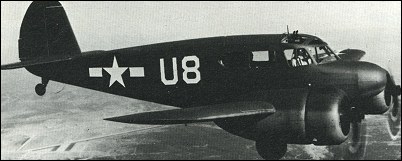
| Cessna Aircraft's first twin-engined lightplane, built and flown in 1939, was a five-seat commercial transport typical of many very similar aircraft which became fairly common in the USA during the late 1930s. Designated Cessna Model T-50 by the company, it was of low-wing cantilever monoplane configuration and of mixed construction. Wings and tail unit were of wood, the latter with fabric covering; the fuselage, however, was a welded steel-tube structure with fabric over lightweight wooden skinning. Retractable tailwheel type landing gear and wing trailing-edge flaps were both electrically actuated.
In 1940 the military potential of this aircraft, as a trainer suitable for the conversion of pilots from single-engine to twin-engine types, became apparent almost simultaneously to two North American nations. First was Canada, which required a machine of this type for the Commonwealth Joint Air Training Plan, and 550 aircraft were supplied under Lend-Lease, these being designated Crane 1A.
The second requirement was for the US Army Air Corps which, in late 1940, contracted for the supply of 33 T-50s for sevice evaluation, allocating to them the designation AT-8. These were powered by two 220kW Jacobs R-680-9 radial engines, but service trials showed that these were unnecessarily powerful for use in a two-seat trainer, and when in 1941 the first real production contracts were placed, less powerful engines by the same manufacturer were specified.
The initial production version, designated AT-17, was equipped with Jacobs R-755-9 engines driving wooden propellers. A total of 450 was built, and these aircraft were followed into production by 223 of the generally similar AT-17A, which differed by having Hamilton-Standard constant-speed metal propellers. The later AT-17B (466 built) had some equipment changes, and the AT-17C (60 built) was provided with different radio for communications.
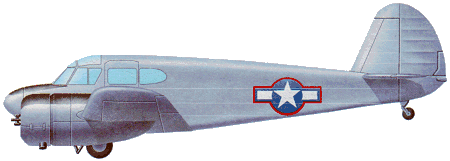
The original use of Cessna's T-50s had been in a light transport role, and in 1942 the USAAF decided that these aircraft would be valuable for liaison/communication purposes and as light personnel transports. Production of this variant totalled 1,287, the aircraft being named Bobcat and given the designation C-78, later changed to UC-78. In addition, a small number of commercial T-50s were impressed for service with the USAAF under the designation UC-78A.
The USAAF's requirement for the two-seat conversion trainers had been difficult to predict, and when it was discovered in late 1942 that procurement contracts very considerably exceeded
the training requirement, Cessna was requested to fulfil the outstanding balance of the AT-17B and AT-17D models as UC-78B and UC-78C Bobcats respectively. Both were virtually identical, but differed from the original UC-78s by having two-blade fixed-pitch wooden-propellers and some minor changes of installed equipment. Production of these two versions amounted to 1,806 UC-78Bs and 327 UC-78Cs.
In the period 1942-3, the US Navy had a requirement for a lightweight transport aircraft to carry ferry pilots between delivery points and their home bases, as well as for the movement of US Navy flight crews. This led to the procurement of 67 aircraft, generally similar to the UC-78, which entered service under the designation JRC-1. Many examples of USAAF Bobcats remained in service for two or three years after the end of World War II.
| MODEL | UC-78 |
| CREW | 2 |
| PASSENGERS | 3 |
| ENGINE | 2 x 450hp Jacobs R-755-9 radial piston engines |
| DIMENSIONS |
| Wingspan | 12.78 m | 42 ft 11 in |
| Length | 9.98 m | 33 ft 9 in |
| Height | 3.02 m | 10 ft 11 in |
| PERFORMANCE |
| Max. speed | 314 km/h | 195 mph |
| Ceiling | 6705 m | 22000 ft |
| Range | 1207 km | 750 miles |
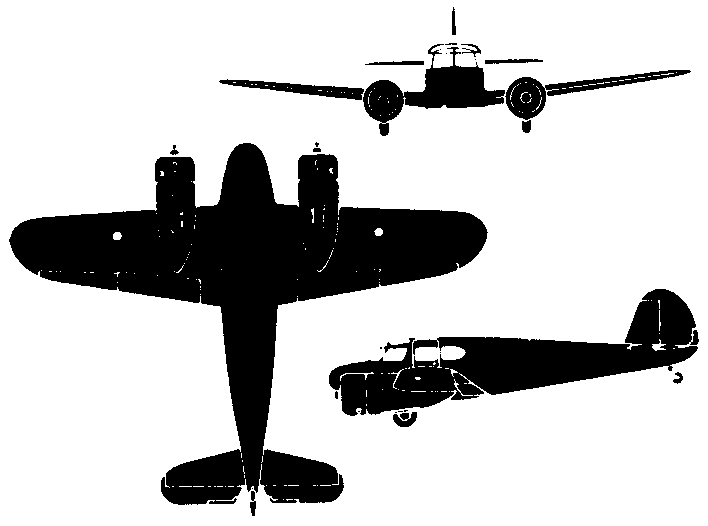
 | A three-view drawing (708 x 526) |
| JLIPSTATE@ICLOUD.COM, 10.03.2014 20:54 I graduated from Advanced at Pecos ,Texas training in this very easy to fly aircraft. It had wooden props that were not constant speed and was not too useful in preparing me for my assignment to the Troop Carrier Command where I was flying C46's. reply | | Bo Kusterer, e-mail, 02.12.2013 21:55 Took my CFI ME check ride in one of these. Gave some dual in a different one. What a slug ! ! ! Probably the worst plane I ever flew. Glad I flew it, though, just to be able to say that I did it. reply | | willis E. Vanderberg, e-mail, 01.03.2013 20:01 The Jacobs engine as described was a 245 HP engine not a 450. Also the t-50 was a lighter wing and had the wooden props, the UC 78 was a heavier wing and has the Hamilton Standart constant speed props.
My father in law used the T-50 as an instrument trainer at Kellogg field in Battle Creek in the late 40's and early fifties. Rumor has it that the aircraft would not fly on one engine. He flew a T-50 from Battle Creek to Coldwater Michigan on one engine. This was from take off to landing. reply | | JOHN BOY, e-mail, 15.12.2012 23:52 I BELIEVE I HAVE A PROPELLER FOR A T50 OR UC-78? SERIAL NO. AF 44-24141. DWG NO. 44K 24605 EVERYTHING I FIND SAYS ITS FOR THIS PLANE. ANY INFO WOULD BE HELPFUL reply | |
| | ed pugsley, e-mail, 03.02.2012 19:23 You are a very good story teller Dad, and thank you for being a B29 pilot in the US Air Force, also congratulations to you and Mom on your anniversary. Many more, love, Carol reply | | Shelton, e-mail, 08.04.2011 03:02 Hello
How Are You Doing..?I Am Mr Shelton And Would Like To Order For Propellers..I Will Like To Know The Types And Prices Of Then..Also I Will Like To Know The Method Of Payment You Accept..Waiting
Regards
Shelton reply | | LTC (Rt) Ray Burke, e-mail, 24.02.2011 14:20 Took my advanced flight training in this bird at Douglas AAF
AZ, right on the mexican border. Graduated in June of '44. Don't remember too much about the airplane, but I sure remember the border town Agua Prieta, Mexico. There was no vice those folks down there couldn't satisfy. reply | | Scott Boyd, e-mail, 07.05.2010 06:27 The old Sky King tv shows used the T-50. Later he had a 310 and Cessna gave them the cockpit mochup to film with. reply | | Chris, e-mail, 13.01.2010 14:28 I have a A-17 wooden propeller, 8 hole bolt pattern. dark wood , think it is mahogany or walnut, made by hartzell. stamped on it is : SR NO. 22251, Airplane A-17, Engine R-755. It measures 90" in length. The Edge gaurds appear to be brass or similar metal. This prop is in pretty good condition. , does anyone know about what this is worth, thinking about putting it up for auction after doing a little more researching. reply | | Ed Pugsley, e-mail, 30.12.2009 23:11 I was the student pilot of an AT-17 in Ft Sumner, NM in 1944 when I tried to take off with the wheel switch in the "UP" position. My student co-pilot and I were in a hurry to get airborne to join a formation training flight and we ran the check list as we taxied out to the runway. It didn't work and we skidded to a stop with the wheels up.
I probably would have been "washed out" if I hadn't been so close to graduation. reply | | Camilo, e-mail, 22.06.2009 01:15 I'm searching the complete list production of Cessna T-50, please any information, send to my mail.
Thanks. reply | | Mike James, e-mail, 13.11.2008 02:59 For those who love this aircraft, I'm building a museum-scale, detailed version of it in 3D. The follow-along article begins at www.mikejamesmedia.com /cessna_t50_01.html
Enjoy! reply | | Mike Spaight, e-mail, 02.08.2008 02:19 Trying to identify attitude indicator that I think came from UC-78. Do you have any photos? reply | | CASTLE22R, e-mail, 13.06.2008 16:16 A truly interesting plane.I like it,brilliant. reply | |
| | Bob Watkins, e-mail, 25.05.2008 21:25 In 1963 I obtained a multi engine certificate in one of these. When the instructor was simulating engine out procedures, I could not hold the airplane straight with one foot on the rudder pedals. It took two feet on one rudder pedal to keep the airplane in control. Also, being too beg for most hangars, they sat outside which brought about their short flying lives. reply | | Bob Watkins, e-mail, 25.05.2008 21:25 In 1963 I obtained a multi engine certificate in one of these. When the instructor was simulating engine out procedures, I could not hold the airplane straight with one foot on the rudder pedals. It took two feet on one rudder pedal to keep the airplane in control. Also, being too beg for most hangars, they sat outside which brought about their short flying lives. reply | | Paul R. Flow, e-mail, 11.05.2008 21:35 I got my Multi-engine rating in a Cessna T-50 /UC-78("Useless 78")in 1946. Good plane but under-powered. reply |
|
Do you have any comments?
|
| 
COMPANY
PROFILE
All the World's Rotorcraft
|