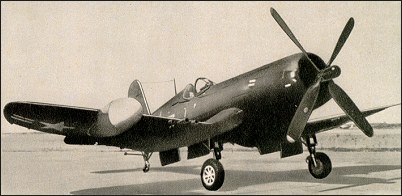
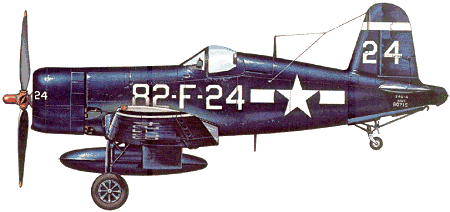
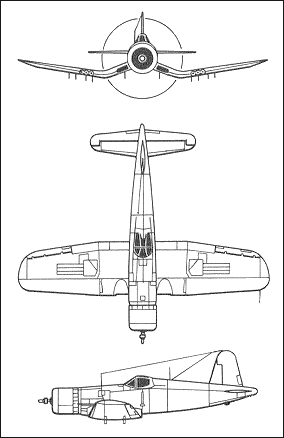
In 1938 -at which time Chance Vought was a division of United Aircraft Corporation (UAC) - the US Navy was seeking a new single-seat fighter suitable for operation from aircraft carriers. Details of the requirement were circulated to US manufacturers and Chance Vought's proposal (then bearing the company identification V-166B) was sufficiently interesting to be selected for prototype construction. A single prototype was contracted for on 30 June 1938, making its first flight on 29 May 1940.
Realising that performance, load-carrying capability and range were essential ingredients of
a carrier-based fighter, Vought set about designing the smallest possible airframe around the most powerful engine then available. The selection of a four-blade propeller meant that the front fuselage had to be kept well clear of the ground. This dictated a tall, stalky landing gear which would be completely unsuitable for carrier landings. The solution to this problem provided the F4U (as designated by the Navy) with a recognition feature - an inverted gull wing. By mounting the main landing gear at the crank of the wing, it was possible to use compact and robust main struts.
Testing of the XF4U-1 prototype soon demonstrated that the Navy had available a fighter faster than anything else in service with the armed forces. On 30 June 1941 the Vought-Sikorsky Aircraft Division of UAC (as the company was then reformed) received a contract for 584 aircraft under the designation F4U-1. What had by then become an honoured name - Corsair - was to be bestowed on this new aircraft, one which was to prove itself the finest carrier-based fighter of World War II.
F4U-1 began to enter service in October 1942, but in order to provide increased fuel capacity the cockpit had been moved further aft to make room for a fuselage fuel tank. When first tested by the Navy it was believed that this adversely affected the pilot's view, to the extent that the Corsair was considered doubtful for carrier operation. Production aircraft were delivered instead to the US Marine Corps for operation from land bases. It was not until 1944, when Corsairs supplied to the Royal Navy under Lend-Lease were being used effectively from carriers, that the US Navy made a serious reappraisal of their suitability for this role. Shortly after, Navy squadrons were given approval to use the Corsair for the task for which it had been designed.
The Corsair was built also by Brewster Aeronautical Corporation and Goodyear Aircraft Corporation to cope with the high production required, under the initial designations of F3A-1 and FG-1 respectively. Both Vought and Goodyear built a number of variants, the last being the F4U-7, of which 90 were built for supply through MAP to the French Aeronavale. By the time that production ended in December 1952 more than 11,000 had been built; of these 2,012 had been supplied to Britain and 370 to the Royal New Zealand Air Force.
Guys you need to look at the record of VMF 221 the recinolying Falcons. Jim Swett, Medal of Honor Recipient, George Johns, Dean Caswell, Duncan many more great heros gave the F4U a great record. These guys were part of the greatest generation with I believe only 12 remaining alive today. Semper Fi All!!! Jerry from FMF(AW) 513 Atsugi.
I'VE ALWAYS LIKED THE F4U "CORSAIR" OF WW2 AND THE KOREAN WAR.THE BEST VARIANT OF THE "CORSAIR" WAS THE F4U-4.MY GREAT UNCLE DURWOOD WORKED ON THE "CORSAIR" DURING THE KOREAN WAR,HE WAS APART OF THE BLACK SHEEP,VMF 214 AS AN ELECTRICIAN.
During WWII I flew 28 different Navy airplanes. The Corsair was by far the best of all. It could do snap rolls all day long if your body could stand it! For example I was flying a FG-3 at 13000feet,a shining new P-51 came along side wanting to race using hand signals. I signaled no three times, then he gave me the finger---we were on. He pulled more inches of manifold pressure, so he jumped ahead until I got my 4 blade prop cranked up with 45 inches of manifold pressure. I caught up to him and was passing giving him my tomcat grin. He leaned forward pushing something, pulling away. He would not put his blower on at 1300feet, but he did. So I turned my blower on. Catching him again, I was watching my cylinder head temp. It was approaching the red. I poped open the water injection and waved good bye to the P51. Do not do that it's too hard on engines.
I would like to know if anyone has any information on the F4U training in Pensacola Fl. My late uncle was a Navy Lt Commander and was a flight instructor in Pensacola during the early to mid 1940's. Does anyone know the name of the airwing or outfit? I am trying to recreate a flying scale model of the exact aircraft he flew as a memorial to him. I am a R /C pilot of warbirds and I have been looking for any info I can get on his squadron or airwing. Thanks in advance for your help.
I was a Marine Pilot,assigned to VF5@ NAS JAX,a Navy fighter squadron,teaching Royal Navy pilots. Flew the F4U-1 birdcage,and later with VMF 111 flew FG1s-5s. 1,550 hrs.total in this plane..5 degrees rt.rudder ,or you weren't getting into the air.Good carrier bird.The F6F would float.The Corsair wouldn't.Flew for 45 yrs.after WWII.The corsair was my favorite.2nd.would be the F8F & The Pitts S-2-B.
Never flew one but "pushed" and chocked /unchecked a lot of F4U4 ( 6-50 cal. machine guns) and 5's (4 20mm guns) as a Aviation Boatswains Mate on the Philippine Sea and Coral Sea in 1948-52
My uncle, Bob Klingman, flew F4Us off Okinawa 1944-45 as a member of VMF-312. Later, he flew ground support missions in Korea before transitioning to the F9F Panther. There's a beautiful restoration in Texas of an FG1, which has been painted with VMF-312s distinctive checkerboard colors. I saw this plane at Addison, TX two years ago at an airshow. Merritt Chance, another member of VMF312, consulted on the restoration, and it wears his old A /C number. For more on VMF312 (which incidentally is still in operation as VMFA312, flying FA-18s) log onto F4Ucorsair.com and click on the link to VMF312 found on the site. Interesting stuff.
This is my "if you could only pick one favorite" Aircraft. I have been a fan since i was a kid in Marin county CA.in the mid 50's. We would watch the fleet come in under the Golden Gate Bridge. I asked about the aircraft carriers and aircraft...i saw my first picture of the F4U Corsair..and I was toast!! Later in life I would Marry my wife Judy and find out that her Sister Patty is married to the "Grandson" of "Pappy Boyington"....The Black Sheep Squadron...my favorite show while it ran....NEVER missed it. The F4U looks and sounds so good...I could sit and listen to that big radial at idle until it ran out of gas.
I neglected to mention that the model was AU-1, a low altitude, close air support version with a single stage blower, and good only to about 18,000 feet. It mad trying to intercept B-29's in an excercise at Ft. Bragg very interesting. 45 minutes at full throttle and it was time to bingo.
I flew the last model, I think, of the Corsair in VMA-225 at Edenton, NC in 1954-55. I guess I have close to 1,000 hours in it, and every one was a pleasure. I was a boot 2nd Lt. and flew about 80 hours a month most months, doing a lot of close air support training missions. I learned the LSO business from Capt John Coffman during that period. We never did get to take it aboard, but we did a great deal of FCLP. Once you learned to close the cowl flaps at the 45, it was pretty easy to see the LSO.
In 1987, I had the privilege of meeting and getting to know a very distinguished older man, Mr. Don Morris of Buffalo NY. We became friends, and during one of our conversations he mentioned that in his past career he had worked for ten years as a test engineer for Curtiss-Wright Aircraft in Buffalo NY. I asked him to tell me all about those days. He did and at one point he mentioned all the time he spent working on the Corsair. I said "Don you must be confused. You have always lived in Buffalo and that airplane was built by Voight or Consolidated or somebody in California. He was a little offended that I challenged his memory. He said, "We designed and built that airplane. Some politics occurred around Wright and we were told to put everything into a crate and box it up. We were under military contract , so we did just that and ASAP". He was 75 at that time. He got up and went to his book shelf and took down a book of family photos. He opened it to a page - and there was a picture of an up-side-down Corsair inside a large room. There was a group of men including Don, and a pile of sand bags standing on the bottom of the wings, with that immensely distinct gull shape. I looked at him and said, "What is this?". He said, "That's the way we stress tested the wings in those days. Remember we didn't have any of those new methods." So I wonder how many people know that this very famous airplane was actually designed and built by Curtiss-Wright in Buffalo in the late 30's?
I flew the F4U-4 in 1948 as a midshipman then the Reseerve FG-1D Goodyear Corsair at NAS NOLA Lakefront in 52. Got 11 carrier landings in the bentwing bird. Stable as a rock and an excellent rocket launching aircaft as was the Abledog.
While it's true that you can get just about any information you want from the various websites available, I for one like to have a good reference book available. For Axis aircraft, I like David Mondey's 256 page book "Axis Aircraft of World War II", published in 1996 by Smithmark Publishers, located at 16 East 32nd St., New York, NY 10016. The copyright is by Aerospace Publishing Ltd., 1984. It contains all the important types (over 100) with specifications, photographs and colored side-view drawings. It lacks three view drawings for every aircraft but does show large colored three views for the most discussed (Bf109, Stuka, Zero, Macchi MC202,etc.). I bought my copy at Costco for $9.59 but I'm sure almost any bookstore could order one for you. Or find one on-line. You won't be disappointed. Mondey has written more than 20 books on aviation and is an assistant compiler of "Jane's All the World's Aircraft".
I can't avoid the thought that the F4U might have had a less rocky career if the fuel tanks had been left in the original wing location and the need for increased firepower met by a pair of Oerlikon FFS 20mm guns (the aircraft version of the familiar AA gun) replacing the .50 caliber wing guns in the prototype.