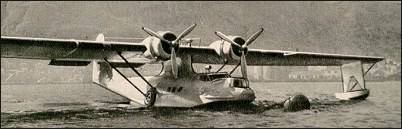
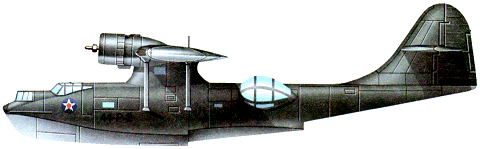
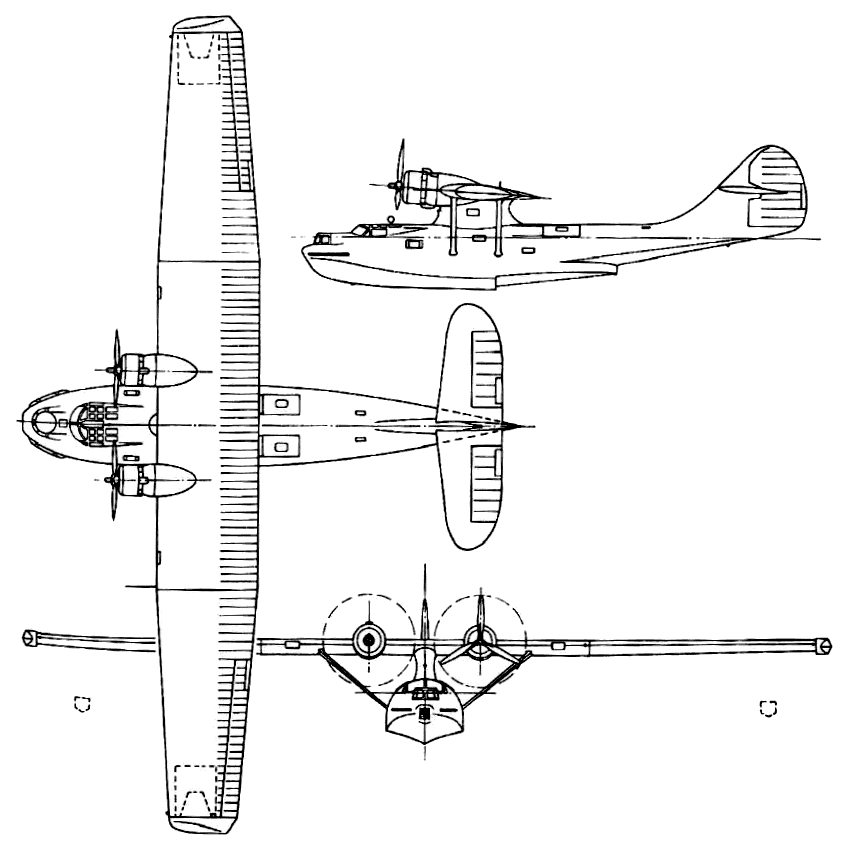
One of the most successful flying-boats to serve extensively throughout World War II and the most numerous flying-boat in aviation history, the Consolidated Model 28, designed by Isaac Laddon, originated from a US Navy requirement of late 1933. The prototype XP3Y-1, developed from the PY-1/P2Y and flown for the first time on 28 March 1935, introduced some distinctive features. Most important was the parasol wing constructed on the basis of a cantilever wing requiring no supporting structures, although in fact two small-section struts were mounted between wing and hull on each side. This deletion of the multitudinous struts and bracing wires - seemingly inseparable from flying-boat design until then - offered an immediate improvement in performance. Another new feature was the introduction of stabilising floats which retracted in flight to form the wingtips. Initial trials of the prototype left little doubt that the Navy was about to acquire a significant aircraft. PBY-1 began to enter squadron service in 1937 and by mid-1938 14 squadrons were operational.
Initial export aircraft went to Russia, where the type was built subsequently in large numbers under the designation GST. The RAF acquired a single example for evaluation in 1939 and almost immediately ordered a batch of 50, the first of many to serve with Coastal Command. The name Catalina (adopted first by the RAF) was used later by the USN for the various versions which entered service. The type was also to serve with the RAAF, RCAF, RNZAF and the air arm of the Dutch East Indies. Production as a pure flying-boat ended with the PBY-4, for the last of these was converted to an amphibian with retractable tricycle-type landing gear, under the designation XPBY-5A. Subsequent aircraft had this as standard. Used widely throughout World War II, many amphibious Catalinas remained in service for air-sea rescue for some years after the end of the war.
Was Navy Radio /Radar Operator, PBY5A , based Adak and Attu, 1943 and 1944. Pilots were Mid White, Bob McGrath, and Ted Cope. 2nd Radioman,Danny Curran. Patrolled half way to Midway one day. Entry and exit was using a small ladder hanging down from one of the side blisters. At 93 years old, could probably not manage today. Great Airplane and many great memories.
My dad, Ernest Gremillion, worked on the assembly plant for this plane in New Orleans. He actually invented a tool to help built it. I remember going down to the plant with him and picking up scraps of aircraft aluminum used on the plane that I cherished for many years.
I few in pby6a sn64089 in Adak Alaska this was the last pby to fly in the aleutians. this plane was lost on a ferry flight from. Adak to the philipines the ferry crew didn't make it to midway they run out of fuel and ditched off midway. sorry ending to a wonderful airplane 1953 1954
My first few flights I had my head out the window below the wing heaving my guts out while flying over convoys in the Gulf. In 1943. I was only 15 at the time. right after boot camp. Pensacola Fl. SQD 8A. I was attending AMM school at the time. If anyone out there that knows of anyone that was in SQD 8A at that time please let me know.
There is a Catalina still flying regularly and has been made Original as a dedication to the RAAF "Black Cat" Squadron. It is based at HARS (the Historical Aircraft Restoration Society) just south of Sydney NSW Australia.
This was not the fastest or most glamorous airplane of World War II, but undoubtedly one of the most important. While other flying boats were built in dozens, or perhaps hundreds, Catalinas were built in THOUSANDS. More Catalinas were built than any other flying boat in history. They served all over the world in the Air Forces of many nations, in every sort of climactic condition, and in a wide variety of roles.
My Dad, CMDR. Jacques Vroom flew left seat on these in the south pacific during WWII. I lost him in May of 2009 but would love to hear from anyone who may remember him. He retired in Brunswick Maine 1961. Thank you for your time.
I am trying to locate an old friend to say hello and catch up. His name is Vern Schille and his name comes up on this site when it's Googled. Can you help me in my search. I am a retired Aviation insurance broker and insured the old ' Canso' for my clients many years ago.
My mom put together Plexiglass side-blisters for PBYs at a small Consolidated sub-assembly plant, (a Willys car dealership before the war) in Anaheim, CA in 1942-3
"Does anyone know the diameter dimension of a PBY-5 wing strut?" Answer as I recall: Don't know the exact size but they were ovoid or tear- drop in shape, approx. 3 1 /2" x 1 1 /2" maybe 10' in length, made of seamless thin wall, approx. 1 /8"-3 /16" thick,chrome-moly alloy steel tubing. Many aircraft surplus stores in the LA area sold them. They were popular as main frame rails with SoCal Hot-Rodders; some early dragsters and dry lakes machines liked them due to rigidity, strength, light weight and low price.
I guess the OA-10 is a bit different judging by the pictures. I volunteer at the National Museum of the USAF. On our OA-10, on the very front there is a corrigated covering /opening, maybe measuring 12 inches by 8 inches, maybe a bit bigger. I'm trying to figure out what this is. Can anybody shed some light on this? Thanks!!
My father and his Navy scouting squadron VP-5F, flew the PBY-3, which they picked up new at the Consolidated plant in San Diego in 1938. The squadron was based at Coco Solo N.A.S., Panama Canal Zone. I have photographs and a film of his plane (5-P-1) and a complete squadron photo.