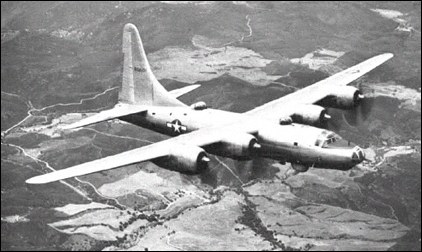
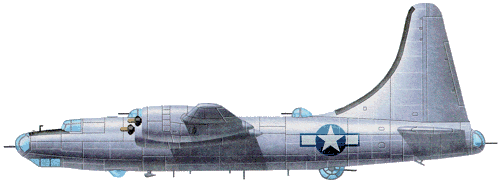
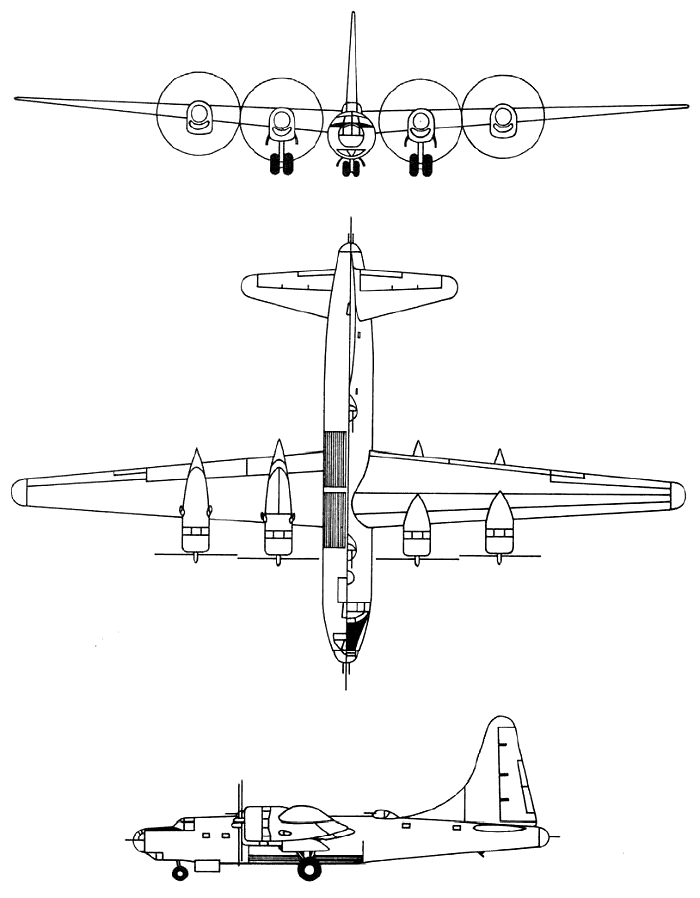
The B-32 was the last US heavy bomber to go into action during World War II, aircraft of this type flying a score or so of sorties before Japan surrendered. It was designed to the same specification as the Boeing B-29, considerably more development being necessary for the B-32. Pressurisation and remote control of the gun turrets were abandoned and the twin-ruddered B-24-type tail was replaced by a very large single fin and rudder on the B-32. The first of three prototypes flew on 7 September 1942. A total of 114 were built, powered by 1,639kW Wright R-3350-23 engines driving Curtiss Electric reversible-pitch four-blade propellers. Armament comprised ten 12.7mm machine-guns and up to 9,000kg of bombs.
my uncle Tilliman Smith, worked for consolidated, convair, General Dynamics and Lockeed for 42 years and never left his area. He worked on everything they ever touched. I have some documentation he left me from the PLANT, and it included the B-32. Quit the air plane builder. His conversation and expertise made me become a naval aviator , 2700 hours F4=j 708 carrier landings , 262 sorties in VN.; Loved the guy for his knowledge, but he was a Texas demo, union guy, no other cars but from Charlie Hillard Ford,, by the way, Charlie Hillard Jr was killed in a crash of a Sea Fury about 20 years ago. Uncle worked on the B-24, B-36,B-58, B-57 canbera modification, B-32, F-111, F-16. I Wished I had talked to him more....
I really do hate it when so-called knowledgeable "experts" don't know what they're talking about. The U.S. Navy used these lumbering giants in coastal and sea patrols right up into the early 50's. I remember watching them taking off from the Chamblee Naval Air Station (along with Hellcats), now DeKalb-Peachtree Airport when I was a kid....I was born in 1944.
I just tried to send you a crew roster I found in one of Mother's scrap books. My father Captain Alfred Neil Brown was assigned to fly one of the B32's to the Philippines. This was a transcribed copy. It looks like the pilot's and crew names were all copies correctly. Sorry about the way this system picked up the formatting. Possibly if you copy and paste it to another document it will reformat itself. ' -RE-S--T
AIR TRANqf&.COP.tiMAND·
OPERATIONS ORDERS) NUMBER 184)
PACIFIC DIVISiaNr WEST COAST WING 1505th AAF BASE UNIT Mather Field, Sacr mento, California
EXTRACT
2'5' July 1945
1. PAC Ltr of Instruction, Hq, PD-.<. tTC, APG· .,;:3.9 Par 6, dated 30 Jul 44, and Opns·order #20) · 2.and 3, Hq, '55th AAF :84ss Unit (5th Ferrying Gp), Ferrying Division, e Field, Dallas 9, Te s, dated .22 Jul 45,. the below listed 0 and EM,... .at the proper time in designated mil acft from Mather Field, Calif to. ARK FIELD, MANILA on temp dy not to exceed thirty (30)days. After delivery of ap, 0 and EM will return by fastest avail mil or comlll ap to perm proper dy sta, CIP1P.
B-32 #(+P.--108544
1st Lt 1st Lt 1st Lt s /sgt Sgt Pfe
CRUSE, ARTHUR W. RUTH, JOHN H. HOUGH, RICHARD G. Briggles, George B., Hubbard, v.:ayne H. Anderson, Charles W.,
For 0 per diem is atzd under provisions of A.R #35-4820 and per diem is atzd for EM under provisions of fR #35-4810.
TDN bGl-39 P 43'2-02 212 /60425. !YORDER OF t':OLONEL BRECKENRIDGE:
/-i () ( /-' fA; OFFICIAL: v '· I. Ac-c.A L{t.·t..l / V · Lk.CLct, 1 'c. RICHARD Po DE!I.NE 1st Lt., Air Corps Project Control Officer DISTRIBUTION: "A" Each i:ndiv( oncerned (10) ·
CAREY J. ANDERSON, TRo Lt.Colonel, dr Corps Director of Operations
PACIFIC DIVISiaNr WEST COAST WING 1505th AAF BASE UNIT Mather Field, Sacr mento, California
EXTRACT
2'5' July 1945
1. PAC Ltr of Instruction, Hq, PD-.<. tTC, APG· .,;:3.9 Par 6, dated 30 Jul 44, and Opns·order #20) · 2.and 3, Hq, '55th AAF :84ss Unit (5th Ferrying Gp), Ferrying Division, e Field, Dallas 9, Te s, dated .22 Jul 45,. the below listed 0 and EM,... .at the proper time in designated mil acft from Mather Field, Calif to. ARK FIELD, MANILA on temp dy not to exceed thirty (30)days. After delivery of ap, 0 and EM will return by fastest avail mil or comlll ap to perm proper dy sta, CIP1P.
B-32 #(+P.--108544
1st Lt 1st Lt 1st Lt s /sgt Sgt Pfe
CRUSE, ARTHUR W. RUTH, JOHN H. HOUGH, RICHARD G. Briggles, George B., Hubbard, v.:ayne H. Anderson, Charles W.,
For 0 per diem is atzd under provisions of A.R #35-4820 and per diem is atzd for EM under provisions of fR #35-4810.
TDN bGl-39 P 43'2-02 212 /60425. !YORDER OF t':OLONEL BRECKENRIDGE:
/-i () ( /-' fA; OFFICIAL: v '· I. Ac-c.A L{t.·t..l / V · Lk.CLct, 1 'c. RICHARD Po DE!I.NE 1st Lt., Air Corps Project Control Officer DISTRIBUTION: "A" Each i:ndiv( oncerned (10) ·
CAREY J. ANDERSON, TRo Lt.Colonel, dr Corps Director of Operations
My father, 1st Lt. Leonard E. Williams, trained in the B-32's. He had been an IP during most of the war. He indicated they were training to start bombing Japan. Destined at that time, I believe, he said Okinawa. The "Bomb" kept him out of combat.
My father "Earl St Germain" was a radio opperator on the 32. He was in 385th Bomb group having crossed over from the 386th and the B-25's. Someone's wrote below that says they got these planes 2 weeks before the end of the war. This is incorrect as they had them several months. My Dad was also on those last couple of missions on Aug. 16,17, and 18th of 1945. He was on "The Lady is Fresh" and the "Hobo Queen II" I have a whole scapbook of photos of these planes and missions that he sent home to my Mother.
Paul J St. Germain, e-mail, 17.04.2020 Mark St Germain
Can you send me the scrapbook for viewing I'll pay for the cost. Why is it that I never remember viewing these items when living at home. Any items you send me to keep from Dads time during the war would be appreciated. I remember he's jacket and other items under the house in the crawl space. I also was in the military I should receive items from dad's World War days. I don't understand why I was never offer these items in the past. Anything you can send me I would appreciate. Hope all is going well. Thanks for maintaining and persevering the memoirs of our father. You can call me 1-775-376-8952 or I'll have Greg whip your ass. I sure do miss you and Tammy, Love Mr. Hollywood.
I have a B-32 load adjuster and leather case in very nice condition. My dad who was a flight test engineer had it. I am sure someone else would enjoy it now. for sale...but I have no idea a fair price.
I slept in all day after having flown the night before at Victorvile AAF. When I went to the club for supper I was told that other squadron members had been looking for me all day because I had been picked to fly to Fort Worth for a 90 day TDY. When no one thought to check the BOQ, Fred Matthews was given the assignment. Turned out that he was one of five radar navigator bombardiers who spent the last few days of the war on B-32 crews flying missions over Japan.
I was a tail gunner on D>T>mCKinna's crew.He was fromj Madison,WI Havent seen or herd of any other crew members that flew the 32's.We all must be getting old or dying!
Approximately 40 of us who were B-24 instructors at FT. Worth Army Airfield were trained in the B-32 beginning in March 1945. We were to pick up a crew after transition training then stage to go to the South Pacific but, midway through training,it was decided to keep some of us (if not all) as the core instructor unit in the 32s. My logbook shows first IP time logged in the 32 was 10 April 1945. My students were mostly seasoned combat bomber pilots who taught me more flying than I taught them. Had only a couple classes when the BOMB ended the war. Had a couple of interesting episodes with engine fires, otherwise found the aircraft stable and easy to fly and land. Would appreciate hearing from anyone who would like to share experiences.
"Roses are red, Violets are blue. You got a tail like a B -32" was a popular ditty in Ft Worth in the 40's. All the kids put it or got it in their autograph books. I still have one of mine. That ditty appears at least 3 or 4 times. My dad worked at Consolidated Vultee /Convair /GD from 1942 until he retired in 1972. We lived in "Liberator Village", which was a housing development just South of the "Bomber Plant". During the summer and on weekends, my friends and I would sneak out of out houses and go to the fence by the runway and watch the planes take off and land. (Notice "runway- there was /is only a north-south runway at the airfield, which is now called Naval Air Station Fort Worth Joint Reserve Base at Carswell Field. The name is almost as long as the 10,000ft + runway.) We moved about three miles south of the end of the runway in 1945, and I was fortunate to see the maiden flights of the B-36, B-58, FB-111, F-16 aircraft. All impressive, but I think the B-58 was just heart-stopping. A beautiful sight.
I have some black model aicraft that they used to train pilots in identification of aicraft in World War II. One of them is a large B-32. But it has twin tails like the B-24.
I was at RTU at March Field, Cal ready to go overseas in B-24 when my crew was selected as one of 14 to go to Tarrant Air Base. Ft. Worth Tex. We were called "Demonstrator Crews" and were to get 100 hours and then go to Okinowa to fly 25 Missions against the wily Japs and then, if we survived, return to Walla Walla AFB, Washington to instruct in the AC. As you read, the big one was dropped before we got to Okie, byt some ATC crews did fly missions, one AC lost off the end of the runway at Okie. I stayed in the Air Reserves in Dallas, my home, and in the Little Rock, Ark ANG. We were activated in Oct 50 and sent to Langly to train in the new F-84. I was selected as a "volunteer" to go to Korea as a replacementF-51 pilot. I arrive Feb.2 1951 and flew 100 missions in 69 days. Came home in May. I have lived in Galveston, Texas for the past37 years. Made LC and retired in 68. I'd be happy to hear from any one with simialar experience. Cell phone is 409-599-1339. Low and slow and throttle back in the turns. Richard H Schiebel
I flew the B-32 in 1945 at Tarant Field , TX, It ws called Fort Worth Army Air Field. I was one of 77 pilots to fly it, according a book written by William Wolf.It was a great improvement over the B-24.It was fast and handled like a much smaller A /C. I ended up with 30years in the USAF and flew about 30 military planes. I retired in1971 as a Lt /Col . Commissioned on 25 March 1943 and fought in WWII, Korea, and Vietnam. The day the war ended we stopped flying the B-32 and started flying them out to Walnut Ridge and Flagstaff, Arizona. Parked brand new a /c in the grass and they started demobilizing them as soon as they defueled them. I was told they cost $800,000 a copy then. I am still flying at 88 years of age. Cheers!!!
July of 1945 I was transferred to Okinawa to be checked out as PIC in the B-32.. We were doing our flying out of Yontan Air Field. Lost one on take off due to a prop malfunction I believe. My hours of training were great ! Was ready to be scheduled when the war ended.
In late 1943 I worked in engineering in the B-32 Controls Group at Consolidated-Vultee in Ft Worth, Texas. If my memory is correct, the rudder design was borrowed from the B-29 and was adapted to the B-32.
Dr. Joe Blanchard, of Baton Rouge, La., was a B32 pilot. He stated that 108 B32's were stationed in Texas and trained to drop 10 ton bombs that would completely destroy 32 square blocks if the atom bomb failed. There has been no mention of this on the internet or anywhere else that I can find. He said that it was a secret mission and that no one in the Army Air Force or Air Force he has talked to knew of this group. Dr. Blanchard is not the type of a man to make-up a fictitious story. Why hasn't this story been told? It is quite an interesting story with an intelligent survivor.


 jack
jack


I just tried to send you a crew roster I found in one of Mother's scrap books. My father Captain Alfred Neil Brown was assigned to fly one of the B32's to the Philippines. This was a transcribed copy. It looks like the pilot's and crew names were all copies correctly. Sorry about the way this system picked up the formatting. Possibly if you copy and paste it to another document it will reformat itself.
' -RE-S--T
AIR TRANqf&.COP.tiMAND·
OPERATIONS ORDERS) NUMBER 184)
PACIFIC DIVISiaNr WEST COAST WING
1505th AAF BASE UNIT
Mather Field, Sacr mento, California
EXTRACT
2'5' July 1945
1. PAC Ltr of Instruction, Hq, PD-.<. tTC, APG· .,;:3.9 Par 6, dated 30 Jul 44, and Opns·order #20) · 2.and 3, Hq, '55th AAF :84ss Unit (5th Ferrying Gp), Ferrying Division, e Field, Dallas 9, Te s, dated .22 Jul 45,. the below listed 0 and EM,... .at the proper time in designated mil acft from Mather Field, Calif to. ARK FIELD, MANILA on temp dy not to exceed thirty (30)days. After delivery of ap, 0 and EM will return by fastest avail mil or comlll ap to perm proper dy sta, CIP1P.
B-32 #(+P.--108544
1st Lt
1st Lt
1st Lt
s /sgt
Sgt
Pfe
CRUSE, ARTHUR W. RUTH, JOHN H. HOUGH, RICHARD G. Briggles, George B., Hubbard, v.:ayne H.
Anderson, Charles W.,
02055995
0522972
0698119
13092206
15196715
37337646
p CP N
FE
ASStT FE
RO (FC-7-289)
B-32 #4a,t..l08530
Maj·Qil:'
1st Lt
1st Lt Sgt M /Sgt
S /S
ADAMS, HOMER Eo
3WALI:T, MERLE H.·
REED, CHARLES B" Whitehead, David N. Brindle, Thomas N. Schaefe.r, Thimothy P.
0403700
0674423
01995923
38243211
6562390
13110527
p CP N
FE
ASStT FE
RO (FC-7-290)
B-32 #42 78
Capt
2nd Lt
1st Lt
/Sgt S /Sgt S /Sgt
BROWN, ALFRED N... MERCIER, F.OBERT J. STARICKA, EDWARD So Titus, Harold J. Honaker, Bill D.. Levinsky, Philip (N)
0321993
0684374
0707129
15073635
18163206
32388544
p
CP
N .
FE
il.SS1T FE
RO (FC-7-318)
B-32 #42-108543
1st Lt
1st Lt
Capt
T /Sgt S /Sgt Cpl
ELLIOTT, HERBERT R.
§IVIITHWILLALD A.
•BEOWN, HOMER E.
Noetzel, Karl V 0
Jayroe, Robert D.
Ford, Robert M.
0537312
0735678
0676013
11098486
18052543
,17059504
p CP N FE
ASSTT FE
RO (FC-7-319)
For 0 per diem is atzd under provisions of A.R #35-4820 and per diem is atzd for EM under provisions of fR #35-4810.
TDN bGl-39 P 43'2-02 212 /60425.
!YORDER OF t':OLONEL BRECKENRIDGE:
/-i () ( /-' fA;
OFFICIAL: v '· I.
Ac-c.A L{t.·t..l / V · Lk.CLct, 1 'c.
RICHARD Po DE!I.NE
1st Lt., Air Corps
Project Control Officer
DISTRIBUTION:
"A"
Each i:ndiv( oncerned (10) ·
CAREY J. ANDERSON, TRo Lt.Colonel, dr Corps Director of Operations
S-3 File lJ R E S T R I C T E D
.
reply