|
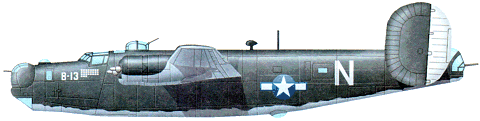
| When in 1939 Consolidated Aircraft Corporation began design of a bomber aircraft intended to be superior to the Boeing B-17, the company could never have imagined that more than 18,000 of these aircraft would be built (as the B-24A to -M for the USAAF and Liberator I to IX for RAF Coastal Command and Bomber Command). The aim of the design team was to achieve better load/range performance than that of the B-17, the basis of the design being a wide-span narrow-chord cantilever wing, mounted high on a deep-section fuselage.
Construction was conventional all-metal, but there were several innovations in addition to the new wing. For the first time on a large aircraft a retractable tricycle-type landing gear was introduced. The bomb bay was deep enough for bombs to be stowed vertically and wide enough to comprise two bays separated by a catwalk providing communication between the flight deck and rear fuselage. Instead of conventional bomb doors, which can affect flight characteristics when open, the bomb bay was closed by roller-shutter-type doors.
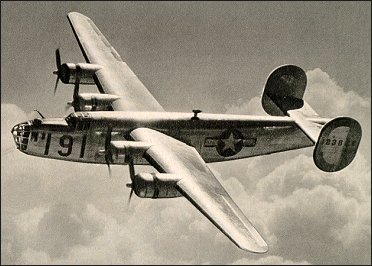
The prototype XB-24 flew for the first time on 29 December 1939, by which time the USAAC had ordered seven YB-24 for service trials and others had been ordered by Great Britain and France. These had the same engines as the prototype, but introduced pneumatic de-icing boots for wing and tail unit leading edges. The first production B-24A were delivered in 1941 to the USAAF (and others to Britain 4s LB-30A transports for transatlantic ferry flights). During the period of their construction the original prototype was re-engined with turbocharged Pratt & Whitney R-1830-4I, at the same time having the oil coolers mounted on each side of the engine. This was responsible for the unusual elliptical cowlings which, together with the large twin oval endplate fins, made the Liberator easily identifiable.
Subsequent Liberators had increased armament and armour protection. The first major production version was the B-24D, powered by R-1830-43 engines, of which the majority of more than 2,700 built went to the USAAF as bombers. A number were subsequently taken over by the US Navy as PB4Y-1 anti-submarine aircraft. RAF Bomber Command and Coastal Command also received 382 as Liberator III/IIIA and V. The major production version of the Liberator was, however, the B-24J with R-1830-65 engines, making up more than one-third of the total production. These were supplied to the US, British, Canadian and other air forces.
Although the B-24 was deployed alongside the B-17 in Europe, and flew in Africa and the Middle East, its major contribution to America's wartime operations was in the Pacific, where it was first flown in action against the Japanese in January 1942. In Europe it is best remembered for bombing Rome on 19 July 1943 and for a low-level attack by 177 aircraft on the Ploesti oil refineries in Romania on 1 August 1943, a 4,345km round-trip mission from Benghazi in Libya, during which 57 of these eight-ten-crew aircraft were lost.
| CREW | 7-12 |
| ENGINE | 4 x P+W R-1830-43, 880kW |
| DIMENSIONS |
| Wingspan | 33.6 m | 110 ft 3 in |
| Length | 20.2 m | 66 ft 3 in |
| Height | 5.5 m | 18 ft 1 in |
| Wing area | 97.4 m2 | 1048.40 sq ft |
| PERFORMANCE |
| Max. speed | 487 km/h | 303 mph |
| Ceiling | 9750 m | 32000 ft |
| Range w/max.fuel | 4580 km | 2846 miles |
| ARMAMENT | 10 x 12.7mm machine-guns, 5800kg of bombs |
| Herb Guiness, e-mail, 28.03.2012 02:06 I was the command pilot of a B-24 H model that we ditched in the Adriatic Sea in June of 1944. The plane didn't ditch very well and the tail broke off, but 8 of us survived and were rescued in our life raft by the RAF.. reply | | Alice Soliwoda, e-mail, 24.03.2012 13:42 My father-in-laws brother was a tail gunner in the 790 Bombardment Squadron 467th Bombardment group. I know he came back on the RMS Queen Mary from Scotland on July 11 1945. He past in 1966 and do not have much info other than that. If any one has any info that you can share, it would be greatly appreciated. reply | | Wayne, e-mail, 02.02.2012 17:45 I have a friend that has a complete original set of manuals in the leather case. They are in perfect condition and have the name CH Hane imprinted on them. reply | | Bruce Parker, e-mail, 21.01.2012 17:12 My father, Thomas Parker, was an inspector at the Willow Run assembly plant - thus my birthplace of Ann Arbor. My cousin, TH Canady, was a B-24 pilot in Europe and went on to a distinguished career with the Air Force. I was lucky enough to get to Oshkosh in 2008, had a chance to get inside the B-24 - and recognized hardware bits my dad had in the shop, little bakelite pulleys, etc.; I still have an exhaust valve [unfilled and uncapped]. The form-follows-function beauty of the B-24 is still stunning; add the heroism of the flight and ground crews, and this is a stirring episode of man's endeavors. reply | |
| | Joe, e-mail, 27.11.2011 04:42 My father in law George Insley piloted 53 missions on B24s out of England during the war. I am very PROUD to have him as a father in law. reply | | Judi (Beaney) Dudley, e-mail, 08.11.2011 19:41 My Dad, Elroy W. Beaney was the pilot on "Perils of Pauline." He passed away May 29, 2000. He never spoke of
the war. If there's anyone with any info on him during that time...I'd love to hear about it. Always, Judi (Roy
Beaney's middle daughter) reply |
| Leonard V. Porter, Jr, Lt Col , e-mail, 08.11.2011 05:51 I flew a B-24J in Combat in WW II. We were in the 7th AF,30th BG, 38th Sq. We flew 40 Combat missions out of Saipan against the Japanese, Primarily IWO JIMA and CHICHI JIMA. Our aircraft, Ruff Knights, was hit by Flac and /or fighters on 29 of those missions. On one mission after bombing Iwo Jima, we were hit by flac and after bombs away shadowed another B-24 who had been hit and lost altitude down to about 500 feet. We visually picked him up, descended so we could keep him in sight and escorted him back to Saipan. We were both low on fuel due to weather and damage. He landed ahead of me and ran out of fuel on touchdown and ran off the runway. I touched down almost on his heels and ran out of fuel after turning off runway. We had been in the air 12 hours and 55 minutes.
I loved flying the B-24 and never considered it difficult to fly. I felt I could do almost any maneuver with it and capped off a single acft mission with an approved fighter pass and pull up tight turn turn and landing. After combat and return to states I flew the B-17 and felt it to be "Mickey Mouse" Not for me. Pilots who complained the B-24 was hard to fly apparently did not know about trim tabs. reply |
| T-SGT H.G.GERHARD, e-mail, 02.09.2011 00:17 CAPT.BILL WETZEL'S CREW OF 10..FLEW 32 MISSIONS..IN THE EIGHT AIR FORCE..SECOND AIR DIV..446 BOMB GROUP..705 SQDRN..FLIXTON AIR BASE..BUNGAY,ENGLAND..IN "THE BATTLE DRAGON"..B24J..AND THEN FLEW HER BACK TO THE STATES. NOT A BETTER BOMBER WAS MADE FOR OUR JOB. reply | | Louis Piazza, e-mail, 02.08.2011 20:58 My 91 year old brother in law flew the fuel and cargo version of the B-24, called the C-109 and C-87 as a hump pilot from November 1944 to Sept 1945. This area was known as the worst flying weather in the world, as heavy loads of fuel and cargo were being carried over the Himalayan Mountains from India to China to support the Flying Tigers as well as the Chinese Army fighting the Japanese. reply | | Steve Wellen, e-mail, 17.06.2011 01:27 My Dad was a B24 pilot and instructor I still have many manuals and flight instruction books. He always said they had the gliding angle of a rock. Landed one at Lunken Airfield here in Cincinnati during WWII reply | | Greg Janusz, e-mail, 28.05.2011 00:49 My Dad Was in the Jolly Rodger 90th Bomb Group in Nadzab, New Guinea in late 1941. He flew the " Yankee Doodle Dandy " / " Twin Nifty's" / " Dinky " and a few other planes from that group. I was sent a Mission Report from one of his missions which was very interesting.
A historian sent it to me while I was researching my Dad's time in the Army Air Corps. I hope this site will stay available to all who seek information and the history about this remarkable aircraft, but especially for their Remarkable Crews.... reply | | Ross Rainwater, e-mail, 24.05.2011 07:23 My late father, Tsgt Roy L. Rainwater, was an original crew flight engineer on "Perils of Pauline" in the 790th Squadron 467th BG, flying a few missions on the famous "Witchcraft." After successfully flying the "Southern Route to the UK, the pilot, Elroy Beaney, landed downwind (!) and cracked up on the end of the runway. Dad finished his 35 missions before "The Pauline" (as he always called her) was shot down with only two survivors (one of them, the flight engineer). reply |
| C J Leleux, e-mail, 23.05.2011 02:43 I was an aircraft and engine mechanic on B-24's from late 1942 until July 1945. I served in the 448th BG, 715th BS and in the 491st BG, 855th BS. I am a retired Chemical Engineerliving in Houston, Texas. reply | | John R. Weyler, e-mail, 19.05.2011 17:32 I was a lead pilot in the 791st bomb squadron of the 467th bomb group out of Rackheath in East Anglia, England. My crew and I were very lucky that none of us were injured although our aircraft took a lot of flac. The B-24 was much harder to fly than the B-17 until the B-24 M was manufactured with a hydraulic booster control. reply | |
| | John Blair, e-mail, 10.05.2011 02:54 I was the nose turret gunner /ordnanceman on a PB4Y1 in Patrol Bombing Squadron 107, an ASW squadron, flying out of Natal, Brazil, Ascention Island, & Dunkswell /Uppottery, England. Not many of us left. reply | | Janet Convertini, e-mail, 05.04.2011 21:35 My Dad, Harold Straub, was the Flight Engineer on a B-24 named Jezebelle. He was in the 529th Squadron, 380th Bomb Group. Spent 1943 flying out of Darwin, Australia.....I have a love affair with this plane, in my eyes it is the most beautiful plane ever flown, it brought my Dad safely back through every mission flown......
Pop has been gone for 8 years, but I am so very proud of him and all those that have served their country and are serving now......We should give our complete support and gratitude to each and everyone of them...... reply | | JOHN R. BOYD, e-mail, 26.03.2011 14:17 WHY NO MENTION OF THE C-87? reply | | Ted Robinson, e-mail, 21.03.2011 23:57 My dad, DA Robinson Jr, was B24 pilot, 514th sq, 376th group. Was stationed at Benghazi and launched on first Ploesti raid. Later we lived at Sewart TN. Right across the street from Col Paul Tibbets. My dad always told us kids that you don't know what fear is until you see your pal's plane erupt in a fiery explosion flying off your wing. He died in 2002. He in many ways to me was the greatest guy who ever lived. reply | | James, e-mail, 06.03.2011 14:29 My father in law, James D. Jelley (LTC USAF Ret) was a B24 pilot and flew 48 missions in the B24 from Guadalcanal and on up the Solomon Chain in the 307th "Long Rangers". On mission 22 he was shot down by a Jap Zero after making a 2nd pass over Rabaul while bombing a Jap heavy cruiser, flying from Guadalcanal. His bombs hung on the first pass and he was ordered to go back, there were 5 other B24's that also had bombs left and went with him. One crewmember, a gunner, was killed and all but others bailed out safely. One gunner's chute did not open and he did a 1200 ft "swan dive" into the ocean - and lived! Jim and his co pilot were injured, Jim in the arm and the copilot in the leg and they flew the B24 until it ran out of gas as the injured gunner was still alive and jumping was out of the question for him. Jim flew the rudders and the copilot flew the yoke. They were picked up after a few hours by a Navy Captain in a PBY. Jim retired in 1967 from the USAF and died May 2010. He always treasured his crew and memories of his B24, "Shehasta".
On another B24 mission over the Pacific, Jim was carrying the payroll for the Americal Division to New Caledonia, I think, when he lost 3 engines. Crew dumped everything overboard to make the plane lighter, including the PAYROLL. After landing he explained where the money was and said he "signed a report giving the location" and that is all that was ever said.
Jim's memory lives on.
James reply | | Kadesh, 23.02.2011 19:45 Called them Privateers but they weren't B-24s. They looked alot like them though, but had several differences, one of which was they came much later. reply |
|
Do you have any comments?
|
| 
COMPANY
PROFILE
All the World's Rotorcraft
|


 Judi (Beaney) Dudley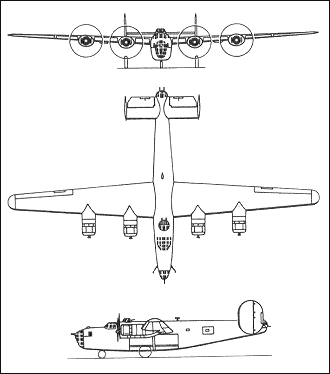


My Mother's Uncle, Bernard LeBar, was the Tailgunner on the Pauline.
reply