|
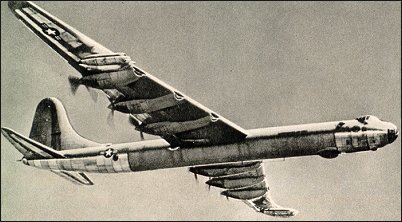
| The first intercontinental bomber, the Convair B-36 originated from a specification issued on 11 April 1941 which called for an aircraft with ability to carry a maximum bombload of 32659kg and, of even greater importance in view of the state of affairs at that time, to deliver 4536kg of bombs on European targets from bases in the United States. An unrefuelled range of 16093km was a prime requirement, with a maximum speed of 386-483km/h and ceiling of 10670m. Selected from four competing designs, the Consolidated Model 36 featured a pressurised fuselage, and 70.10m span wings with a root thickness of 1.83m to permit in-flight access to the six pusher engines. The aircraft was designed originally with twin fins and rudders, but by the time the XB-36 prototype was ready to be rolled out at Fort Worth, on 8 September 1945, single vertical tail surfaces had been substituted.
First flown on 8 August 1946, the XB-36 had single 2.79m diameter main wheels, also a feature of the YB-36 second prototype on which they were replaced later by the four-wheeled bogies adopted for production aircraft. In this form the aircraft was designated YB-36A and also differed from the first aircraft by introducing a raised cockpit roof. On 23 July 1943 100 aircraft were ordered but it was more than four years before the first of the 22 unarmed crew-trainer B-36A models took off on its maiden flight, on 28 August 1947. Production of the B-36 continued for almost seven years, the last example being delivered to Strategic Air Command on 14 August 1954, and the type was retired finally on 12 February 1959.
| CREW | 16 |
| ENGINE | 6 x P+W R-4360, 2575kW |
| WEIGHTS |
| Take-off weight | 162162 kg | 357508 lb |
| Empty weight | 72051 kg | 158846 lb |
| DIMENSIONS |
| Wingspan | 70.1 m | 230 ft 0 in |
| Length | 49.4 m | 162 ft 1 in |
| Height | 14.3 m | 47 ft 11 in |
| Wing area | 443.3 m2 | 4771.64 sq ft |
| PERFORMANCE |
| Max. speed | 696 km/h | 432 mph |
| Cruise speed | 362 km/h | 225 mph |
| Ceiling | 13700 m | 44950 ft |
| Range w/max.fuel | 16000 km | 9942 miles |
| ARMAMENT | 12-16 20mm machine-guns, 32600kg of bombs |
| Ken Mangum, 22.11.2022 04:49 My father CMSGT Pete Mangum was a flight engineer on the B36, B36D in the FICON program. Loved the aircraft reply | | Disabled Veteran Rex Bahr, e-mail, 18.12.2021 06:46 Where is the sound address? I did have it and now can't find it. reply | | John Burgess, e-mail, 05.06.2021 17:58 is there anyone out there that worked on the gun system at Carswell on the B-36, 1952-55 in the 7th reply | | jerry, e-mail, 21.01.2017 03:54 I was at Biggs 53 t0 56 and ended up as a crewchief on 2053 (a D model with -41 engines. Have sat up on engine with my legs Also had privilege of crawling out past landing gear (gear was down and you crawled by in a narrow ledge - with no chute on ( went under first engine, over second, and under third looking for a fuel leak). You cannot imagine the noise, oil smells. fuel smells of three engines on that wing. Not sure but I think OSHA would not like what we did to keep those birds flying. reply | |
| | Harold Weatherly, e-mail, 18.07.2016 20:43 1956 was the year I attended Radar bombing and nav... jnthe USAF then assigned to 95 A&E at Biggs. Retired june 1976. reply |
| calvin thomas, e-mail, 23.03.2016 13:28 I was stationed at Ramey 72nd and was a ground power Tech .
Flew the b-36 from Ramey to French Morocco as part of the operation . flight was 19.5 hrs and for an old farm boy that was a long flight Trying to remember what that operation was called . we sent a plane from Ramey to morocco each day and returned plane from morocco the Ramey on a daily basics so we hat a loaded b-36 in the air at all times. remember the noise level in the rear of that plane and the tunnel reply |
| J. C.De Long, e-mail, 09.04.2015 03:59 When did Castle Air Museum's RB-36H arrive at Castle Air Museum??? I have never be able to find this date. I saw it before it was assembled. I took a couple dozen pictures of it I HAVE ABOUT 10,000 A /C picture but I can't remember about when they were taken. Someone please the date so I can look them up. Thank you very much and thank you in advance. J. C. De Long reply | | Barry E. Sullins, 25.02.2015 04:03 When we lived in Denver I saw alot of B-36s flying over the city headed for Lowry AFB. Most of these birds I learned were from Ellsworth, RB-36s that would come into the base and give the photo personnel practical experience. The last B-36 i saw was in my hometown of Amarillo, TX in the Fall of 1958. I was 8 and walking home from school when I heard that familiar thundering sound as she came within view above the trees. At that time there were only two B-36 Bomb Wings still flying the aircraft. It was a clear warm afternoon as she headed west. Probably headed to Davis Monthan AFB. She is my all time favorite aircraft. reply | | Merritt Lawless, e-mail, 04.02.2015 00:03 I was a Philco Tech Rep assigned to the COM /NAV shop at Ramey AFB Puerto Rico. I have scanned through all of the comments and have not seen any mention of a B-36 incident that I witnessed in early 1956. I was in a car pool with several AF personnel, as we approached the eastern gate and were making the 90 degree turns to enter the base we were shocked to see two B-36's setting at the extreme eastern end of the runway. Both had burned off the main landing gear up to the axles. They were each setting 30 degrees or so off the center line of the runway. It was very strange to see the giant B-36 setting that close to the runway surface. We peered thru the chain link fence at them in amazement and then proceed to enter Ramey. I am providing these comments in the hope that some one may respond with more info. I am still amazed that two aircraft were sent down that runway to experience a failed take-off. These heavily loaded flights to North Africa and beyond were made at night. Surely the tower must have been aware of the sparks /fireworks generated by the first aircraft burning off it's main landing gear. The aircraft had been removed from the end of the runway by the end of my workday. They were repaired and back in service in 4 days.
I have fond memories of my time at Ramey. Two of my children were born at the base hospital. I was given access to a house on base, so that I could be on call 24 /7 as needed. I elected to return stateside after three years. I volunteered to return to Ramey in 1961 to support the Tail Defense system of the B-52G. That tour was for 18 months. I have fond memories of supporting both of those fine aircraft. Regards Merritt reply | | Carroll Johnson, e-mail, 30.01.2015 01:23 If you are still alive and was at Rapid City AFB 49-52 and have information on two dog mascots named Shep and Bismark please share.Bismark caught on to catching the base bus to Rapid City where he would visit (both)bars than take up the intire seat at 11PM on his return trip.The following morning you could find him sleeping it off in a Line Shack next to the Pot Bellied Stove with blood shot eyes and sour temper.When he died the Base Paper had his picture standing on a diving over a swimming pool of beer. reply | | Paul Scott, e-mail, 16.12.2014 16:22 Amazing aircraft! I read somewhere (think it was Wikipedia) over 300 were actually produced, astounding! reply | | Stephen Pain, e-mail, 23.11.2014 00:35 I would like to know more about T sergeant Richard V. Lee a radar mechanic injured in an accident in 1952 when a B-36 caught fire at Carswell Afb in 1952. reply | | Buck Seibert, e-mail, 23.07.2014 19:26 Checked out the 360 view of the cockpit. Question came up about the four J47 engines. We located the gauges for the engines but could not find any throttles or switches for the jets. There is a lever marked increase rpm and decrease rpm on the console between the seats next to the trim controls. Could this have been used to control the jets? reply |
| George Haloulakos, CFA, e-mail, 25.06.2014 22:02 How did a WWII aircraft design like the Convair B-36 beat out the futuristic Northrop YB49 Flying Wing as the lead strategic bomber for SAC? The behind-the-scenes story can be found in chapter 3 of my new book.
HIGH FLIGHT
Aviation as a Teaching Tool for Finance,
Strategy and American Exceptionalism
By George A. Haloulakos, MBA, CFA
ISBN: 9780-1007-2738-0
Order your copy online at: ucsandiegobookstore.com
Or by phone: 858-534-4557
"Partial proceeds support aviation heritage" reply | |
| | Jeffrey Lee, e-mail, 18.06.2014 20:39 We were living in Corpus Christi in 1950 -1952, when I was 10 years old. The B-36's flew low level flights almost daily. We could easily see the rivets. The barrels of the guns were easy to see on both sides of the fuselage. A WWII pilot lived behind us. He was always happy to tell us about airplanes and his favorite was the B-36. He explained that the two outside pods were for jet assisted take off. The Blue Angels flew out of the Navel Base at Corpus Christi, too. When they flew, we stopped what ever we were doing to fall onto our backs to watch them fly over head. reply | | Donald MacIver, e-mail, 22.04.2014 22:25 In May 1951 we moved from Duluth MN to Dallas TX. into a house just north of Love Field which I believe had been military housing. We lived on Sumter Street. The approach for landing was right over our house and the B36s shook the ground as they passed probably only a few hundred feet overhead. It was amazing for me, a 5-year old! One weekend we drove over to Love Field and got as close as possible to the fence separating us from the B36s. My dad asked a guard who was posted at the gate if we could go in for a closer look. He said it was off limits to civilians. I have always thought that it was a fantastic looking bomber with the engines reversed on the wings, and I can still remember exactly what it looked like flying so close overhead! reply | | Gordon Hyde, e-mail, 29.03.2014 18:20 I graduated from pilot training in August of 1955 and was assigned to Ramey AFB Puerto Rico. I was a third pilot on Capt Bob Bolton's crew for a year then moved up to copilot when the airplanes were feather weighted, guns removed. As third pilot I had the privilege of being the left forward gunner and even got to shoot live ammo out over the ocean.
Our first engineer was Leslie Haas and the second engineer was Jim Larson. On one flight the flaps on the right wing would not go down, Jim and I went out in the wing and checked circuit breakers on a panel between engines 4 and 5. All in, landed fast with flaps up . In March of 1956 I did my annual instrument check with number 5 and 6 feathered with jets running at idle in case we needed extra power. We were able to fly in the traffic pattern with the recips in idle by running the four jets at 95%. My longest flight was just short of 36 hours from PR over the top of the world and landed at Fort Worth. The highest was 45000 feet, hard to keep the 4360's running that high. Many memories in that neat old airplane! reply |
| Hans Crews Jr, e-mail, 24.03.2014 02:38 I received my A&E training at Sheppard and in April of 1953 I was assigned to the, 492nd Bm sqn, 7th Bm wing at Carswell. I was there until Sept. of that year after which I was reassigned to the, 335th Bm sqn 95th Bm Wing Biggs A.F.B Texas. I remained there until my discharge in 1956. It was a great experience and a great aircraft to work on. I worked for several outstanding crew chiefs during that time there. After my discharge I went to work in civilian aviation until retirement in 1995. I enjoyed my time and my only regret is that I didn't stay active and retire. But my military training went a long way in teaching me how to deal with civilian life and all of the issues it presented over the years. I would like to hear from any other mechanics who worked in either the docks or on the line crews. reply | | Billy Grubb, e-mail, 28.01.2014 23:14 Grubb; I was stationed at Loring AFB Maine from 55 to 58. Trained as fire control tech. Lowery, Denver 54 & 55. Worked mostly on tail radar. Cross trained on B52 in 57. Like ever one says you never forget the sound of the B36. I did fly twice in one as in-flight tech. reply | | Marvin Harthcock, e-mail, 20.09.2013 00:38 Ramey AFB, 1954-Dec, 1956, NCOIC Comm /Nav-I was on flying status from time -to-time. I remember how cold it could get. We used to tune the HF transmitter with a lead pencil, watching the arc until it was maximum. Some of the radio operators taped a six inch flourescent bulb to the antenna lead-in and tuned for maximum brightness. Guys in the aft ECM compartment used to stand in the port with their feet down in the rim to shake the trash out over the ocean before landing! (No chute! brave or what?) Ramey had a golf course and lots of palms at the west end of the runway. The planes used to power up with all ten engines at max power prior to releasing the brakes. You should have seen those palm trees bending back almost double in the prop wash! There were two PT boats below the west cliff for air-sea rescue. Great place to lay on the beach and have a few swigs of Barrilito Rum, occasionally taking a dive in that pristine blue water. Crews on the mainland who had won bombing competition took a little R & R coming with their plane (loaded with cargo racks in the bomb bay) to Puerto Rico on Rum Runs. And Gen. Lemay occasionally flew his pristine B-17 down. There were two XC 99s that made regular runs down from (I think) Travis AFB. Those were the days!!! reply |
|
Do you have any comments?
|
| 
COMPANY
PROFILE
All the World's Rotorcraft
|


 calvin thomas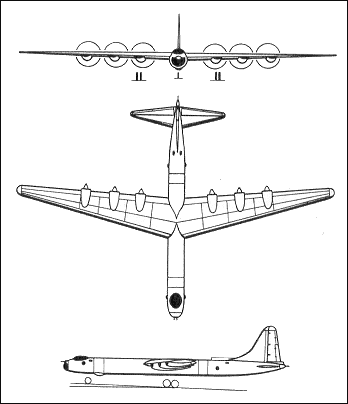


Harold,
I remember you from my childhood. We were at Biggs AFBand then went to Turner AFB. I attended your wedding in Albany GA.
Steve Jeffryes
reply