|
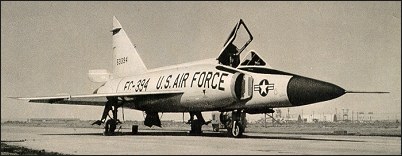
| The Convair F-102 Delta Dagger resulted from a 1950 USAF design competition for an integral all-weather interceptor weapon system. Combining the Hughes Falcon air-to-air missile, the delta wing platform first flown on the XF-92A, and the 4944kg thrust Pratt & Whitney J57-P-11 turbojet, the first of 10 YF-102s (52-7994/7995 and 53-1779/1786) flew at Edwards AFB, California, on 24 October 1953. The prototype was lost in a mishap nine days later, but tests with other YF-102 airframes revealed a disappointing truth: the type was sorely underpowered and incapable of level supersonic flight. Rarely had the Air Force invested so much in a system which performed so poorly.
Convair designers went back to the drawing board and the indented fuselage or 'area rule' configuration developed by NACA's Richard Whitcomb was hastily introduced in the much-altered YF-102A, which was assembled in a scant 117 days. The first of four YF-102As (53-1787/1790) flew at Edwards AFB on 20 December 1954, not merely with 'area rule' but with cambered wing, new canopy (except on 53-1788) and 5443kg thrust Pratt & Whitney J57-P-23. The new design was supersonic and met USAF expectations.
The production F-102A began to reach Air Defense Command squadrons in June 1955. The first two-seat TF-102A combat proficiency trainer (54-1351) flew at Edwards AFB 8 November 1955 and operated alongside F-102As in ADC service. Total Delta Dagger production was 873 airplanes.
The F-102B designation was briefly assigned to a new aircraft completed as the F-106. The little-known YF-102C (53-1806), a converted F-102A model, tested change in the internal fire control system, but these were not adopted.
A rakish, well-liked and easily-handling aircraft, popular out of proportion to its importance, the F-102A eventually served with 27 ADC and 23 ANG squadrons. Air Defense Command machines went through several modernisation programmes before being relegated to the ANG, the internal provision for rockets being eventually omitted. A few F-102As went to Greece and Turkey. A few camouflaged F-102As were deployed to South East Asia in 1964-6, and to trouble-plagued Korea in 1968 but, while they flew a few missions over North Vietnam, they are not thought to have actually been in combat.
The PQM-102A is a Sperry-converted airframe under the Pave Deuce programme for use as a fully manoeuvrable manned or unmanned target drone. About 30 have been converted. Numerous F-102A airframes have been saved, the 199th Fighter Interceptor Squadron of the Hawaii Air National Guard having retained no fewer than four non-flyable F-102As for display purposes after transitioning to the F-4C Phantom.
FACTS AND FIGURES © To make it supersonic, the
original YF-102 was
lengthened and given bulges
on the rear fuselage to
change the cross-section.
These protuberances were
known as 'Marilyns'. © The YF-102 was a
development of the XF-92
research aircraft, which was
originally to be the ramjet-powered
'return' component
of a large two-part composite
attack aircraft. © The canopy of the YF-102
had heavy framing more
akin to an early World War
II fighter. Convair were
probably worried about the
stress of supersonic flight on
large areas of Perspex.
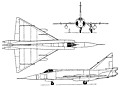 | A three-view drawing (1680 x 1223) |
| CREW | 1 |
| ENGINE | 1 x Pratt Whitney J57-P-23, 7802kg |
| WEIGHTS |
| Take-off weight | 14187 kg | 31277 lb |
| DIMENSIONS |
| Wingspan | 11.62 m | 38 ft 1 in |
| Length | 20.84 m | 68 ft 4 in |
| Height | 6.46 m | 21 ft 2 in |
| Wing area | 61.45 m2 | 661.44 sq ft |
| PERFORMANCE |
| Max. speed | 1328 km/h | 825 mph |
| Range | 2173 km | 1350 miles |
| ARMAMENT | air-to-air missiles |
| George McBride, e-mail, 22.03.2026 07:15 I have a photo of one of the rarest patches associated with the 82nd FIS. One of my best friends, Ernest John Martini, a Deuce driver flew the Dagger across the Pacific to Okinawa. He also bagged an Air Medal for that flight. If anyone would like a copy of it, please email me: gwmcbride@comcast.net
. reply | | A2/c John Yde, e-mail, 18.01.2026 03:28 I was a flight line security police officer in the 82nd FIS at Travis AFB in 1963 until the whole squadron was transferred to NAHA AFB, Okinawa in 1965. We had the pleasure of flying in a cold, noisy, with cargo nets C-130. hah. All F-102's DELTA DAGGERS,( 25?) were equipped with, air to air refilling that they called "band aids". If I remember right, They expected to loose some aircraft in the Pacific.. BUT... All the F-102's made it to NAHA AFB replacing F-4C's . I was given the choice of re-upping, going to NAM, or take an EARLY-OUT in July of 1966. Took the EARLY-OUT! Back to Travis. BIG RED (tail) flew me to Alaska. ( Northwest Orient Airlines.) Sadly,, I have lost all contact with my buddies. Still ware my fatigue shirt at Veterans Day Parade in Petaluma, Ca. "VETS in VETTES" reply |
| Louis Lavoie, e-mail, 12.01.2026 00:33 I was an MG-10 tech with the 317th FIS when it received its first F-102 in 1956 at McCord AFB. Left the 317th in August, 1959 in Elmendorf AFB, Anchorage Alaska. I recall the little plaque over the airspeed indicator that read as I recall, 'Limit speed to 655 knots or Mach 1.??, whichever is lower.' Anyone straighten me out in my old age? reply | | George McBride, e-mail, 15.10.2025 08:54 I was stationed at Travis AFB, with the 82nd FIS from '62 to '64 as AWCS (radar) tech. Then went to Ramstein, Germany with the 526th FIS, of the 86th Air Division, also F-102As. After that, I was stationed at Suffold County AFB, Long Island, NY, part f the 2nd FIS flying the F-101B Voodoo. I'm still in contact with John Martini, (82nd Deuce pilot) from Travis. reply | |
| | Gary Holt, e-mail, 21.11.2024 22:31 I was stationed at Keflavik Iceland from March 1972 to March of 1973. I was a machinist assigned to the 57th Fighter
Intercept Squadron.(Black Knights) We maintained the F102 Delta Daggers, intercepting Russian Bear Bombers flying to Cuba. I discovered an F102 that I worked on in Iceland at the Air Force Museum, Wright Patterson Air Base in Cleveland Ohio last year. (2023)
It brought back many memories of my time there. reply | | Gary Holt, e-mail, 21.11.2024 21:02 I was stationed at Keflavik Iceland from March 1972 to March of 1973. I was a machinist assigned to the 57th Fighter
Intercept Squadron.(Black Knights) We maintained the F102 Delta Daggers, intercepting Russian Bear Bombers flying to Cuba. I discovered an F102 that I worked on in Iceland at the Air Force Museum, Wright Patterson Air Base in Cleveland Ohio last year. (2023)
It brought back many memories of my time there. reply | | GENE, e-mail, 09.03.2022 02:30 I WAS STATION AT ELLESON AIR FORCE BASE FAIRBANKS ALASKA FROM 1963 - 1965 , I WAS A AIR POLICE THAT GUARDED THE F102, WE HADFOR OR THEM. GREAT PLANE . reply | | Jerome Nordskog, e-mail, 06.01.2022 01:25 I served a 15 month duty at Goose Bay 59th FIS
IN 1961-62.. reply | | johnny carrouth, e-mail, 08.02.2020 17:44 I recently came across a picture of the entire 59th FIS at Goose Bay made in 1966. That was the year we deactivated the 59th. I would be willing to share this photo with any interested parties. reply |
| John Pearson, e-mail, 26.02.2018 05:07 To Chuck Gilbert,
was stationed at Richards Gebaur AFB from late 1962 until early 1964. I worked on the MG-10 radar fire control system on the F102. On May 13, 1963 I had just left the flight line and while driving back to the radar shop I heard a loud explosion and saw a large smoke column on the other side of the hangers between the runway and the road I was on. Everything was in out of control and I could not return to the flight line.
We were in the midst of an ORI ( organizational readiness inspection) and had to act as if we were under attack. Your father was on alert and had to be in the air within 5 minutes of the notice of an enemy target in the area (test). What we were told was that on take off his plane had some kind of malfunction and nosed up and stalled. He ejected while the plane was vertical and did not make it.
I do know that he was one of our best pilots and he was missed. Also I was and still am sorry for his loss. He was the only pilot we lost in my assignments at Richards Gebaur, Clark AB, Danang, Saigon and Bangkok.
I hope this gives you some feeling of what happened and some information you want about your fathers death.
John Pearson reply | | heineck1375@bellsouth.net, 05.06.2017 22:41 Comm /nav tech on 102s in Goose Bay 1961-1963. 59th FIS. Anyone else in that area then? reply | | Eddie P. Duff JR, e-mail, 19.05.2017 00:42 I was assigned to 509th FIS in 1966 /1967, crew chief on the F-102A and the F-102F two seater. Worked on the FltLine and phase docks. Transfered to the 64th FIS and went TDY to Danang (Alert Missions). Live in the Gun Fighters Village. We went through mant Motar attacks. We lost several acft on the fltline, to include: C-141, F-4 Phantom. I remmember, "Shaky", the C-124 that always parked at in of the Fltline. If anyone remmeber me there, please contact me. reply | | Terry Soterhou, e-mail, 03.04.2017 20:56 I remember this incident very well. If anyone would like to discuss please feel free to reach out.
@ Nick Guzman and Chuck Gilbert, I would really like to speak with you.
425 345 0402 reply | | Rock Roszak, e-mail, 03.04.2017 16:40 We've just published a digital book titled "F-102 Delta Dagger in Detail & Scale". I'm now working on another book titled "Colors & Markings of the F-102 Delta Dagger." This book will have a section on every squadron that flew the Deuce. Anyone who can contribute usable photos of the F-102 to any squadron section will get my thanks and a free copy of the digital publication when it becomes available. You can email me at Rock@detailandscale.com reply | |
| | Dallas Smith, e-mail, 08.03.2017 00:14 For Jerry Doty: I met your father at Travis when I was with the 25thAD IG. I was later stationed with him at Naha, Nha Trang and Perrin. Contact me and I can give you lots on your Dad. reply | | Robert Stoeckel bluebark67@gma, e-mail, 04.02.2017 04:07 Greetings to all. I am looking for people who knew or met my father Capt. Charels G. Stoeckel. I think they called him Curly. He flew F-102's for the 64FIS but his history in the military goes back to his days at West Point. If this name rings a bell and you have a story or two to tell...actually anything...I would love to it reply | | tom mandziara, e-mail, 26.12.2016 03:32 1966 with 64th FIS December 1966,we were playing war games with a navy carrier going back to states,we lost a f102 with a head on collision with a navy plane ,,never seen that reported in the f102 book listing all f102s seen one f102 shown downed over south Vietnam same date think that how they coverd that up,,i was a f102 crewchief a1c worked on 102s for 4yrs from perrin afb texas to paine field wa, to clark pi reply |
| Garry Wallen, e-mail, 16.12.2016 06:29 Message for Gary Childress.... Gary, I say your entry on here and would love to get in touch with you.. I hope you check back on here... You and I and Gary McEldowney worked together at Travis in ther 82nd and then McEldowney and I shipped over seas to Clark... I hope you get this and we can get back in touch... that would be awesome... my E-mail is gwallen@cableone.net hope to hear from you.. reply | | Thomas E. Crews, e-mail, 29.09.2016 08:53 Michael Flannagan, I was at Perrin the same time as you 63-66. Worked in "F" flight and played softball for OMS. Would like to hear from you, contact me at: tomecrews@att.net reply | | Thomas E. Crews, e-mail, 29.09.2016 08:44 I was a Crew Chief on a TF-102A at Perrin from 1963-66, had a TDY to Korat Thailand in 65 then back to Perrin. I worked out of "F" flight 4780th OMS on the flight line. I read what Grady Howell wrote about run-up and taxi and taking the Duce to the run-up pad, it was a blast to run at full military power, then kick it in afterburner. You could feel the strain at Full power, then AB kicked in, the nose would come up for a second, then hang on, you hoped those cables would hold, boy what a ride! Calling the Tower to get permission to cross the run-ways, "Perrin Tower maintenance F-102 request permission to cross East and West run-ways", they would call back " maintenance F-102 clear to cross the East, hold short of the West". Going across hold the brakes down, increase power and let off the breaks, getting the nose /wheel in the air,(not that I would have done something like that}. Never forget my time at Perrin! Oh yea, One of the guys said they on their squadron softball team, I played for OMS, Maj. Hammer Sq. Commander love the softball team. I would love to hear from anyone that was there during 63-66 contact me: tomecrews@att.net reply |
|
Do you have any comments?
|
| 
COMPANY
PROFILE
All the World's Rotorcraft
|

 johnny carrouth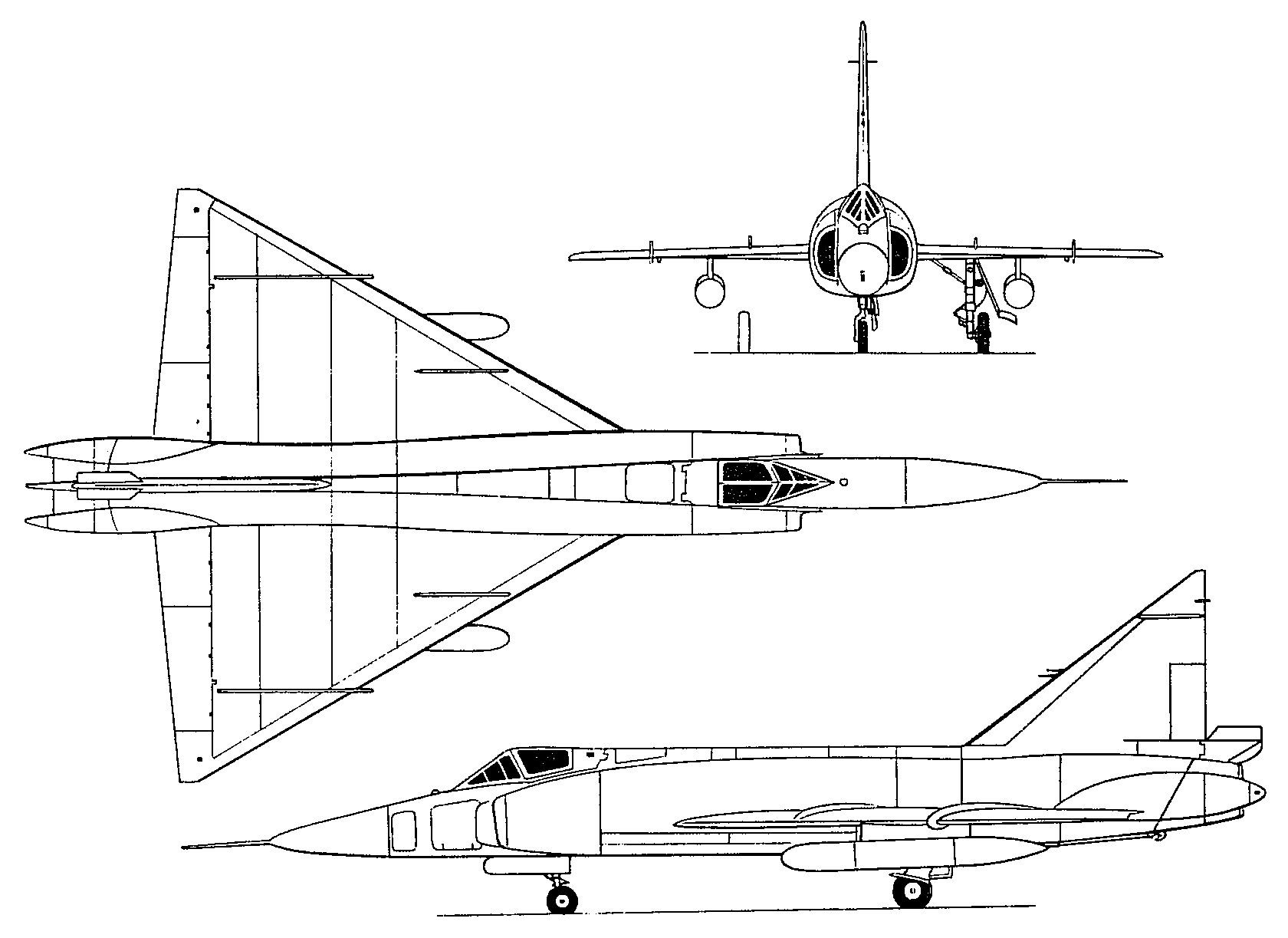


Hi John, I wish we knew each other on the flight line at Travis. I was an MG-10 AWCS Tech in the 82nd and remember what a PIA the installation of the IR seeker heads was when the aircraft were upgraded for that. I also remember when a VERY different Skunkworks aircraft touched down due to some difficulties and was immediately shoved into a secure hangar. I was one of "chosen" for a TDY to a lovely beach resort in S.E Asia to support the Deuces that were supposed to restation there. They did not arrive then due to runway issues created by Cong mortars. Can't blame you for taking the Early Out !! Luckily, I returned to Travis and was given orders to Ramstein where the 526th FIS was based.
reply