|
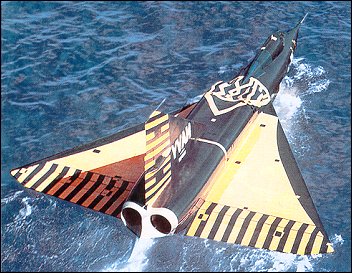
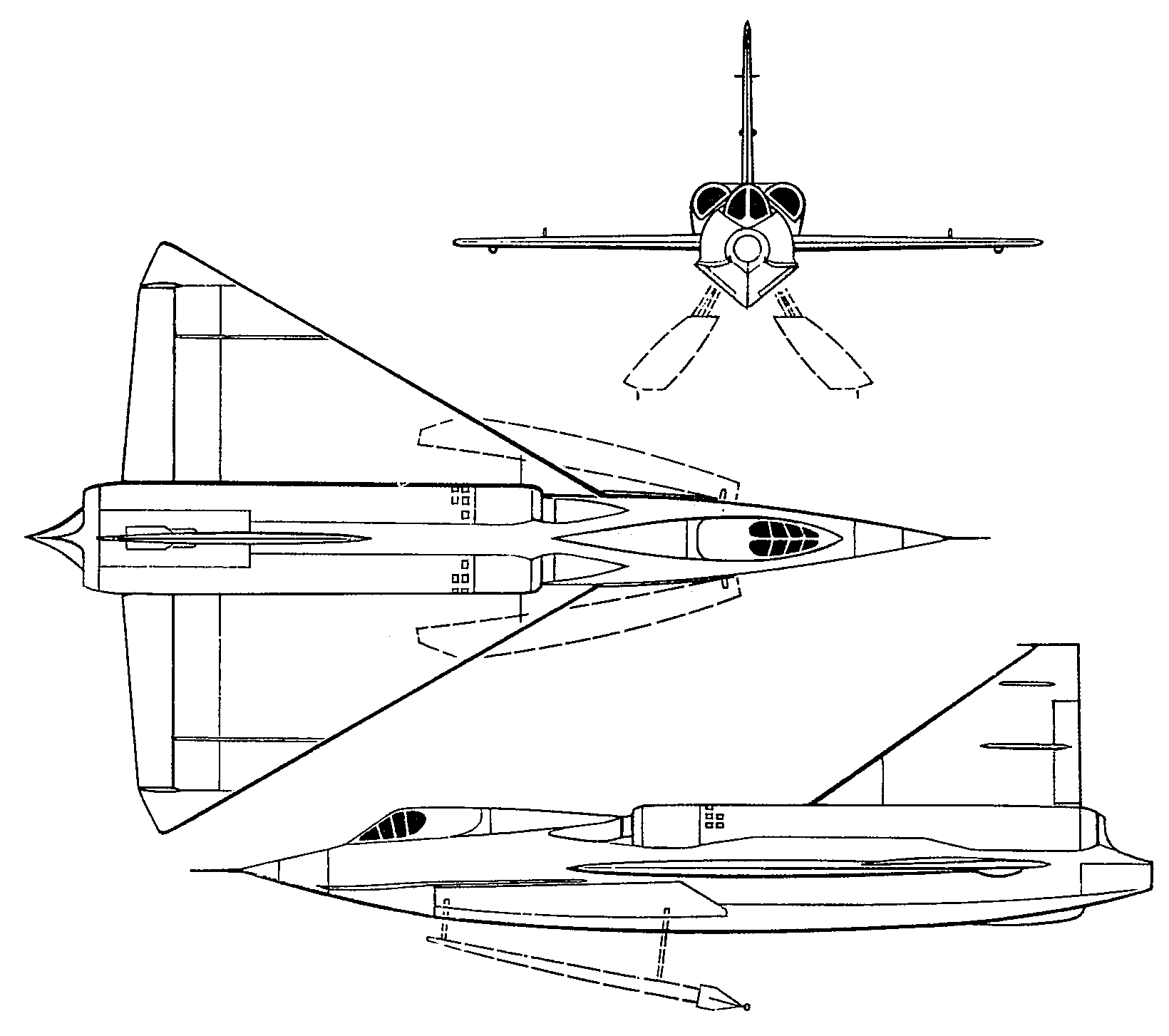
| One of the most unusual single-seat fighters to be developed during the early years following World War II, the water-based Convair Sea Dart had a blended hull mounting delta wings and large vertical tail surfaces. For take-off and landing it had extendable hydro-skis; these produced sufficient hydrodynamic lift during the take-off run to raise the hull clear of the water, the Sea Dart then aquaplaning on the skis until flying speed was attained.
The concept embodied in the Convair Model 2-2 proposal was sufficiently interesting for the US Navy to award a contract for a prototype XF2Y-1 on 19 January 1951, followed by
an order for 12 production F2Y-1 fighters on 28 August 1952; to this was added subsequently four YF2Y-1 pre-production aircraft. First flown on 9 April 1953, the prototype offered performance much below expectations and this factor, coupled with serious vibration problems with the hydro-skis, led to the XF2Y-1 and the production F2Y-1s being cancelled. More power was needed than the 1542kg thrust provided by each of the Westinghouse J34-WE-32 turbojets installed in the prototype and the first YF2Y-1. This latter aircraft was re-engined with two J46-WE-2s, the rear fuselage being modified to accommodate the engine afterburners and the same powerplant was installed in the remaining three YF2Y-1s. On 3 August 1954 the YF2Y-1 exceeded a speed of Mach 1 in a shallow dive, the first seaplane to become supersonic, but only two of these aircraft were used in a limited test programme that was terminated finally during 1956. FACTS AND FIGURES © It was intended that a
production version would have
armament of 20mm
cannon and a pack of unguided
rockers. © Problems with vibration during
water operations saw a variety of
multiple and single ski and skid
arrangements tested. No totally
satisfactory solution was found. © The Sea Dart took off on a pair
of retractable hydro-skis, one
on each side of the hull. These
moved between three positions
during the take-off run. © The dive brakes in the lower rear
fuselage doubled as water brakes
and a water rudder when floating.
| MODEL | YF2Y-1 "Sea Dart" |
| CREW | 1 |
| ENGINE | 2 x Westinghouse J46-WE-2, 2722kg |
| WEIGHTS |
| Take-off weight | 7495 kg | 16524 lb |
| Empty weight | 5739 kg | 12652 lb |
| DIMENSIONS |
| Wingspan | 10.26 m | 34 ft 8 in |
| Length | 16.03 m | 53 ft 7 in |
| Height | 6.32 m | 21 ft 9 in |
| Wing area | 52.30 m2 | 562.95 sq ft |
| PERFORMANCE |
| Max. speed | 1118 km/h | 695 mph |
| Ceiling | 16705 m | 54800 ft |
| Range | 826 km | 513 miles |
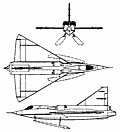 | A three-view drawing (1640 x 1453) |
| Mike, e-mail, 10.04.2017 05:21 .,., what I wanted to also suggest is to make the underside of the
Sea Dart a similar profile as a modern Jet Ski underside. Failing
that , a similar profile to the WWII 'Catalina' type aircraft fuselage
underside. Of course I want one .,.,, to protect my waterside abode & defeat the /a enemy . What do you think ? reply | | mike, e-mail, 10.04.2017 04:59 Hi,
I believe this type of jet to be viable. To me (amateur), redesign the aspect of the jet engine angle , use a better & more modern(?titanium} airframe , make a half a dozen of them and
DO NOT flog the daylights out of it by overuse. My son-in-law
can redesign ANY hydro plane & make it work. Deployment of the Sea(water surface) Dart is as simple as you like: drive the Dart & trailer to any reasonably sized body of water , float it out
and blast off. After the mission , get the Dart onto the trailer and take it home to a nice dry shed or undercover. I t will last years and
everybody WILL want at least one. Cheers. reply | | Tom Hyland, e-mail, 17.11.2012 00:00 Dean Flesoras is exactly right. I was a member of the dive and rescue crew on the U.S. Nereus, AS-17. As with the Sperry crew, we watched the Sea Dart practice take offs and landing tests for many weeks. Our ship hosted the news media and camera crews (as well as some VIPs) on our large boat deck. As the second rescue boat, we stood by for the Sperry crew. A real tragedy. Was very glad when we did not have to recover the pilot's body! reply | | jackson carter, e-mail, 10.11.2012 04:40 see this plane rightful re-fly again in the planetary patriot next book out 2013. the said sea dart was truly a great plane that never was allowed to be said great! at least in fiction it will be. reply | |
| | Rick Boyette, e-mail, 19.08.2012 18:38 The Lakeland plane is the one that used to be on display at the old Boeing SST Mockup museum in St Cloud near Orlando FL in the 1980's. reply | | R.W. Negus, e-mail, 08.11.2011 20:31 I was employed at Convair in the Flight Dynamics group. In 1956 we studied film and eye witness accounts of the fatal
breakup of the SeaDart. We concluded that the breakup was due
to "PIO" pilot induced oscillations. As the ship passed over
downtown San Diego it hit an updraft and the pilot over corrected causing the main spar to fracture while passing
over PCH. Had the ship been equipped with a pitch damper
there would not have been any problem. We did an extensive
study of PIO and later equipped all later Convair jets with pitch dampers -F102,& F106. reply | | Russ Bateman, e-mail, 13.07.2011 17:50 I worked on the Camera Bench at Convair and my assignment was maintenance of the Cameras for the instrumentation use in flight testing Air Craft. I checked out the instrumentation camera used in the Sea Dart. Dan, sandidande=cox.net, 20.06.2011 see above is correct in his statement about the Crash. I witnessed this incident. It was a major promotion display for the public that went a foul with lots of news coverage world wide. This Publicity killed the Sea Dart Program. reply | | Crossdresser JulieDan, e-mail, 08.07.2011 02:59 Dan,I'll bet your father has some stories to tell reply | | Douger, e-mail, 01.07.2011 04:02 Saw one of these sitting behind one of the hangars at the airport in St Cloud, Florida in the late 70's. Always wondered what happened to it? reply | | Dan, e-mail, 20.06.2011 09:44 There is some speculation that the crash was not caused by water ingestion, but rather, the test pilot brought the aircraft in way to "hot" in front of a group of Navy "Brass" and got close enough to the sound barrier to form a shock wave. That shock wave was said to have bounced off the water and over pressured the wings causing the aircraft to disintegrate. I was told this by my father after I began to fly Navy aircraft. He was a member of the test team that was flying the XFY-1 "Pogo" at Brown Field during this period. The Sea Dart crash occurred THE DAY PRIOR to "Skeets" Coleman's first successful vertical take-off and transition to horizontal flight in the XFY-1 at Brown field. There was a "great deal" of competition between the two programs to acquire Navy funding, and in the opinion of a number of CONVAIR "insiders" this competition was the driving factor which led to the Sea Dart's test pilots pushing the aircraft beyond it's design specifications during the demonstration. reply | | Warren Roepke, e-mail, 18.04.2011 17:59 Was employed at Convair San Diego 1952 - 1954. I joined the Sea Dart design group in early 1954 and did basic layout of a single ski configuration in hopes of alleviating the vibration of the twin skis.
Earlier had worked on the F-102 canopy and was involved in the area rule redesign of F-102 aft fuselage. reply | | leroy McVay, e-mail, 18.03.2011 02:43 Stationed at NOrth Island in 1953, saw one of these doing taxi test. My question: How would you operate one of these in open ocean warfare? reply | | John Cummings, e-mail, 26.01.2011 02:15 Two of these a /c sat in the boneyard at NAS North Island for quite a few years. Around 1962-64. John K7LM reply | | Don safer, e-mail, 20.12.2010 03:54 While with VAW-11 at North Island NAS (San Diego) in '64 or '65 I was poking around Lindberg Field and found one of these in a private lot. reply | |
| | Jon W, e-mail, 08.09.2010 16:13 It did fly....some pics on-line...on wikepedia. reply | | Dean Flesoras, e-mail, 27.08.2010 08:22 1954 I was stationed aboard the USS Sperry AS12 in San Diego bay.Almost every day we could see the Sea Dart being tested.I did see the Sea Dart explode and the crash.The USS Sperry rescue team and divers were the first to reach the site.Sadly the pilot was lost.Yes,it did fly.It flew over the San Diego, civic center, and began it's flight over the bay. We saw its wings shake or wobble then the plane came apart and crashed. reply | | Tom, e-mail, 07.04.2010 08:07 The Sea Dart and the P-6M Seamaster were interesting concepts bringing jet power to flying boats. However having been a P-5M Marlin pilot in the 60's I quickly learned the serious limits of seaplanes.
Night landings at Whidbey Island in winter weather with half floating logs in the seadrome were just one problem. Engine water ingestion in choppy water with a jet would be another. The piston engine A /C's did OK by dispersing water but lacked sufficient power on take off at higher gross weights.
Even having flown jets off carriers, I enjoyed water ops and making a buoy after landing the P-5. They were fun in the water, but so slow in the air. "The P-5M has a very big nose that slows it down wherever it goes!"
It is great though, to see the Mars Boats still fighting forest fires.
The Grumman Albatross HU-16 with turbo props are ideal with their amphibian gear. Another era fades... reply | | J Dam, e-mail, 03.04.2010 22:37 The Engine, like the first engines of the seamaster, were underpowered, but she could get airborne and fly brilliantly.
the seamaster, and the seamaster fighter, were two projects I had hoped they would have continued to work on. reply | | Doug Rodrigues, e-mail, 13.03.2010 09:53 Did this plane actually fly? I thought that it didn't have enough power to actually get airborne? reply | | Bill Wolk, e-mail, 20.10.2009 19:04 The last YF2Y-1 one is in Willow Grove, PA at the Wings of Freedom Aviation Museum. Here's the link to their web page: www.dvhaa.org /index.html It was on static display outside of Willow Grove Naval Air Station for years. reply |
|
Do you have any comments?
|
| 
COMPANY
PROFILE
All the World's Rotorcraft
|