|
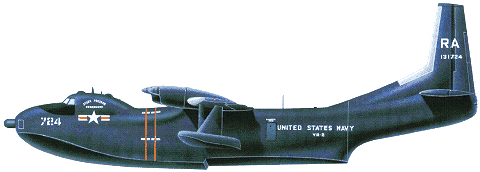
| In March 1943, Reuben Fleet sold his interest in Consolidated Aircraft Corporation and the company was reorganised as Consolidated Vultee (Convair). Shortly after this the US Navy expressed interest in a new long-range multi-role flying-boat, and Convair's proposal for an aircraft powered by four turboprop engines, was the subject of a contract for two prototypes, awarded on 27 May 1946. Designated XP5Y-1, the new aircraft featured an unusually slim fuselage for an aircraft of this class with a length-to-beam ratio of 10 to 1. it was powered by four Allison T40-A4 turboprops, each driving two contra-rotating propellers through a common gearbox. The type's main role was anti-submarine warfare, and it was to have been fitted with advanced radar, ECM and MAD equipment in addition to carrying a heavy load of bombs, mines, rockets and torpedoes. The first aircraft was flown from San Diego on 18 April 1950, and in August the type set a turboprop endurance record of 8 hours 6 minutes. August was an eventful month for the XP5Y-1 as the US Navy decided to discontinue its development for maritime patrol, but to persevere with the basic design for use as a passenger and cargo aircraft.
Work continued, despite the loss of an XP5Y-1 in a non-fatal crash off San Diego in 15 July 1953 and the first R3Y-1 Tradewind flew on 25 February 1954. Major changes included the deletion of all armament and of tailplane dihedral, the addition of a 3.05m wide port-side cargo hatch aft of the wing and the provision of redesigned engine nacelles to accept the improved T40-A-10 engines. Cabin sound-proofing and air-conditioning were installed and pressurised accommodation provided for up to 103 passengers or, in medevac configuration, for 72 stretcher cases and 12 attendants; cargo payload was 24.4 tonnes (24 tons).
The R3Y-1 's performance was demonstrated on 24 February 1955 when one of the five aircraft built flew coast-to-coast at an average speed of 649km/h on delivery to the Navy Test Center at Patuxent River, Maryland. Similarly, on 18 October a 6 hour 45 minute record flight at an average 579km/h was accomplished between Honolulu and NAS Alameda, California. US Navy transport squadron VR-2 received the first of its mixed fleet of R3Y-1 and R3Y-2 flying-boats on 31 March 1956, but financial considerations and continuing problems with the engine/propeller combination, culminating in two in-flight separations of propellers and gearbox from an engine (on 10 May 1957 and on 2 January 1958), led to a curtailment of Tradewind operations. Squadron strength was first cut to two R3Y-1s and two R3Y-2s and the unit was finally disbanded on 16 April 1958. FACTS AND FIGURES © The R3Y-2 had a nose loading
door and integral hydraulic
ramps. The opening door
blocked the pilots' forward
view during beach operations. © For beach landings and docking
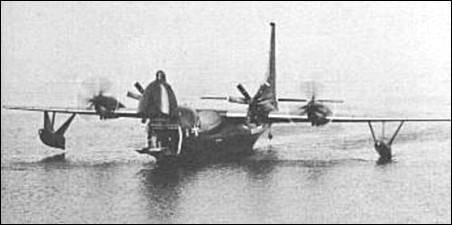
operations, the inner engines
would be stopped and the outer
engines used for manoeuvring.
When unloading was complete
the propellers could be reversed to
allow the Tradewind to back away. © The R3Y-1 was a straight transport
version, the R3Y-2 was the assault
transport version with the hinged
nose. It could also refuel jets in
flight using two or four wing pods.
| MODEL | R3Y |
| CREW | 5 |
| PASSENGERS | 80 |
| ENGINE | 4 x Allison T40-A-10 turboprops, 4362kW |
| WEIGHTS |
| Take-off weight | 74843-79379 kg | 165001 - 175002 lb |
| Payload | 21750kg | 47951 lb |
| DIMENSIONS |
| Wingspan | 44.42 m | 146 ft 9 in |
| Length | 42.57 m | 140 ft 8 in |
| Height | 13.67 m | 45 ft 10 in |
| PERFORMANCE |
| Max. speed | 580 km/h | 360 mph |
| Cruise speed | 480 km/h | 298 mph |
| Range w/max.fuel | 6437 km | 4000 miles |
| GrahamClayton, e-mail, 01.01.2023 09:25 Woudn't the Tradewind be a magnet for enemy fire if it actually landed on a beach to discharge its troops? reply | | Vance Belliston, e-mail, 04.03.2018 07:41 My dad Walt Belliston was the flight engineer on the XP5y-1 when it went down. They were doing some test dives to determine the vibration that they experienced on a previous flight. During one of the dives the tail surfaces hit a resonance and lost control. From this he indicated that the vortex generators came out of the crash. He was also one of the field service reps on the R3Y in Alameda and involved in the recovery of the R3Y that crashed in the bay near Alameda. reply | | wally prost, e-mail, 01.09.2017 22:50 I was on the r3y that went into the bay may 10, 1957.I was assigned to #723, but took this flight since I was due to go on leave and needed flight time. My rank was AM2, I was setting on the deck, behind the side hatches, with my back against a tied down trash can when we went into the bay. That 2 foot of deck is all that was left after the crash. reply | | Dwight Small, e-mail, 19.04.2016 06:24 I met Ned Broyles, the pilot in command of the Tradewind that ended up on the sea wall at NASAlameda. He told me in detail about that mishap and he told me about the many problems this flying boat had. The problems could have been worked out but the hand writing was on the wall. The flying boat era was over! FedEx Capt. Dwight Small (ret) reply | |
| | JOHN, e-mail, 27.05.2015 10:17 I am retired Navy was stationed at a fighter squadron at Alameda 1955-1957 and had the privilege to have seen this bird in operation. It was to replace the MARS Sea Plane for Navy transport but do to funding and other problems the Navy was more interested in New fighters than getting into Troop Transporting. reply | | Charles Foster, e-mail, 29.01.2015 03:35 I was at N.A.S Alameda Ca. attached to the fuel depot Jan. 1958. I was sent to the plane that ended up on the seawall in S.F Bay. A defueling truck was placed on a barge to remove the fuel. It was a cold windy day and was quite a hairy assignment that took most of the day.I think this was the last flight of that aircraft type. reply | | Klaatu83, e-mail, 21.07.2014 01:30 Not one of the aircraft powered by the T-40 engine was successful. This was the only T-40 powered aircraft that ever went into production, and even this one was retired after only two years in operation. reply | | Harry Ragsdale, e-mail, 14.07.2012 19:25 my father Homer Ragsdale was at the controls of the hawaii flight that lost the prop! he is alive and well living in Redlands california..He has a photo album with pic from a chase plane that show the approach, landing and hitting the sea wall!!! reply | | William Gerow, e-mail, 31.10.2011 23:51 I was a bright young 2nd class AE when I was assigned to VR-2 I spent many hours in engine build up, The propellers were Counter rotating, and they were clutched so the engines could be started without props turning. When the aircraft lost the propeller enroute from Hawaii to Alameda the pilot in command elected to land in the carrier lagoon because he felt there might have been holes in the hull, what he did not know was that there was no control of #1 and when reverse was applied it caused the aircraft to make a sharp right turn into the seawall, I would agree that the T-56 would have been a good replacement, however corrosion was the main enemy of the R3Y, as it is in most seaplanes. I retired in 1978 after many years and hours in the P-3 reply | | bombardier, e-mail, 17.05.2011 12:50 The reason for it's failure were it's engines which also
doomed the A2D Skyshark and some other aircraft.The T40s were
like the German DB606 extremely unreliable with a lot of problems reply | | bombardier, e-mail, 17.05.2011 12:44 The reason for it's failure were it's engines which also
doomed the A2D Skyshark and some other aircraft.The T40s were
like the German DB606 extremely unreliable with a lot of problems reply | | Don Safer, e-mail, 20.12.2010 04:39 About the "crash" near the San Mateo Bridge. If I remember right, That was a few miles north of the bridge off of San Lorenzo. I remember as a ~12 year old riding my bicycle out to the Southern Pacific tracks next to the hog farm where I could see the Tradewind stuck in the mud. It was stuck there for several days. reply | | Charlie Coleman, e-mail, 29.11.2010 18:44 I worked for the Sperry Gyroscope Co. The R3Y had the Sperry A-12 autopilot installed. I helped calibrate the A-12 in '54 and investigated an aileron pulsing problem in '55. I was on-board on a flight to evaluate using the R3Y as a refueler. That flight was almost a disaster when the 'dishpan' on the end of the hose broke off and the hose could not be retracted and the guillotine failed. Don Germeraad told us to prepare to jump. reply | | John Flanagan, e-mail, 23.08.2009 23:28 As an airman on temporary duty awaiting "A" School, I was assigned to the base newspaper, "The Carrier", at NAS Alameda. One day in early 1957 I was down by the seaplane ramps and observed a sight so awesome it remains with me to this day: an R3Y was heaving up out of the water like some gigantic,prehistoric sea monster, beckoned by a seemingly tiny figure which proved to be a chief petty officer. I am currently working on a book that will include the R3Y. I would like to hear from anyone who knows about the seawall collision or the crash near the San Mateo Bridge. reply | |
| | Paul T Cook, e-mail, 09.06.2009 19:46 In about 1962 /63 I happened to have a conversation with an officer who had been at the Air Station where one or more of these R3Y's were located. I had a flight in the Caroline Mars in 1950 from Alameda to Honolulu and thought it was very special. Then the tradewind got my attention so asked this officer (name ??) what ever happened to this new R3Y? He said in the night, public works dug a big hole and buried them there where he was. I read that congress ordered them scrapped, but . . . buried! reply | | Paul M. Kosen, e-mail, 27.02.2009 00:59 My dad was working on the Convair seaplane ramp and watched the XP5Y-1 go down, as he and his co-workers listened to the crew over the company radio. It was quite an event, with celebrations after for the 100% bail-out. I understand that the US Navy recently located the ship lying in the San Diego trench, probably too deep for recovery. I have had the honor of dining with Don Germeraad, Chief Test Pilot, who related his perspective of the incident in great detail. reply |
| William G. Kelley, e-mail, 18.04.2008 00:40 I was on the first flight crew to TransPac an R3Y-1 from Alameda, California, to Keehe Lagoon, Honolulu, October 16, 1956. I was on this crew as the electrician. Later, I qualified as 1st Flight Engineer. I was on the crew that flew several from the Convair Plant in San Diego to Alameda in 1956 after making the BAR acceptance flights. I taught part of the Ground School, Electrical and Instrument systems for Pilots, Flight Engineers and Maintenance personnel in VR-2 in Alameda, California. Captain Ned Broyles was our Commanding Officer. reply | | Douglas C. Cox, e-mail, 08.08.2007 20:13 I was a flight test engineer in VR-2from 1944 to 1945. I would like to know more about the prop failure.Was it the gearbox or the prop itself? I read about theboat in Aviation Week back in the 1950's What a beautiful plane.I flew the run from Alameda to Cavite a few times and this plane would have been just perfect.Too bad it had such a bad ending. reply | | James Bono, e-mail, 04.07.2007 04:07 This was a beautiful plane. Too bad the engines were junk! If only the Allison T-56 engine was available at the time. This engine would've been perfect for it. This plane would be perfect for the U.S. Coast Guard today. They definately need a longrange, high speed flying boat for search and rescue missions today, especially if the missions are beyond the range of helicopters. This aircraft will shorten the time that survivors have to wait in freezing waters of the oceans for help to arrive, instead of waiting for the nearest ships to come, as slow as they are. reply | | Peter Hawley, e-mail, 15.01.2007 08:14 Could you please provide specifications in English (not metric)? reply |
|
Do you have any comments?
|
| 
COMPANY
PROFILE
All the World's Rotorcraft
|




Fascinating. I watched (1-5-24) a Discovery Channel show re "unsuccessful"
efforts to find the XP5Y-1.
Lots of missing aircraft's & missing veterans.
God bless our Military.
reply