|
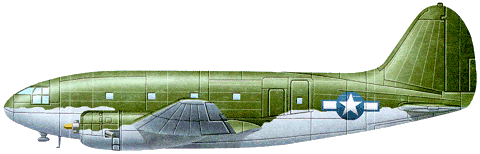
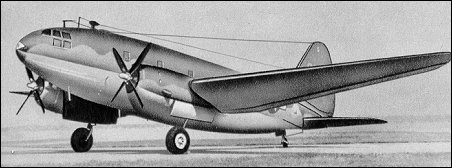
| The Commando was evolved from the Curtiss-Wright CW-20 which was originally laid out as a 36-passenger pressurised commercial transport in 1937. The prototype CW-20 first flew on 26 March 1940 and, because the US Army was impressed with its possibilities, authorisation was obtained for the purchase of a large number as cargo transports. In the meantime the prototype was bought, modified and given the Army designation C-55. It was later re-converted for civil use and sold to the British government.
The Army production model of the CW-20, designated C-46, was a redesign not only to suit it to the duties of a military cargo or task-force aircraft but to allow easy large-scale production. It was produced in three large manufacturing plants and was put into widespread use by the US Army Air Transport Command, Air Service Command and Troop Carrier Command, and by the US Naval Air Transport Command and Marine Corps. The main compartment of the C-46 could accommodate (in addition to general cargo) 40 fully equipped troops, up to 33 stretchers, five Wright R-3350 engines or their equivalent weight of other goods.
Profiting from the experience of the C-46, the Curtiss company in 1944 prepared designs and a mock-up of a commercial version of the aircraft for immediate post-war production. Interestingly, by the end of that year at least two American airlines had ordered the type as the CW-20E. Several hundred of the 3,000 or so Commandos built survived the war and served in a commercial capacity for many years.
| CREW | 3-5 |
| PASSENGERS | 62 |
| ENGINE | 2 x P+W R-2800-51 M-1, 1495kW |
| WEIGHTS |
| Take-off weight | 21770 kg | 47995 lb |
| Empty weight | 13562 kg | 29899 lb |
| DIMENSIONS |
| Wingspan | 32.9 m | 108 ft 11 in |
| Length | 23.3 m | 76 ft 5 in |
| Height | 6.6 m | 22 ft 8 in |
| Wing area | 126.3 m2 | 1359.48 sq ft |
| PERFORMANCE |
| Cruise speed | 370 km/h | 230 mph |
| Ceiling | 6700 m | 22000 ft |
| Range w/max.fuel | 2770 km | 1721 miles |
| William Foard Yearout, e-mail, 03.09.2023 01:58 I am trying to determine what happened to a C49 that was parked in Princeton WV during the 50s. During much of that time is served as the meeting place for a boy scout troop. The tail number appears to be 2107305. The last digit may be incorrect. Thanks! reply | | John C Roseborough, e-mail, 01.07.2017 03:30 My dad flew these over the Hump during WWII -China, Burma, India while living in India. I flew cargo in them from Ypsilanti, MI Willow Run Airport in 1971 /1972. reply |
| Stan Mason, e-mail, 17.01.2017 16:18 I have been tracing histroy and latest on C45 C-GBIX still at Gimli.
First saw aicaft in Nairobi in 1992 flying releif supplies in Air MAnitoba colours
Would like to contact Al Gawryluk (see cooment above) and also Bill Fraser ex Air Manitoba engineer -also in Nairobi at same time.
Be glad to hear from anyone with info. reply |
| jeff arnett, e-mail, 11.01.2017 07:25 Loved the plane reply | |
| | Anthony Gagliani prinair108@ya, 05.09.2016 23:48 Edgar Hall
Do you remember aircraft numbers with Associated Air Transport airlines that was owned by Charles Blair? reply | | Louis Piazza, e-mail, 19.03.2015 02:57 there are a number of books about flying the C-46 in the CBI
during WWII. My brother in law turning 95, 4-19-15 was a pilot flying the C-46, C-87 & C-109 (both converted B-24's) in the CBI from 9 /44 to 9 /45 and earning his 750 hours. Of those that survived the worst flying in the world, there were 509 crashes with 1,314 killed while 1,171 walked out of the jungles and 345 still missing. reply | | Alex Mello, e-mail, 11.12.2014 05:34 For anyone wishing to see this beautiful aircraft in person please email WarriorsandWarbirdsInc.gmail.com We are a non-profit that still operate the only military painted C-46F left flying in the lower 49 states. We are located at the Charlotte /Monroe Executive airport, (KEQY) Monroe, NC. We normally man the aircraft during the week, and weekends with a little advanced notice. Please stop by to say hello. N78774 "The Tinker Belle" reply | | Barton, e-mail, 30.09.2014 21:09 I was an RO on C-46s and C-47s in the CBI. I felt okay in the 47 but always nervous flying in the Curtis Abortion (as it was called and sung of in a rather ribald ditty). Never had anything untoward in a C-47 but I had several occasions with white knuckles and sweaty palms. reply | | Colleen, e-mail, 08.07.2014 00:43 Correction, there were about 700 young women in the first engineering program. reply | | Colleen, e-mail, 07.07.2014 23:07 Have read all comments here w great interest; proud of all you heroes of the wars. Writing an article about my neighbor who was a Curtiss-Wright Cadette in WWII. She and 900 other college girls trained in aeronautical engineering to assist in the plants making the C-46 in Buffalo. Have been fascinated to learn of the use of this plane for "flying the Hump", etc. Great to learn there are some still in the air today! reply | | Jim Thompson, e-mail, 24.10.2013 10:53 Westair Transport flew C-46's to DEW line outposts in the late 1950's. Many outpost airfields had short runways that used the old Pacific airfield metal landing ramp covers. reply | | Jim Thompson, e-mail, 24.10.2013 10:53 Westair Transport flew C-46's to DEW line outposts in the late 1950's. Many outpost airfields had short runways that used the old Pacific airfield metal landing ramp covers. reply | | Cyril E Jackson Squella, e-mail, 19.04.2013 23:59 In early 1969 I flu from Chile to the U S A (at 18 year old
what a fantastic adventure )Santiago to Antofagasta to Oruro (Bolivia) to Lima (Peru ) to Panama City (Panama) to finalmente MIAMI The plane c-46 T A S tansportes aereos Squella CC_CEX reply | | Cyril E Jackson Squella, e-mail, 19.04.2013 23:59 In early 1969 I flu from Chile to the U S A (at 18 year old
what a fantastic adventure )Santiago to Antofagasta to Oruro (Bolivia) to Lima (Peru ) to Panama City (Panama) to finalmente MIAMI The plane c-46 T A S tansportes aereos Squella CC_CEX reply | |
| | lawrence varick, e-mail, 20.11.2012 15:26 corrected email above reply | | Hans Danielsen, e-mail, 04.08.2012 22:47 Flew the C-46 as copilot for Transair Sweden in 1964, after flying the DC-3 for the same company. Also a short period in Congo, flying for UN. The Curtiss was powerful and agile - much more sprity than the Dak. But a handful during x-winds. It was a challenge to fly , but loved it!! The sound from those Pratts on take off is sommething I shall never forget! reply | | Martin O'Donnell, e-mail, 30.05.2012 13:23 Used to load one almost everyday in Alaska back in "69 /70". Reeve Aleutian flew 2. Lots of fun loading anti-freeze in drums pushing them "Up Hill" to get them "Forward". Memories------------ reply | | Ray Bopp, e-mail, 10.05.2012 01:43 I worked for Skycoach in Chicago. Mel Lawerence was the Honcho.Sales and scheduleing and honey bucket's....that was me. The ommando's were 28mike and 16victor....A DC4,070.I found myself doing stuff I never dreamed of.I'm 86 now and 1953,54 are years that keep my blood flowing. the best of luck, Bopp reply | | Stan Miller, e-mail, 13.04.2012 20:03 I piloted 46Ds during WWII. Our Combat Cargo Unit trained Stateside in the 46, flew them to the CBI Theater where we supplied the Briticsh 14th Army during its mission to drive the Japanese out of Burm. Many poor, hastily built short airfields and one mission no airport, just a large grassy field! Para pack drops as needed. Also flew the HUMP to support the forces in Western China. Excellent planne for both missions. Rugged, powerful and large cargo compartment. Stable in the air but tough during cross wind landings. Flew them additionally Stateside between WWII & Korea and as a passengwe with Wein Airlines in Alaska between a radar site and Fairbanks. I am now retired Air Force and 90 years old. Lots of memories.
I question some of your Statistics. We cruiused at about 165, had take-offs as heavy as 54,000 pounds and the highest I ever got one was 26,200 feet. reply | | Bill Lumley, e-mail, 22.03.2012 02:28 I flew the C-46 for Southern Air Transport out of Miami from July 1960 through March 1964 and found it a delight to fly. It was my first heavy aircraft experience after instructing in everything from Cubs to Bamboo bombers.
All but a few of our cargo departures out of MIA were at midnight going usually to San Juan, then to St. Thomas, St St. Croix, St. Marten, Guadeloupe, Barbados, back to San Juan and then to MIA - 14 or 15 hours in a 18 hour period, but it was all good experience. We hauled all the dynamite from MIA to Freeport in the Bahamas for the blasting of the Freeport harbor. It was mandatory that we took off toward the everglades (West) irregardless of the wind. We were told that there was no chance for an explosion in the event of a crash as the blasting caps went over separately in a Piper Apache that they had leased. We routinely brought 15,000 pounds of tomatoes back to MIA either from Mastic point on Andros Island or from Freeport and that old Pratt powered gentleman hauled them without any effort at all. Even had an engine fire warning just after the gear came up out of Freeport with 15K of tomatoes and that old bird flew just fine with one feathered for a return to the runway. It had less groundlooping tendencies that the DC-3 /C-47. All you had to do to land in a stiff crosswind is have the downwind cowl flaps full open and the other side closed, close only the downwind throttle prior to flare, wheel land the thing (leave the flaps full) and keep the tail stuck up in the air during the landing roll until it slowed down a bunch then let the tail down with maybe a touch or two of the downwind brake after the rudder was used up, and you were done. Got typed in the thing back then as am now flying the C-46F Tinkerbelle for the City of Monroe NC to their various airshown and meets. I fully realize that I am very fortunate to have this opportunity and am enjoying every minute of starting up those Pratts and flying it. reply |
|
Do you have any comments?
|
| 
COMPANY
PROFILE
All the World's Rotorcraft
|


 John C Roseborough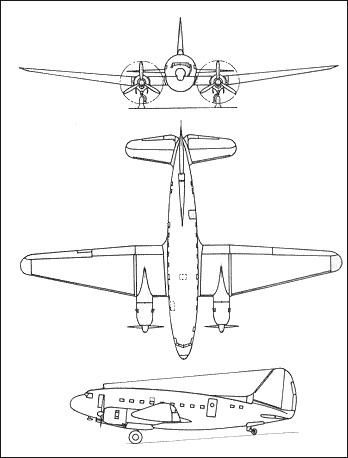


i worked for TCA at willow run. 1978-1980 as a mech. we had 3 c-46's. real workhorses.
reply