|
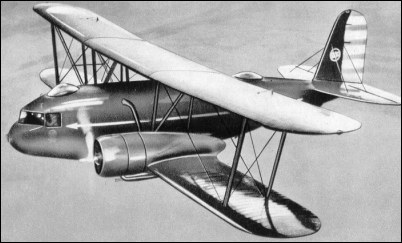
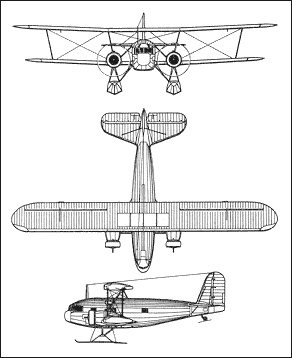
| Not to be confused with the Curtiss B-2 or its 18-passenger Condor airliner development, the Condor was a 15-passenger commercial biplane airliner of the early 1930s, powered by two 529-536.5kW Cyclone radial engines. It enjoyed considerable success and was produced in two versions: for normal daytime flying and as a convertible day- and night-sleeper transport with six compartments, each accommodating two berths/seats. One was used on the Byrd Antarctic Expedition and two were operated by the US Navy as R4C. An all-cargo version was produced as the CT-32.
As a military heavy bomber with troop-carrying and ambulance capability, the Condor was supplied to China. Armament comprised five 7.62mm machine-guns and up to 1,800kg of bombs.
| CREW | 2-4 |
| PASSENGERS | 12-24 |
| ENGINE | 2 x Wright "Cycl. SR-1820-F3", 520kW |
| WEIGHTS |
| Take-off weight | 7620 kg | 16799 lb |
| Empty weight | 5192 kg | 11446 lb |
| DIMENSIONS |
| Wingspan | 25.9 m | 85 ft 12 in |
| Length | 15.0 m | 49 ft 3 in |
| Height | 4.4 m | 14 ft 5 in |
| Wing area | 125.5 m2 | 1350.87 sq ft |
| PERFORMANCE |
| Max. speed | 274 km/h | 170 mph |
| Cruise speed | 235 km/h | 146 mph |
| Ceiling | 7150 m | 23450 ft |
| Range w/max.fuel | 2700 km | 1678 miles |
| Range w/max payload | 550 km | 342 miles |
| ARMAMENT | 3 machine-guns, 1800kg of bombs |
| FatalFlaw, e-mail, 25.07.2014 05:04 I just did a conversion of the Condor Float-plane version back to a BT-32 Condor Bomber. To my understanding the Spanish Republicans purchased 6 of these in n1934, but they got waylaid in Mexico for a time and eventually made it to Nationalist China by way of Hong Kong in either 36 or 38....1938 being more likely. they were apparently refitted as Chinese Bombers and one even served as Chiang Kai Shek's personal, and relatively luxurious, transport. FF reply | | Margie, e-mail, 12.04.2014 23:47 My late Father-in-law worked for Brewsters during the war. I have some photos of the Curtiss and the Hindenberg and an odd looking aircraft that looks like a boat and has the prop mounted above the seats and facing back. reply | | Noebert Raith, e-mail, 29.01.2013 22:32 I have 2 small BW photo's of what looks like a B-32 sitting on a dock or something, came with some Pan Am photo's taken in the 30"s any comments or info would be welcome reply | | SADY, e-mail, 05.01.2012 07:03 MRKLAATU83 , THE 4 BT32 SOLD TO BOLIVIA WAS INPOUNDED IN PERU, SERVING Y THE PERUAVIAN AIR FORCE TILL 1956. reply | |
| | Klaatu83, e-mail, 22.12.2011 18:57 In addition to China, at least one military Condor was also sold to Bolivia, for use during it's war with Paraguay. I believe it never reached Bolivia, however, being impounded in Chile while en route. reply | | Ron Hampton, e-mail, 25.10.2011 20:45 Howdy, I flew with Chamberlin in his Condor but it had inline engines in 1935, out of the old Capital Airport in DC. The photo that you see of this plane, with his insert photo with signature and the AMACO logo on the plane is the photo he sold as took people up on local flights as he barnstormed across the US during this period. He later crashed it in Indiana. reply | | Steven Y., 04.05.2011 05:41 That is a fascinating airplane. A biplane. It carried up to 24 passengers. It does look like a biplane DC-3! It cruised at almost 150 miles per hour. That's fast for such an airplane, and it had that magic number for range (for radial air-cooled engines; about 1,500 miles. Wow, 1,500 miles at 146mph. It's engines could take it up to 10,000 feet with ease (it's ceiling is stated at twice that)...that's what most people can handle without oxygen. It must have had near STOL performance for a 15 to 24-passenger plane(being a biplane), and it must have had good handling for the same reason. It looks like the pilot had unimpeded excellent vision. the tail is big and strong looking. The oval /tubular body fuselage looks very strong. It shows it being able to fly with twin floats (wow!), and it looks like it could be modified for fixed tricycle undercarriage landing gear. Interesting design. Only required two engines (not three or four). reply | | JAW, e-mail, 25.12.2010 23:30 My adventuresome Father took me for my first airplane ride in a Curtiss Condor liner which was selling sightseeing rides at the airport in Ceder Rapids, Iowa in the early 1930's. For a 7 year old small town lad, it proved to be a life changing experience !! It was never anything else for me -- to this day I am actively contracting to do design work on the Aries system. My "hardware" has travelled to the moon and back on Apollo and I have some of my "hardware' sitting on Mars since about 1975 (from the Viking program). And I ain't done yet !!! -JAW reply | | MAP, 14.03.2010 20:16 There is a info void as to the use of this one in 1939. reply | | Tom Drennan, e-mail, 22.05.2009 06:47 The plane in the picture is a BT-32 bomber while the text is mostly about the airliner making it confusing. The Commercial airliner was known as the Curtiss T-32 Condor. The airliner was a fabric covered airplane, well insulated to make it comfortably warm and quiet for sleepers.
The Boeing 247 was the first of the "modern," airliners meaning all metal stressed skin construction. I believe both airplanes won Approved Type Certificates the same day, if not it was the same week. I suppose that makes the T-32 the last the old type.
This was an interesting time in aviation. Variable pitch propellers had won approval as reliable, retractable landing gear was catching on and the autopilot was had recently won approval for use on airliners. The airplane had matured as a commercial transport that ought to support itself without government subsidies. From here the airlines were competing with each other, they had been competing with the railroads. reply | | Sgt.KAR98, 25.06.2008 05:02 This plane is bizarre,looks a biplane version of the DC-3. reply | | Fat Marvin, e-mail, 25.06.2008 04:41 In reply to Jay Bailey's comment, I think it is in Air Enthusiast Quarterly No. 6, page 94 perhaps? reply | | arthur huseboe, e-mail, 02.07.2007 22:09 I am looking for a picture of the Condor that Glenn Curtiss flew in 1930 not long before his death. It is also referred to as the Model 18 Condor. reply | | Jean Wellington, e-mail, 24.01.2007 07:11 What was the material that covered the metal frame? Canvas or wood or metal? I am particularly interested in the construction of Admiral Byrd's planes. Thank you. reply | |
| | Jay Bailey, e-mail, 10.11.2006 08:27 Hi, I'm trying to run down any information about one or more Curtiss Condors in use in the 1930s by the White Pass & Yukon Railroad. It's my understanding that an Air Enthusiast Quarterly has some mention of this aircraft or aircrafts. I am trying to compile enough information for an article in the Narrow Gauge & Shortline Gazette, a bi-monthly magazine specializing in light and industrial rail prototype and model subjects. Any leads on the above subject was be appreciated; and I would consider a (modest) financial reward as well as a printed credit for any photos, drawings or the like. Sincerely yours, Jay Bailey reply |
|
Do you have any comments?
|
| 
COMPANY
PROFILE
All the World's Rotorcraft
|