 |
Curtiss XF-871948 |  |
| ALL-WEATHER INTERCEPTOR | Virtual Aircraft Museum / USA / Curtiss |
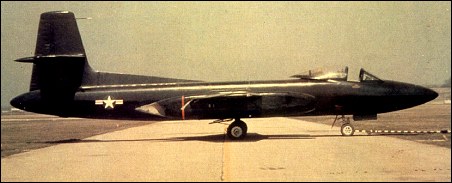 |
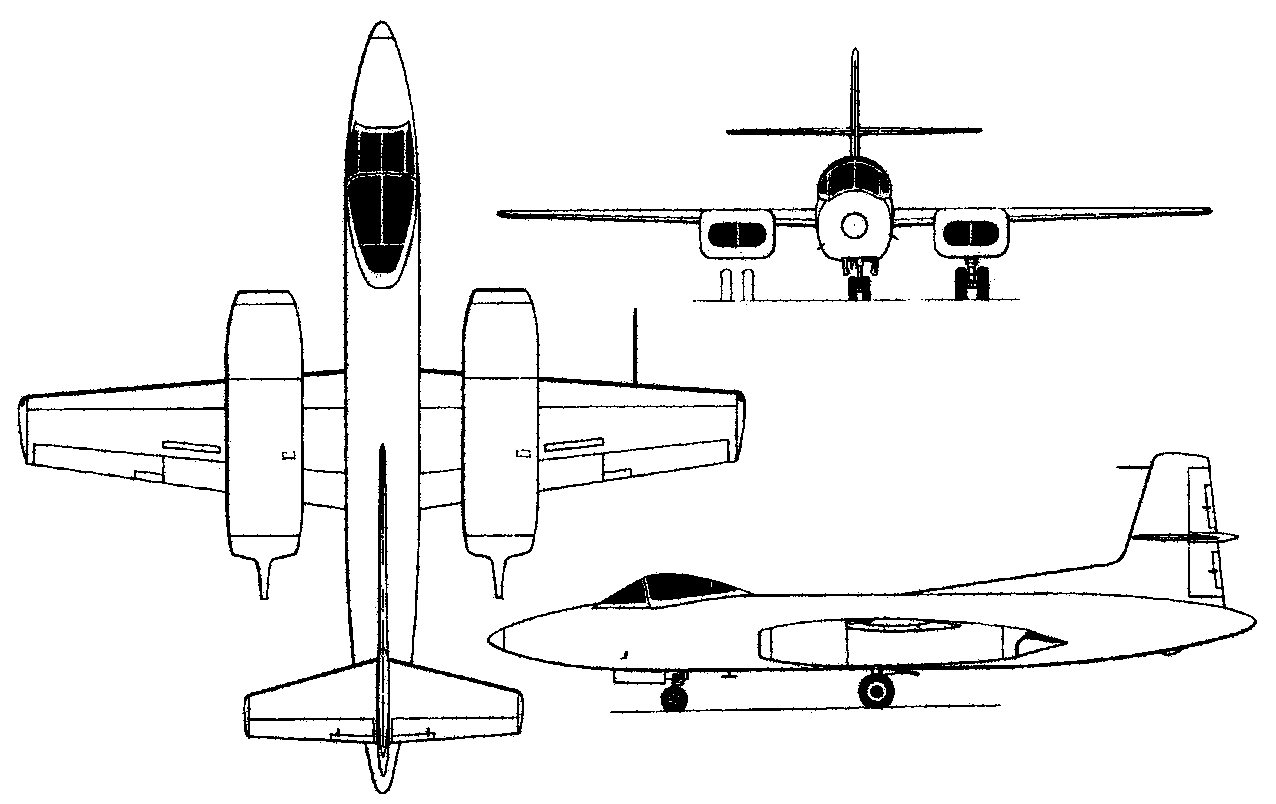
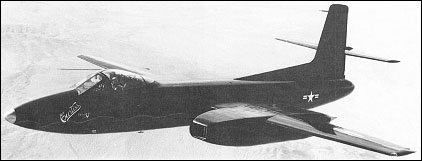
The Curtiss XF-87 Blackhawk fighter was an eye-catching and truly graceful all-black aircraft which attracted plenty of attention in flights over the California desert. The XF-87 resulted from studies by the manufacturer in a last-ditch effort to compete in the jet era. Curtiss had obtained tentative approval to build a twin-jet ground-attack aircraft, the XA-43. On 21 November 1945, this project was redirected towards completion of the Blackhawk fighter, a huge, mid-wing, four-engine craft with a two-man crew in side-by-side seating and with impressive fuel capacity. Powered by four 1360kg thrust Westinghouse XJ34-WE-7 turbojets, the sole XF-87 was belatedly flown at Muroc Dry Lake, California, on 1 March 1948 following long delays in its development and shipment from the company's plant (later sold to North American) in Columbus, Ohio. The XF-87 proved to be underpowered. In the expectation that a different powerplant arrangement would make the Blackhawk more competitive, the twin-engine scheme was resurrected. On 10 June 1948, the USAF awarded a contract to Curtiss for 57 production F-87As to be powered by two 2722kg thrust each General Electric J47-GE-7 engines. A further order was placed for 30 RF-87A reconnaissance aircraft. The F-87 Blackhawk or company model CW-29A would have been fitted with an extraordinary nose turret developed by the Glenn L. Martin Company which revolved in a 60-degree arc enabling four 20mm guns to be fired at any angle from zero to 90 degrees from the centre-line. Though the Blackhawk was able to overcome teething troubles in flight tests and seemed to offer promise as an all-weather intercep tor, it was the misfortune of this beautiful aircraft that Curtiss was suffering from management difficulties and Northrop was developing an interceptor with solid potential, the F-89 Scorpion. On 18 October 1948, the USAF cancelled the F-87 Blackhawk programme in favour of the F-89. A second prototype which would have evaluated the twin J47 installation was never completed. It was to be the last Curtiss fighter.
Matthew Moss, e-mail, 24.07.2020  Mark lane Mark laneHi Mark, I'm a historian my current project is www.armourersbench.com and I was planning on writing an article and making a video about the XF-87 and have been doing some research into the Blackhawk and also noticed a lot of the information is identical so would be interested to hear from you.
|  COMPANY PROFILE | ||||||||||||||||||||||||||||||||||||||||||||||||||||

|


|
Is your dad still alive ? Would like to talk to him or find someone that was involved with this. My grandfather was chief engineer at Curtiss Wright for 28 years and I know the true story behind this and info to back it up. All these websites that have info seem to just copy and paste the same info that is not accurate.
It’s a shame.
reply