|
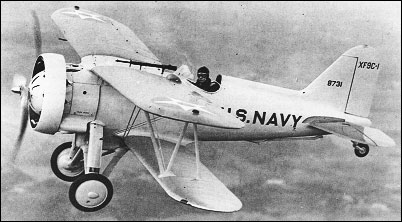
| Designed to meet a lightweight shipboard fighter requirement
- other contenders being the Berliner Joyce
XFJ-1 and General Aviation XFA-1 - the XF9C-1 was
flown on 12 February 1931. It failed to gain acceptance
as a carrier-based aircraft, but its small dimensions
commended it for use from the dirigibles Akron and
Macon whfch had been designed with internal hangar
bays. The XF9C-1 was subsequently fitted with the so-called
"skyhook" which engaged the retractable trapeze
carried by the dirigibles. Some directional instability
resulting from the hook dictated the enlarging
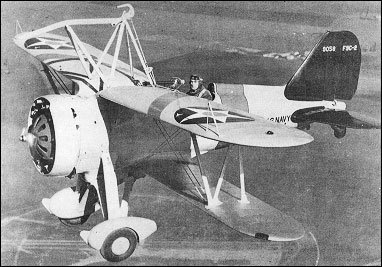
of the vertical tail surfaces. A second prototype, the
XF9C-2 with single-strut main undercarriage members,
was built at Curtiss' expense prior to the placing
of a US Navy contract for six F9C-2s which featured a
similar tripod undercarriage strut arrangement to that of the XF9C-1. The XF9C-2 was later purchased by the
US Navy and modified to F9C-2 standard. The F9C-2
was powered by a 438hp Wright R-975-E3 radial
engine and carried an armament of two 7.62mm Browning machine guns. Originally intended to
provide fighter protection for the dirigibles, the F9C-2s
were used primarily to extend the reconnaissance capabilities
of the parent craft. The Macon was lost on 12
February 1935, together with four of the F9C-2s.
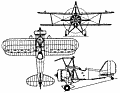 | A three-view drawing of F9C-2 (1280 x 996) |
| WEIGHTS |
| Take-off weight | 1256 kg | 2769 lb |
| Empty weight | 947 kg | 2088 lb |
| DIMENSIONS |
| Wingspan | 7.75 m | 25 ft 5 in |
| Length | 6.27 m | 21 ft 7 in |
| Height | 3.34 m | 11 ft 11 in |
| Wing area | 16.07 m2 | 172.98 sq ft |
| PERFORMANCE |
| Max. speed | 284 km/h | 176 mph |
| Range | 563 km | 350 miles |
| Klaatu83, e-mail, 27.07.2014 16:46 The odd-looking upturned fairings in front of the landing wheels were intended to prevent the aircraft carrier arresting wires from snagging the landing gear, causing the aircraft to pitch over onto it's nose. However, these aircraft rarely operated from carrier decks. Instead, they were operated from the airships USS Akron and USS Macon, often with the landing wheels removed completely to save weight and drag. Neither airship lasted long, both crashing not much over two years after being commissioned. After that the remaining F9Cs were considered obsolete and placed in storage. One F9C survives today, on display at eh Air and Space Museum in Washington DC. reply | | machia, e-mail, 27.04.2014 08:08 It may be interesting to note that some of these airplanes had there landing gears removed to save weight and increase speed. This came in later years w / USS Macon I beleive. reply | | ALFRED FOX, e-mail, 10.03.2012 15:37 i have a section of wing fabric that was removed from
the original f9c-2 bureau #9056
during restoration 1971-1974 signed by the director of the national air and space mseum michael collins.if you want to see it send me a email and iwiil send a photo.
thanks alfred fox reply | | loupan, 20.06.2011 14:16 Dad had a paper-weight on his desk that turned out to be a portion of a damaged interplane strut on the F9C. It's now on my desk. reply | |
| | van talley, e-mail, 08.02.2011 23:49 Can you please tell me the interior color of this aircraft
thank you reply | | Mike Horton, e-mail, 02.07.2010 21:39 It would have been most interesting to have seen the result of the USS Akron or the USS Macon at Pearl Harbor flying patrol to the north. Certainly these airships with thier loiter time might have made a sighting of the Japanese air armada. Too bad they were destroyed before Pearl Harbor attack. reply | | Dean Engelhardt, e-mail, 25.04.2008 04:39 One small correction: the F9C was designed from the start as a hook-on fighter. The story in the archives was planted by the government so as to keep the true nature of the fighter secret. All three planes competing for this contract had the gull upper wing for best visibility of the trapeze. The tailhook was so it could fly the planes to a carrier when lifting gas was contaminated and needing purification.
How do I know? My dad, Lloyd F. Engelhardt, was one of the designers of the airplane along with George Page, Don Ackerman, and Ross Goodlett. For years, Dad had a paper-weight on his desk that turned out to be a portion of a damaged interplane strut on the F9C. It's now on my desk. reply | | Chris Sheppard, e-mail, 03.06.2007 04:08 Great site. Thanks for all the work.
On mentioning the Macon crash which ended this unique aircrafts role, you don't mention the loss of the Akron, April 4, 1933. Being half of the Sparrowhawk experiment, I would think it important. Thanks reply |
|
Do you have any comments?
|
| 
COMPANY
PROFILE
All the World's Rotorcraft
|