|
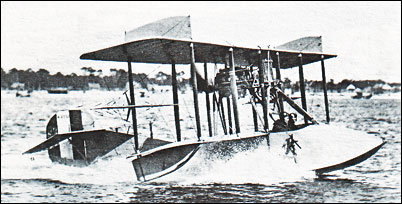
| The definitive 1913 Model F was used by the US Army as well as the US Navy, and sold to several civil owners and a number were exported. Of wooden construction, the two-bay biplane had inter-plane ailerons on each side, fabric-covered wings and tail unit, and a carefully contoured single-step plywood-covered hull which accommodated two side-by-side in a cockpit location just forward of the wings. Power was provided by a 56kW Curtiss O engine driving a pusher propeller, the engine being mounted on struts just below the upper wing centre-section.
The 1914 version of the Model F had rounded wingtips, a tougher hull and increased strut support for the engine to prevent it collapsing on the crew in the event of a crash. This basic design was ordered by the US Navy, and after the United States entered World War I on 6 April 1917 it was adapted as the service's standard primary training flying-boat, 144 more being ordered.
The 1917-18 version of the Model F eliminated the original shoulder-yoke type aileron control in favour of a more
conventional arrangement; and some aircraft had the ailerons transferred to the upper wing from the interplane position, span of the upper wing being extended. Several ambulance conversions flew with provision for a stretcher patient to be carried above the hull behind the cockpit. The more powerful Curtiss OXX-3 engine was fitted from 1917 onwards.
The Model F, particularly in its earlier versions, was sold to a number of foreign navies. Russia obtained a considerable number for operation in the Baltic and Black Seas. The Italians also flew the Model F and eight examples were licence-built by the Zari company at Bovisio.
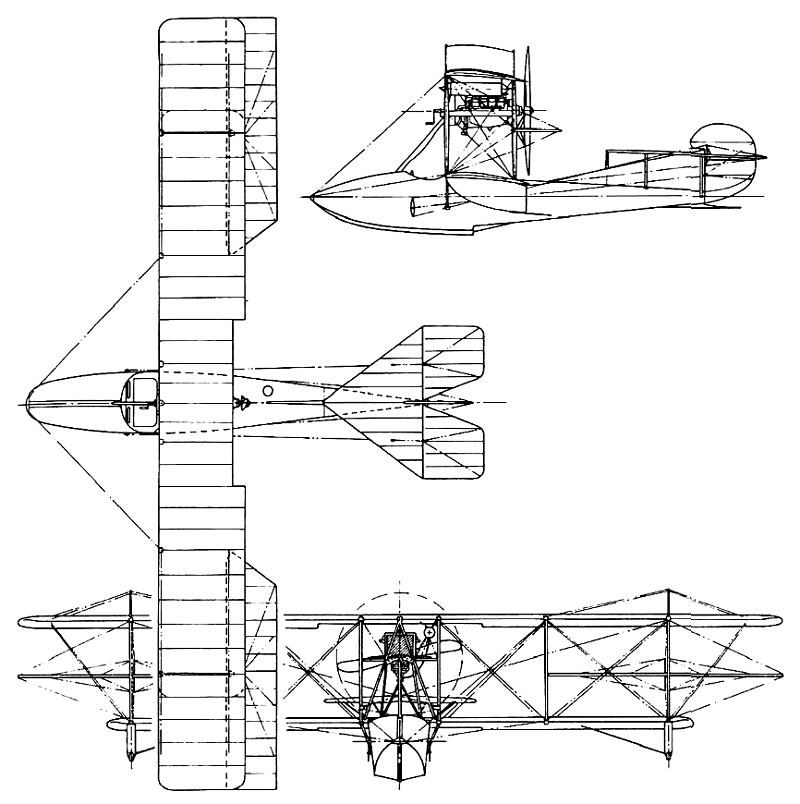
 | A three-view drawing (800 x 804) |
| ENGINE | 1 x 75kW Curtiss OXX-3 inline piston engine |
| WEIGHTS |
| Take-off weight | 1116 kg | 2460 lb |
| Empty weight | 844 kg | 1861 lb |
| DIMENSIONS |
| Wingspan | 13.75 m | 45 ft 1 in |
| Length | 8.48 m | 28 ft 10 in |
| Height | 3.42 m | 11 ft 3 in |
| Wing area | 35.95 m2 | 386.96 sq ft |
| PERFORMANCE |
| Max. speed | 110 km/h | 68 mph |
| Range | 1370 km | 851 miles |
| Local History, e-mail, 13.09.2014 15:29 There are persistent local legends that at some time in the past a flying boat made trips to and from the Cumberland River near Canton, in western Kentucky. None of the legends are specific as to the type of flying boat or time frame. Most put it during Prohibition in the 1930s, but some say that it was earlier, in the 1910-1915 era. Does anyone know if a Curtiss flying boat was sold to anyone in the area in that era? reply | | Mark in Iowa, e-mail, 24.03.2014 04:42 Super grateful for your site! Fun and educational. One question: I keep seeing that 850 mile range figure in different places on line. Is that right? At 65 knots, for 5.5 hours, aren't we talking more like 350 miles? reply | | S,F.Kemp, e-mail, 01.11.2013 03:19 I have one of the pusher propellers. They are from a Navy
H2Sl. They are not matched or balanced as the original would be, because numbers do not match. For their age, they are in good shape. Time to get rid of items like this.Email me if you know of a collector that would be interested. If this not a proper subject for this site,then please delete.Thanks reply | | Dr. A. K. Kundu., e-mail, 17.04.2013 11:49 Dear Sir /Madam,
I have authored a book titled 'Aircraft Design' published by Cambridge University Press. In my next publication titled 'Aircraft Performance' and in the 2nd edition of 'Aircraft Design', I wish to use this 3-view diagram of Curtiss Model 4.
I will be grateful if you kind allow me to use this diagram, of course acknowledged with the credit 'Courtesy of......',.
Thanking you. reply | |
| | Ayrthon Santana Vieira, e-mail, 15.04.2013 03:21 In the year of 1916, they sell 3 Curtiss F to the Brazilian Navy; in 1918, 1 Curtiss HS-2 and 4 Curtiss F, and more 1 was license-built by the EAvN (Navy Aviation Scholl). Please correct my bad english. reply | | Joe Alcock, e-mail, 15.01.2012 20:09 Where did you find the three-view drawing? Do you know iif I could use it in amy book on the life of Sir John Alcock, aviator? reply |
|
Do you have any comments?
|
| 
COMPANY
PROFILE
All the World's Rotorcraft
|